
BUYER GUIDE / CHINA SOURCING
How to Buy Wholesale Squishy Toys from China
Learn how to buy wholesale squishy toys from China by comparing SKU, MOQ, samples, packaging, compliance and lead time for a first order.
Buying wholesale squishy toys from China is easier when the first request is built around product facts rather than a broad catalog link. A buyer needs to know which formats fit the retail channel, how many pieces the first test requires, what package will reach the shelf, and which documents apply to the destination market. The same product family can contain slow-rebound foam, transparent TPR, different fillings and different case packs, so a generic category name is not enough for a purchase order.
1. Write the buying brief before contacting a supplier
Start with the commercial job the squishy must do. A gift shop may want a compact food shape that can sell from a counter display. A toy retailer may need several colors, a child-appropriate presentation and a replenishment plan. A party-favor distributor may care more about unit cost, carton efficiency and a repeatable assortment. Record the sales channel, destination country, estimated first quantity, target retail price, launch date and whether the order is a trial or a repeat program. Add the preferred feel, size range and package format if those details matter to the listing. This short brief lets a supplier separate a stock-SKU quote from an OEM request and prevents a low price from hiding a carton or packaging mismatch.2. Shortlist stock formats before asking for a custom mold
A stock format is often the fastest way to learn what your customers will actually pick up. Existing squishy shapes let a buyer compare softness, rebound, color, surface finish and display footprint before paying for a new design. A food-shaped TPR item can create visible movement, while a PU foam item usually communicates a quieter, pillowy squeeze. Neither material should be selected from a word in a title alone; request the exact sample and product specification. Once one or two formats show a clear sales role, use them as the reference for a private-label package, logo application or new-shape OEM discussion. This staged approach keeps the first test measurable and gives the factory a concrete target when you later ask for custom work.3. Compare SKU-level facts, not just product photos
Product photos are useful for shape and merchandising, but they do not answer the logistics questions that determine a landed cost. Ask for the public SKU, material, finished size, individual package, units per carton, carton dimensions, gross weight, MOQ and current EXW reference. Also ask whether the displayed price is for one color, a mixed-color carton or a particular filling. For compliance, identify which report or certificate references the exact product and intended market. A buyer should be able to put the answers into a comparison sheet and see why two visually similar squishies have different order thresholds. The three real SKU references below show how a compact gummy format, a food-shaped display item and a slow-rebound foam item can have different carton logic.4. Treat the sample as a commercial approval
A sample is not only a quality check. It is the reference for the product page, the package dimensions, the retail photograph and the customer expectation. Test compression with the same hand pressure across samples, record how quickly the item recovers, and inspect the surface for tackiness, seams, bubbles, print alignment and odor. Confirm that the sample uses the same material and filling proposed for the bulk order. If a display box or OPP bag is part of the sale, request the actual package or a package mock-up as well. Sample cost, courier freight and dispatch timing are confirmed by SKU and destination, so place those questions in the first inquiry. Keep the approved sample or an agreed photo and measurement record with the purchase order.5. Convert MOQ into a store and carton plan
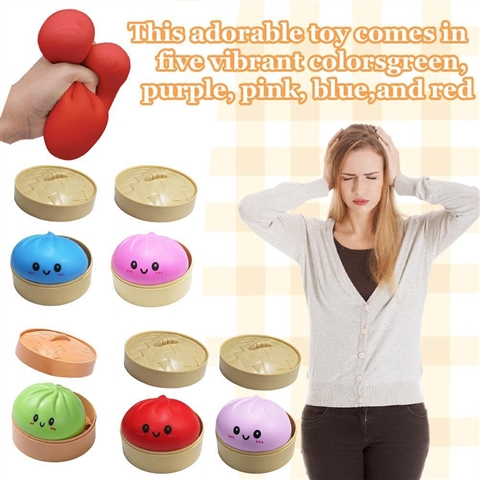
MOQ is most useful when it is translated into the number of stores, displays or online units that the order will support. A current reference such as sqz350815 is shown at 5 cartons / 720 pieces with 144 pieces per carton, while sqz349246 is shown at 72 pieces and one carton. That difference can change the right sales channel: a one-carton test may suit a small gift-shop rollout, while a multi-carton food display may need a chain or distributor plan. Do not assume that several low-MOQ items can be mixed into one carton or one production batch. Ask whether mixed colors, mixed SKUs and mixed packaging are allowed, and get the answer written against each SKU. The quote should distinguish piece MOQ, carton MOQ and any packaging minimum.6. Choose packaging that helps the product sell
Packaging is part of the product proposition for a tactile novelty. A steamer-style display can explain a baozi theme without extra signage, while a clear or compact bag can support a lower-cost counter assortment. Review the package size, material, print area, barcode space, warning-label area, carton marks and master-carton protection. For a stock test, standard packaging usually reduces variables and supports a cleaner sample comparison. For a branded launch, provide the logo file, color references, package dimensions and target market before artwork is approved. A supplier should confirm whether the package is included in the current unit-price reference or quoted separately. Final package approval should happen before the production clock is treated as firm.7. Check compliance for the exact product and market
Toy compliance is not a blanket claim for an entire category. The relevant document path depends on the product material, construction, age grade, packaging claims and destination market. Tell the supplier where the product will be sold and which retailer requirements apply. Ask for the report name, test scope, product match, report date and any required warning or tracking label. If a logo, color, filling, structure or package changes, confirm whether the document review must be repeated. Avoid putting a certificate logo on a listing until the evidence matches the final SKU. A focused request for the exact item number and market is more useful than asking for a general factory certificate folder.8. Build lead time from approvals, not from a headline number
The production lead time starts after the important inputs are approved. For a stock item, the sequence may be product selection, sample confirmation, package confirmation, production scheduling, quality checks and export handoff. A private-label project adds artwork proofing, print approval and sometimes a new package or mold. Ask which milestones are included in the quoted timing and whether the estimate changes for mixed colors or mixed SKUs. Freight is a separate planning step: carton dimensions, gross weight, destination, incoterm and forwarder route affect the transport assumption. Request a realistic date for sample dispatch, production completion and cargo handoff rather than relying on one undated phrase such as fast delivery.9. Send an RFQ that can be answered item by item
A quote-ready message should include product URLs or SKUs, target quantities, destination country, requested colors, package preference, sample requirement, target launch date and any compliance documents. Add whether you need a stock item, private label or new OEM design. Ask the sales desk to return unit price by quantity tier, MOQ in pieces and cartons, package description, carton pack, carton dimensions, sample cost, lead-time assumptions, certificate scope and freight basis. This format creates an auditable response and makes it easier to compare a second supplier without rewriting the whole request. Use the RFQ workspace when several products are under review so the final response keeps the item list together.10. Vet the supplier with evidence you can reuse
A useful supplier comparison records evidence that can be reused on the next order. Save the product specification, sample photographs, package proof, carton data, document references and the name of the person who approved each item. Ask whether the factory or trading team owns the product information, who will answer quality questions, and how repeat orders are matched to the approved sample. A supplier that can explain its MOQ, material, package and document assumptions clearly is easier to manage than one that only sends a large photo folder. You do not need to turn the first inquiry into a factory audit, but you should ask where the item is produced, where packaging is completed, and which checkpoints occur before cargo handoff. For a new relationship, request a small, controlled order and use the result to improve the next brief. Keep a note of response time, quote completeness, sample accuracy and any changes between the quotation and the final package. Those operating signals are as valuable as a low unit price because they show whether the supplier can support a repeatable wholesale program. When a buyer moves from stock items to private label or OEM/ODM, the same evidence file gives the development team a clear starting point and makes the expanded scope easier to price.Published SKU references for the discussion
These pages provide the current item image and available product facts. Use the SKU in the RFQ to confirm current price, MOQ, packaging, samples, certificates and delivery for your market.
| Published product reference | Buyer facts to confirm |
|---|---|
| Five-Color Steamer Baozi Squishy SKU sqz350815 | Material: TPR Size: Confirm by SKU MOQ: 5 cartons / 720 pcs Packaging: Display Box Case pack: 144 pcs/carton |
| Small Color-Printed Butter Cheese Sticks SKU sqz349244 | Material: PU Polyurethane (slow-rebound foam) compliant with safety standards Size: 14*4*4 MOQ: 2 cartons / 1080 pcs Packaging: OPP bag Case pack: 540 pcs/carton |
| Gummy candies SKU sqz349246 | Material: Filled with maltose gel, encased in a highly transparent, highly elastic TPR soft rubber shell. The entire toy is translucent with a subtle pearlescent sheen, is odorless, and resists tearing when str Size: 5.5*5.5*9.5 MOQ: 1 cartons / 72 pcs Packaging: Display Box Case pack: 72 pcs/carton |
Buyer questions
What is the MOQ for wholesale squishy toys from China?
MOQ is specific to the SKU, carton pack, color mix and packaging scope. The published product references show current carton and piece quantities for comparison; the final MOQ is confirmed in the quote.
Can I receive a sample before placing a bulk order?
Yes. Request the exact SKU and package version. Sample cost, courier freight and timing are confirmed by item and destination.
How long does wholesale squishy toy production take?
Timing depends on stock status, artwork, packaging, sample approval and quantity. Ask for sample, production-complete and cargo-handoff dates in the same RFQ.
Which documents should I request?
Provide the destination market and age grade, then request the reports or certificates that match the exact material, structure, package and final SKU.
Continue the sourcing review
Use the wholesale squishy toys supplier route and the squishy toys wholesale collection for the wider buying route, then compare the two published product references below before requesting current freight and document scope.
- Five-Color Steamer Baozi Squishy SKU sqz350815 / MOQ 5 cartons / 720 pcs.
- Small Color-Printed Butter Cheese Sticks SKU sqz349244 / MOQ 2 cartons / 1080 pcs.
For logo, color or retail-packaging work, review custom squishy toys OEM and private label squishy toys. Send the selected products through the wholesale RFQ workspace.