
How to Write a Squishy Dumpling Toy SKU-and-Carton RFQ
Build a squishy dumpling toy RFQ that compares pack contents, squeeze feel, carton count, dimensions, CBM, weights, strength, and shipping marks.
Specify the squeeze-and-recovery feel, assortment contents, and selling unit before requesting a carton price for a squishy dumpling toy. For party favors and carnival prizes, request individually distributable pieces; for a countdown assortment, quote the complete retail pack separately. Put both the product specification and proposed closed-carton configuration on one RFQ sheet. Then approve the packing proposal before the purchase order and reconcile final packed measurements, counts, weights, strength evidence, and shipping marks before shipment.
Which product format fits a giveaway assortment versus a retail pack?
Choose a distributable-piece configuration for giveaways and a complete countdown pack for retail sale; do not compare them as interchangeable units.
Squeezing and recovery are the interaction to evaluate, but a product name does not establish softness, rebound speed, or filling. Request a reference sample and record piece size, texture, resistance to squeezing, recovery behavior, surface finish, and approved colors. These are commercial selection criteria, not safety-test results. The category comparison approach is also recommended in Global Toy Buyer Notes.
For a mix pack, specify each design and color allocation rather than accepting an undefined assortment. State whether substitutions are permitted and whether the same mix must appear in every carton. If a countdown product is being considered for loose distribution, request that configuration as a separate quotation rather than assuming the retail pack can simply be divided.
Which catalog configurations should the RFQ distinguish?
| Fruit Stress-Relief Squeezing Toy | Catalog item: CPS349462. Recorded material: ABS. Packing: display box. Reference MOQ: 1,152 catalog units. Recorded quantity: 1,152 units/carton. Reference price: USD 0.25; require confirmation of the quoted unit and included packaging. |
|---|---|
| Mystery Dumpling & Baozi 24-Day Fidget Squishy Countdown Calendar | Catalog item: CPS350808. Recorded material: mixed sensory-toy materials. Packing: color box. Reference MOQ: 500 catalog units. Recorded quantity: 100 units/carton. Reference price: USD 1.95; require confirmation of the quoted unit and included contents. |
| Dumpling calendar carton reference | For the recorded 100-unit color-box configuration: carton dimensions 75 × 50 × 45 cm; listed volume 0.169 m³/carton; net weight 28 kg; gross weight 29 kg. Use these as proposal references, then obtain final packed measurements. |
What must be clarified before comparing these two configurations?
Confirm what one quoted unit contains before calculating any per-piece figure.
A display box is not itself a confirmed piece count, and a 24-day product name is not a verified count of usable toys inside the pack. Ask for the complete contents list and the number of individual toys, retail packs, display boxes, and inner packs in each master carton.
The ABS entry may describe a casing or component; it does not establish the construction or feel of the entire fruit toy. Request exterior, internal component, and filling descriptions separately. Likewise, confirm the construction of each item in the mixed-material countdown assortment.
Carton quantity and MOQ answer different questions. A recorded minimum order does not establish an order multiple, and units per carton do not automatically mean that only full-carton orders are accepted.
Which fields belong on the SKU-and-carton RFQ worksheet?
| RFQ identity and revision | Requested specification: RFQ number, revision, issue date, buyer contact, response date, and product reference image. Supplier confirmation: identify the quotation and revision being answered. Proposed alternatives: list any different model or configuration explicitly. |
|---|---|
| Selling unit and assortment | Requested specification: individual toy, display box, or complete calendar; contents per selling unit; design/color allocation; substitution policy. Supplier confirmation: list exact contents and allocation. Proposed alternatives: describe and price each different mix separately. |
| Construction and sample reference | Requested specification: exterior material, component materials, filling, piece dimensions with units, and approved sample reference for squeeze feel and recovery. Supplier confirmation: describe the quoted construction and identify the matching sample. Proposed alternatives: disclose construction or feel differences. |
| Packaging components and count hierarchy | Requested specification: individual packaging, retail box, display, inner pack, and master carton; state counts at every level. Supplier confirmation: confirm all included components and units/carton. Proposed alternatives: show the revised count hierarchy and packaging charges. |
| Order quantity and quote basis | Requested specification: quantity by configuration, currency, price per defined selling unit, included packaging, separate charges, quote validity, and requested schedule. Supplier confirmation: state MOQ per configuration and any order-multiple restriction separately. Proposed alternatives: quote quantity or packing changes on separate lines. |
| Proposed closed-carton dimensions | Requested specification: external length × width × height in cm, measurement orientation, proposed CBM, and buyer-agreed dimensional tolerances. Supplier confirmation: provide the proposed fully packed, closed-carton dimensions and calculation. Proposed alternatives: identify any different carton or pack arrangement. |
| Proposed carton weights | Requested specification: net and gross weight in kg, with an explicit definition of what net weight excludes; state agreed tolerances. Supplier confirmation: provide both weights and their measurement or calculation basis. Proposed alternatives: explain changes caused by packaging or contents. |
| Carton strength and closure | Requested specification: agreed carton construction, strength target and verification method, closure method, and any required reinforcement. Supplier confirmation: provide the matching carton specification and agreed test evidence. Proposed alternatives: identify substitutions and obtain approval before use. |
| Shipping marks | Requested specification: approved mark artwork and revision, purchase-order reference, item identifier, assortment identification, quantity and unit, carton numbering, and required handling marks. Supplier confirmation: return a proof showing the actual layout. Proposed alternatives: flag changes rather than silently abbreviating identifiers. |
| Final packed-data handoff | Requested specification: final packing-list revision, carton quantities, measured dimensions, weights, measurement photos, and strength-document references. Supplier confirmation: identify the shipment and inspected cartons, and distinguish final observations from estimates. Proposed alternatives: submit any changed configuration for review. |
| Approval and discrepancy closure | Requested specification: record specified target, observed result, discrepancy, decision, conditions, responsible approver, and approval date. Supplier confirmation: assign a correction owner and due date. Proposed alternatives: document the proposed disposition; close it with recheck evidence and reviewer/date. |
How should carton cost and cost per piece be compared?
Compare quotations only after the selling unit, pack contents, and included packaging match.
An unpackaged toy price and an individually boxed toy price are different commercial offers, even if the toy looks identical. Packaging differences must be normalized before comparing prices, as explained in Squishy Toy Specification Sheet.
For a confirmed individual-toy quotation, carton merchandise cost equals the quoted price per toy multiplied by the confirmed toy count in that carton. For a calendar quotation, compare complete-calendar cost and calendars per carton. Do not divide the calendar reference price by 24 to create a loose-toy price.
Keep one-time and separate packaging charges visible. When comparing cartons with different counts, examine both merchandise cost per defined selling unit and carton volume per that same unit. Do not carry the dumpling calendar’s dimensions or weights over to the fruit display configuration.
How do you calculate carton CBM from closed-carton measurements?
Calculate carton CBM from external closed-carton dimensions in centimeters, then multiply by the carton count.
Formula: L(cm) × W(cm) × H(cm) / 1,000,000 = m³ per carton.
Explicitly hypothetical example: a closed carton measuring 60 × 40 × 35 cm has a volume of 60 × 40 × 35 / 1,000,000 = 0.084 m³. For 20 identical cartons, total carton volume is 0.084 × 20 = 1.68 m³. These figures are illustrative, not specifications for either catalog product.
Calculate each different carton configuration separately and add the results. Keep sufficient precision until the final total; do not multiply a heavily rounded carton value across the shipment. This calculation describes carton volume, not palletized volume or a freight quotation.
What is the inspection sequence for the final closed shipping carton?
Inspect the final sealed carton against the approved packing revision and final packing list, not against an unapproved RFQ estimate.
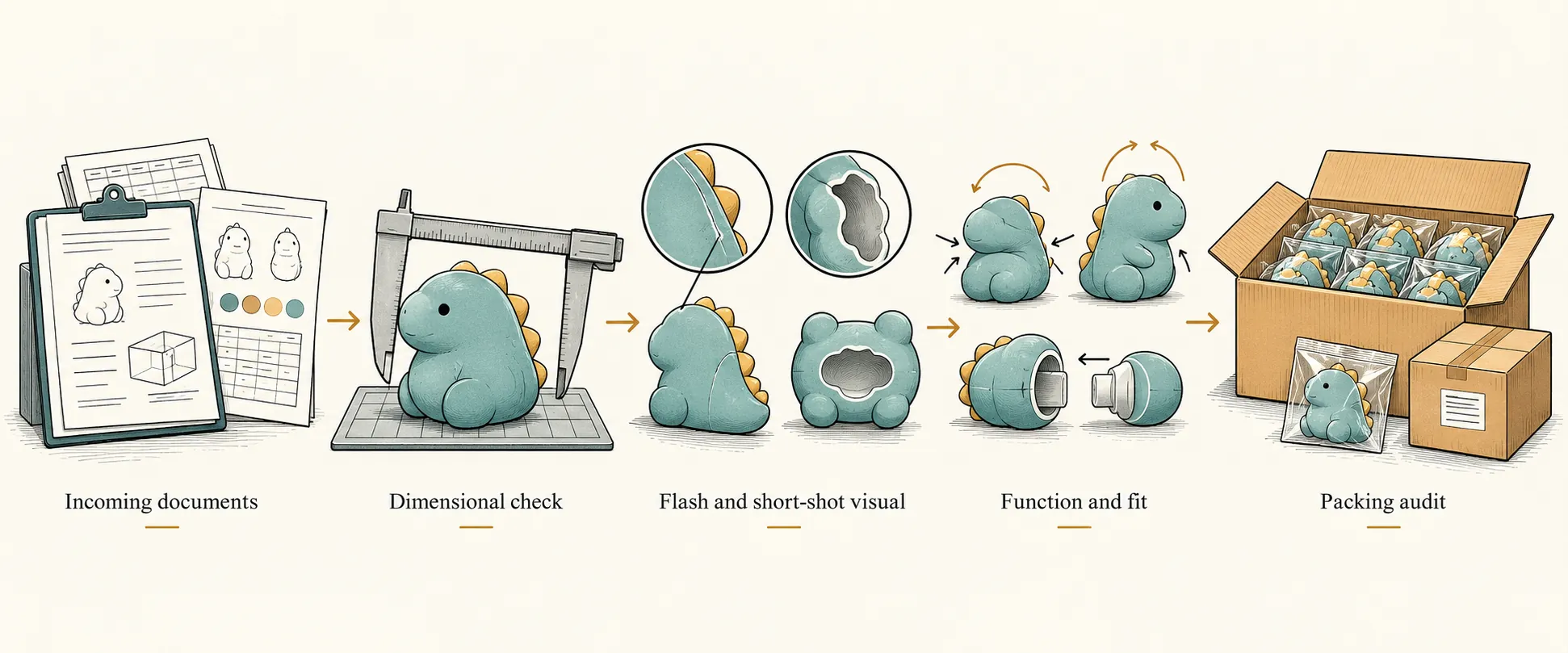
Record the shipment, carton identifier, inspection date, inspector, and measurement evidence. Agree which cartons will be checked and how discrepancies will be escalated before inspection. The following sequence is a purchasing control, not a product-safety test.
Closed-carton inspection and disposition record
| 1. Identity and shipping marks | Inspect: readable item/configuration identifiers, PO reference, quantity and unit, carton numbering, and mark layout. Compare: approved artwork revision and final packing list. Discrepancy: wrong item, obsolete revision, duplicate number, or inconsistent quantity. Next decision: hold the affected cartons for identification or relabeling, then verify the corrected marks and packing list. |
|---|---|
| 2. Dimensions and CBM | Inspect: external length, width, and height of the fully packed, closed carton, including protrusions or bulging; photograph measurements and record cm. Compare: approved packing dimensions, agreed tolerances, and final packing-list dimensions. Discrepancy: measurements outside tolerance or a material volume change. Next decision: remeasure, confirm packing configuration, and approve revised data or require repacking. A small difference within the agreed tolerance is not automatically a rejection. |
| 3. Count and assortment reconciliation | Inspect: carton labels, carton numbering, and sealed-carton count. Compare: final packing list, approved pack-out, and packing tallies or pre-closure records. Discrepancy: missing carton, conflicting unit definitions, or unreconciled mix/count. Next decision: reconcile records; if contents remain uncertain, authorize opening selected cartons for recount and reseal with a traceable record. Matching exterior labels alone do not prove the contents. |
| 4. Gross and net weights | Inspect: gross weight of the sealed carton on a suitable scale, recording kg and scale identification. Compare: agreed gross-weight range, final packing list, and packing records supporting net weight. Discrepancy: a result outside tolerance or inconsistent weight definitions. Next decision: reweigh and investigate contents or packaging differences. Do not infer an exact shortage from weight alone; sealed-carton weighing does not independently establish net product weight. |
| 5. Strength, condition, and closure | Inspect: crushed corners, split seams, punctures, moisture damage, bulging, and closure condition. Compare: approved carton construction/closure specification and matching strength-test evidence. Discrepancy: visible damage, an unapproved construction change, or test results below the agreed target. Next decision: segregate damaged cartons, replace or repack as needed, and obtain the agreed verification for any construction change. A visual check alone does not verify carton strength. |
| 6. Shipment totals and closure | Inspect: total cartons by configuration and the sum of quantities, measured volumes, and weights. Compare: order allocation, final packing list, and completed inspection records. Discrepancy: totals do not reconcile or a correction remains open. Next decision: correct the affected records or packing, document any approved exception, and obtain named approval with date and follow-up closure evidence. |
When should the packing proposal and final shipment be approved?
Approve the product and proposed packing configuration before placing the order, then approve final packed data after reconciliation.
Before the purchase order, approve the reference sample’s color, hand feel, assortment, and retail packaging; identify the approved sample and packing revision in the order. Record proposed carton dimensions, counts, weights, and strength requirements as targets—not as measurements of a shipment that has not yet been packed.
At final review, enter the actual observations beside those targets. Use clear decisions: accept, accept subject to stated conditions, or hold for correction. Name the approver and date, assign any corrective action, and record the evidence that closes it. A record provides traceability; it does not by itself reveal an undisclosed substitution.
Keep product-safety release separate from carton acceptance. Identify the destination and intended use, and have the applicable testing and documentation reviewed for the actual construction. Carton inspection and a buyer’s squeeze-feel check do not certify safety.
Send the same RFQ revision to every supplier and require a stated deviation for every proposed substitution. That makes the purchasing decision a comparison of defined products and cartons—not merely a comparison of headline prices.
Continue the sourcing review
Turn this guide into a quote-ready shortlist. Start with the squishy toys wholesale category, then compare two published SKUs before asking for current freight and document scope.
- Five-Color Steamer Baozi Squishy (SKU sqz350815)MOQ: 5 cartons / 720 pcs; packaging: Display Box.
- 8.5 cm Colorful Bead-Filled Baozi Squishy (SKU sqz350809)MOQ: 5 cartons / 720 pcs; packaging: Display Box.
For logo, color or retail-packaging work, review the custom squishy toys OEM and ODM program or send the selected items through the wholesale quote workspace.