
Stress Balls Wholesale: Outer Skin Integrity, Inner Fill Risks and Holiday Counterfeit Red Flags
Stress balls wholesale buyers: verify 1000 ppm phthalates, 100 ppm lead, small-parts abuse results, CPC citations and batch tracking before holiday cartons ship.
A pre-holiday carton of 300 squeeze balls arrives at a dollar-store DC with a smiling snowman printed on the master case and a one-line supplier email that reads 'non-toxic material.' The receiving clerk has 20 minutes to decide whether that carton enters the holiday flow or goes to quarantine. For stress balls wholesale buyers, that decision rests on four paper and physical checks: the eight-phthalate disclosure at 0.1% (1000 ppm), the 100 ppm total lead citation, the small-parts abuse result for under-3 labeling, and a batch number that matches a current Children's Product Certificate.
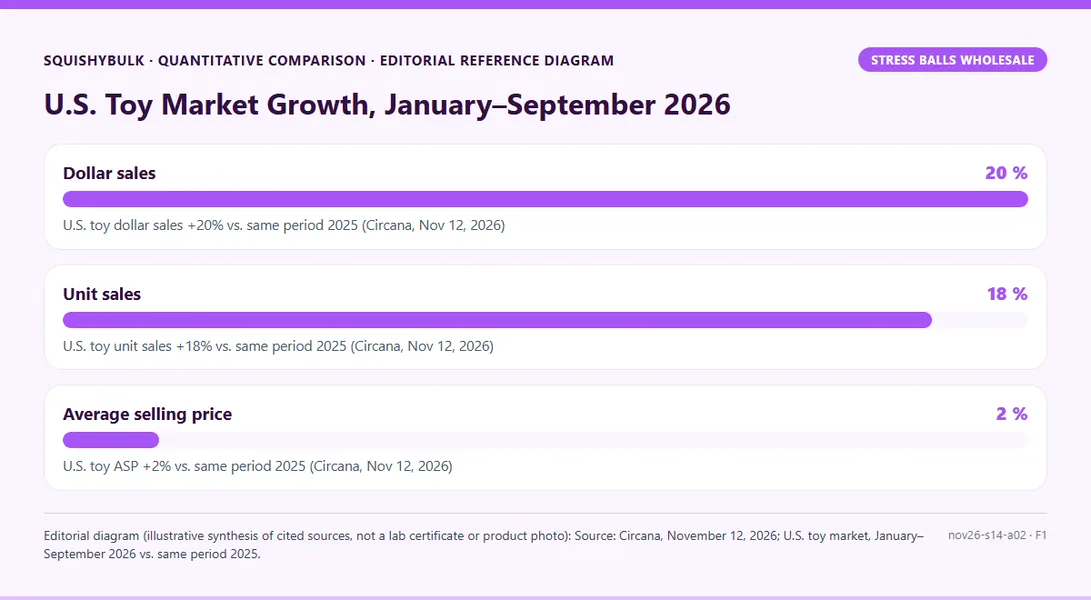
The demand backdrop makes the stakes concrete. ed on November 12, 2026 that U.S. toy dollar sales grew +20% from January through September 2026, units rose +18% and average selling price rose +2%. Within that growth, Arts & Crafts dollar sales rose +23% on the strength of slime making kits, and Explorative and Other Toys climbed +75% led by sports cards — the same tactile, collectible, self-expression behavior that drives squeeze-ball and squishy assortments into carnival, party and dollar-store cartons. Volume is there; the risk is that a fast seasonal buy outruns the documentation that makes a squeeze ball legal for a child 12 or younger.
Why Outer Skin and Inner Fill Are Two Separate Compliance Questions
The outer skin of a sealed elastomer squeeze ball is the accessible plasticized component a child touches, squeezes and occasionally mouths. CPSC caps eight named phthalates — DEHP, DBP, BBP, DINP, DIBP, DPENP, DHEXP and DCHP — at 0.1% (1000 ppm) in any accessible plasticized component of a children's toy under 15 U.S.C. § 2057c and 16 C.F.R. part 1307. A 'phthalate-free' adjective does not satisfy that rule; a component-level report that names all eight substances and reports each result against the 1000 ppm ceiling does.
The inner fill is a second component with its own chemistry. A gel core, a bead fill or a foam bead blend is assessed on its own material composition, and a skin that passes at 900 ppm does not rescue a fill that carries a regulated plasticizer above 1000 ppm. Buyers should require separate line items for skin compound and fill compound on the same test report, with the batch or lot number printed on each page.
Lead is the parallel test. Children's products with more than 100 ppm lead in an accessible component are a banned hazardous substance under 15 U.S.C. § 1278a, and the CPC citation reads '15 U.S.C. § 1278a – Total lead content'. Materials exempt from lead testing under 16 C.F.R. § 1500.91 still require CPC certification, and a firm can be held responsible if the end product as received by a consumer exceeds 100 ppm — so an 'exempt material' note is a testing shortcut, not a compliance exemption.
Worked Example: How Small Is the 1000 ppm Ceiling at Piece Level?
Illustrative planning example, not a lab test or a product finding. Assume a sealed squeeze ball with a 40 g outer elastomer skin and a 60 g gel fill, ordered at the 300-piece minimum. The phthalate ceiling applies to the accessible plasticized skin at 1000 ppm, so the maximum permitted mass of a regulated phthalate in that skin is 40 g × 0.001 = 0.04 g, or 40 mg per ball. Across a 300-piece carton, 0.04 g × 300 = 12 g of permitted regulated phthalate mass in total.
That 40 mg figure is the entire legal headroom for one ball's skin. A single substituted plasticizer batch, a regrind blend or an unlabeled compound swap can consume it, which is why the carton's batch number must tie to a component-level report rather than a blanket certificate issued for a different formulation. The gel fill is assessed separately at its own 60 g mass, and its result belongs on the same report under its own line.
The Small-Parts Abuse Test: Seams, Fragments and the Under-3 Ban
Under 16 C.F.R. part 1501, a small part is any object that fits entirely, without compressing and in any orientation, into the small parts cylinder. That definition covers a whole toy, a separate part, and a piece that breaks off during testing that simulates use or abuse by children. Children's products intended for use by children under 3 that present a choking, aspiration or ingestion hazard because of small parts are banned hazardous substances. A seam split that releases a gel bead or a skin fragment is therefore a test failure, not a cosmetic defect.
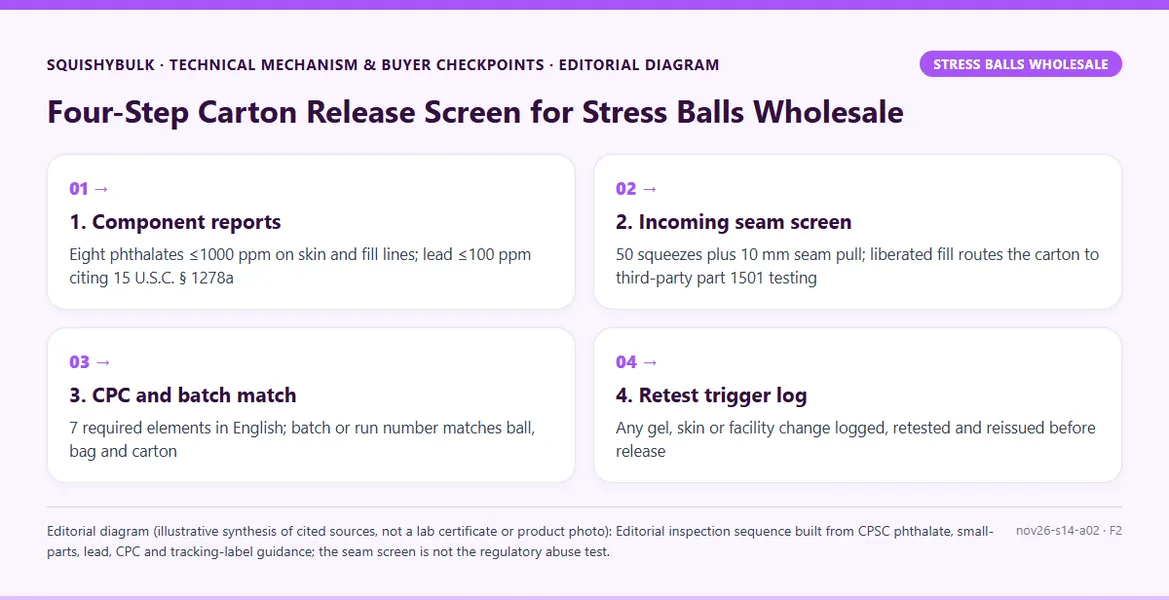
The regulatory abuse test is the third-party part 1501 protocol. The incoming screen is separate and simpler: squeeze each sample ball 50 times at the seam, pull the seam 10 mm by hand, and inspect for liberated fill. Any liberated piece that fits the small parts cylinder without compressing fails the under-3 claim on the incoming screen, and the carton goes to third-party part 1501 testing before any release decision. Passing the 50-squeeze screen does not substitute for that laboratory test.
For products that are or contain small parts, balloons, small balls or marbles, choking hazard warning labeling is codified at 16 C.F.R. § 1500.19, and advertising for toys subject to that warning must use the same warning label per 16 C.F.R. § 1500.20 — so the carton, the insert and the product listing must carry one consistent age warning. Pediatric guidance reinforces the same physical logic for parents: check warning labels and age recommendations, make sure toys and parts are larger than a child's mouth, and avoid toys with small bean-like pellets or stuffing that can cause choking or suffocation. A squeeze ball sold to a carnival or party channel with a 3+ label but a seam that sheds beads under 50 squeezes contradicts that guidance and invites a return wave in January.
Compliant Sealed Elastomer/Gel Ball vs Unverified Knockoff
Use this six-row screen at carton release; each row maps to a document or a physical check, and a single failed row holds the carton. The seam row is an incoming screen only — it routes the carton to third-party 16 C.F.R. part 1501 testing, it does not replace it.
| Checkpoint | Document or check | Unverified knockoff | Compliant sealed ball |
|---|---|---|---|
| Phthalate disclosure | Component-level third-party report | 'Non-toxic' adjective only, no substance list | Eight named phthalates, each ≤1000 ppm, skin and fill on separate lines |
| Lead content | CPC section 2 citation | No report or no citation | ≤100 ppm accessible; CPC cites 15 U.S.C. § 1278a |
| Small-parts result | Third-party report plus incoming screen | Seam splits or loose fill beads after 50-squeeze screen | Part 1501 abuse test passed; no fragment fits the cylinder |
| CPC | CPC and supporting reports | Missing, outdated or non-English certificate | 7 required elements, English, current formulation |
| Tracking label | Three-way label match | No batch code or mismatched codes | Batch or run number on ball and carton, matching |
| Retest trigger | Change log and new CPC | Silent gel or skin supplier swap | Material change logged, retested, new CPC issued |
Paper Trail: CPC, Material Change and Periodic Testing
A Children's Product Certificate must contain 7 required elements, rest on test results from a third-party CPSC-accepted laboratory, and be supplied in English together with the supporting test reports. Beginning July 8, 2026, importers of most regulated consumer products must electronically file certificates of compliance with U.S. Customs and Border Protection through a Partner Government Agency Message Set, so a PDF emailed after the container sails is a late document, not a compliance plan.
A material change is a change to a product's design, manufacturing process, or source of component parts that could affect compliance. It requires retesting by a third-party CPSC-accepted laboratory and a new CPC. Changing the manufacturer of the product requires retesting the entire product, because the facility, equipment and process controls can affect compliance. A buyer who swaps the gel fill or the skin compound mid-season inherits a retest window and a new certificate, not a carry-over.
Periodic testing runs at minimum 1-, 2-, or 3-year intervals depending on the plan under 16 C.F.R. § 1107.21, with records of periodic test plans and results kept for 5 years. Products produced exclusively in short production runs of less than 1 year without material changes carry no periodic testing obligation, but a material change still triggers retesting. A holiday squeeze-ball program built from many short runs sits close to the line where CPSC staff could construe the production as continuing production subject to periodic testing — so lock the formulation before the peak season.
Tracking Labels as a Counterfeit Screen
A tracking label must be visible, legible and permanently affixed to the product and its packaging to the extent practicable. It must state the manufacturer or importer name, the location and date of production, a batch or run number, and other information that identifies the specific source of the product. Code form is allowed if the consumer knows who to contact to decode it. A squeeze ball with a printed batch code on the ball and a different code on the master carton is a traceability failure that blocks recall containment.
The counterfeit screen is a three-way match: ball label, polybag or header card, and master carton. All three carry the same batch or run number, the same production date and the same manufacturer location. A carton that shows a 2026 production date while the CPC cites a 2024 formulation is a red flag. A carton with no batch code at all is a stop. These are inspection heuristics, not documented enforcement actions, and they exist because the tracking label is the field that lets a buyer isolate one bad lot without scrapping a season.
Holiday Carton Inspection: What to Check Before Release
Sample every mix-pack SKU at 3 pcs per carton and record squeeze feel, seam integrity and rebound. Run the 50-squeeze seam stress and 10 mm hand seam-pull as an incoming screen, and route any carton with liberated fill to third-party 16 C.F.R. part 1501 testing before release. Match the batch or run number on the ball, the bag and the carton to the test report and the CPC citation; a mismatch holds the carton. Confirm the phthalate report names all eight substances at ≤1000 ppm per component and the lead report cites 15 U.S.C. § 1278a at ≤100 ppm.
Flag unverified knockoffs that offer only a 'non-toxic' adjective, a certificate without a lab name, or a CPC missing any of the 7 required elements. The EU regime is a separate check, not a substitute: Directive 2009/48/EC chemical safety requirements have applied since 20 July 2013, and Regulation (EU) 2025/2509 enters into force on 1 January 2026 and applies from 1 August 2030 with a digital product passport requirement. A carton bound for the U.S. needs the CPSC citations; an EU-bound carton needs its own file.
Volume Planning Around Retest and Lead Time
Illustrative planning example, not a quote or a lead-time guarantee. At a 20,000 pcs/month capacity, a 300-piece mix-pack SKU consumes 1.5% of one month's output; 12 SKUs at 300 pcs each equal 3,600 pcs, or 18% of monthly capacity. The profile lists a 25–35 day lead time and 12 production lines, so a 12-SKU holiday mix fits inside one month of capacity with room for sampling, provided the formulation is locked before the run starts.
Sequence the calendar backward from the ship date: lock skin and fill compounds, complete third-party testing, issue the CPC, then release the 300-piece cartons. A material change after release adds a retest window on top of the 25–35 day lead time and can push a holiday carton past its in-store date. The profile lists no certifications and no lab reports, so every compliance statement in this article is a regulatory requirement to verify per carton, not a claim about any named product.
Are stress balls always classed as children's toys under CPSC rules?
No. A stress ball is a children's toy only when it is designed or intended by the manufacturer for a child 12 years of age or younger for use when the child plays; in that case the phthalate, lead, small-parts and CPC rules apply, and the intended age belongs in writing on the purchase order. An adult desk toy marketed to offices sits outside that definition, but the moment the same SKU appears in a carnival or party assortment aimed at children, the children's product file governs.
Does a 'phthalate-free' supplier statement satisfy the 1000 ppm rule?
No. The rule caps eight specific phthalates at 0.1% (1000 ppm) in each accessible plasticized component, so the carton needs a component-level test report naming DEHP, DBP, BBP, DINP, DIBP, DPENP, DHEXP and DCHP with a result per substance. A general 'phthalate-free' claim carries no substance list and no 1000 ppm comparison, and it cannot be matched to a batch number.
If the gel fill supplier changes, is the old CPC still valid?
No. A change to the source of component parts that could affect compliance is a material change, requiring retesting by a CPSC-accepted laboratory and a new CPC before the carton ships. The same rule applies to a skin compound swap or a new manufacturer: the entire product is retested when the manufacturing facility changes, because equipment and process controls affect compliance.
Build the Holiday Carton on Documents, Not Adjectives
SquishyBulk supplies squishy and squeeze toys by the carton from Chenghai, with a 300-piece minimum order, mix-pack options, 25–35 day lead time and 20,000 pcs monthly capacity across 12 production lines. Send the target SKU, the intended age band and the destination market, and the sourcing desk will map the carton to the phthalate, lead, small-parts and tracking-label fields this article sets out. No certifications or lab reports are listed on the profile, so every compliance document is confirmed per order before release.
Sources
www.cpsc.gov — Phthalates Business Guidance | CPSC.gov
www.cpsc.gov — Small Parts Ban and Choking Hazard Labeling | CPSC.gov
www.cpsc.gov — Total Lead Content | CPSC.gov
www.cpsc.gov — Children's Product Certificate | CPSC.gov
www.cpsc.gov — Tracking Label Business Guidance | CPSC.gov
www.cpsc.gov — Material Change Testing | CPSC.gov
Continue the sourcing review
Turn this guide into a quote-ready shortlist. Start with the squishy toys wholesale category, then compare two published SKUs before asking for current freight and document scope.
- Five-Color Steamer Baozi Squishy (SKU sqz350815)MOQ: 5 cartons / 720 pcs; packaging: Display Box.
- 8.5 cm Colorful Bead-Filled Baozi Squishy (SKU sqz350809)MOQ: 5 cartons / 720 pcs; packaging: Display Box.
For logo, color or retail-packaging work, review the custom squishy toys OEM and ODM program or send the selected items through the wholesale quote workspace.