
Slow-Rise vs Fast-Recovery Squishies: A Buyer's Comparison
Compare slow-rise vs fast-recovery squishies for B2B buying: materials, rebound, MOQ, packaging, QC, and certification questions.
Choose slow-rise squishies if your end customers want a drawn-out, calming sensory experience; choose fast-recovery squishies if they want a quick, bouncy squeeze-and-pop interaction. This buyer's comparison lays out the material, rebound, MOQ, packaging, QC, and certification questions you need to answer before sourcing either format. No product in the current catalog is explicitly labeled slow-rise, so if that's your target, you'll need to verify specs with the supplier rather than assume from a product name.
Key Takeaways
- Fast-recovery squishies (like silicone dumpling squishies) suit high-turnover retail: they return to shape quickly, are durable and easy to clean, and the listed $0.75 price point with MOQ 1440 fits mass-retail favor packs.
- Slow-rise squishies are marketed for anxiety relief because the gradual rebound extends the sensory experience, but none of the listed products are explicitly slow-rise—confirm recovery time and material (PU vs TPR) with a TDS before ordering.
- MOQ varies widely by format: silicone dumpling squishies require 1440 units, while fast-recovery push games start at 120–240 units; choose based on your container strategy and willingness to test multiple SKUs.
- Certification is per item, not per supplier: ask for ASTM F963, EN71, or CPSIA certificates for the exact SKU you're buying, and request a TDS for Shore hardness and rebound time—consumer blog claims are not proof.
- Packaging and carton data are part of total cost: retail-ready packaging and pieces-per-carton information support party-favor distribution, but confirm packaging type (blister, polybag, box) and carton dimensions in the proforma invoice.
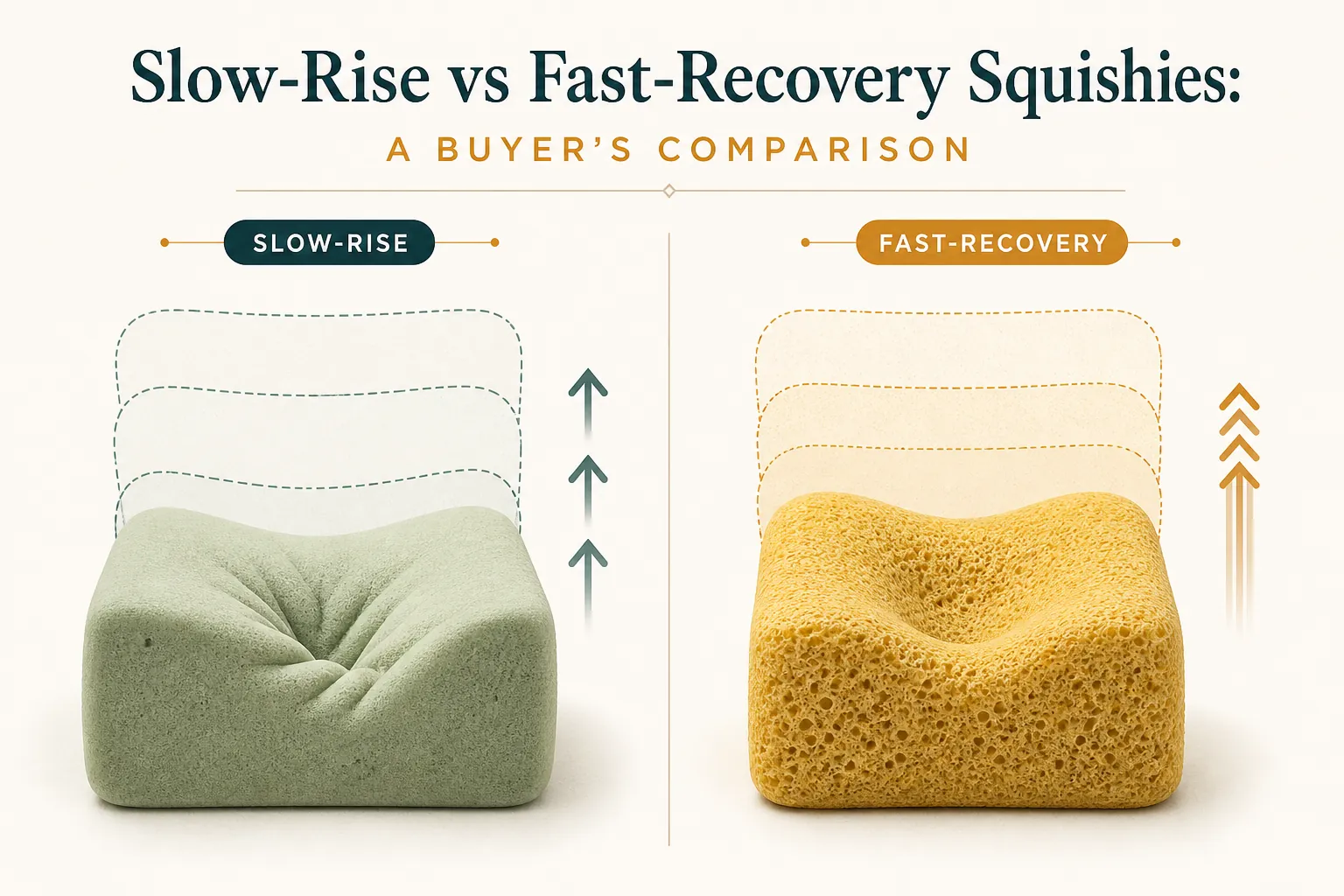
Slow-Rise vs Fast-Recovery at a Glance
| Format | Slow-Rise Squishies | Fast-Recovery Squishies |
|---|---|
| Typical material | PU foam or TPR (per market talk; not verified in catalog) | Silicone (listed products: Dumpling Squishies) |
| Rebound time | 3–10 seconds (per consumer blogs; ask TDS) | Under 1 second (per consumer blogs; ask TDS) |
| Feel | Soft, plush, calming | Bouncy, rubbery, quick |
| Durability | Delicate; may tear or yellow with overuse | More durable and washable |
| Example SKU | None listed as slow-rise | Colorful Silicone Dumpling Squishies (MOQ 1440, $0.75) |
| MOQ | Varies by spec; ask for quote | 1440 units (listed silicone squishies) |
| Price per unit | Varies by spec; ask for quote | $0.75 (listed silicone squishies) |
| Packaging | Retail-ready packaging documented for squishies/pop-its (supplier evidence) | Retail-ready packaging documented for squishies/pop-its (supplier evidence) |
| Certification | Ask per item (ASTM F963, EN71, CPSIA) | Ask per item (ASTM F963, EN71, CPSIA) |
How We Compare the Two Formats
This comparison is built on seven criteria: recovery behavior, material composition and feel, packaging and retail readiness, QC and sample integrity, compliance and documentation, merchandising fit, and supplier evidence quality. Where a metric (like Shore hardness or recovery time) is not stated in the provided records, it is marked 'ask TDS'—you should request that data from the supplier before committing to an order.
The evidence base for slow-rise vs fast-recovery is largely consumer blogs and supplier articles (e.g., SentiaPlay's slow-rising foam quality guide). These sources describe material science and testing methods, but they are not substitutes for a manufacturer's technical datasheet or third-party test certificate. Treat any 'non-toxic' or 'safe' claim as unverified until you see the per-item certificate.
Which Format Fits Your Channel?
If you're sourcing for retail shelves where kids expect a quick, satisfying squeeze-and-pop interaction, fast-recovery squishies are the safer bet. The listed silicone dumpling squishies at $0.75 with MOQ 1440 fit a mass-retail price point, and their durability reduces returns from tearing. Supplier evidence shows retail-ready packaging and pieces-per-carton data for squishies and pop-its, which supports party-favor distribution.
If your channel is anxiety relief or sensory fidgeting where a slow, calming rebound is the selling point, slow-rise squishies are the better match—but you'll need to source a dedicated slow-rise line. None of the listed products are explicitly slow-rise, so you must verify recovery time and material (PU vs TPR) with the supplier. Expect a higher per-unit cost due to material and molding complexity; request a sample and a cost breakdown before quoting.
A hybrid assortment often works best: carry fast-recovery silicone squishies for impulse retail and a slow-rise PU foam line for the anxiety-relief niche. This spreads risk across formats and lets you test which one your market actually turns.
Verifying Recovery Time and Material Performance
The core difference between slow-rise and fast-recovery squishies is rebound time, but none of the listed products state a recovery time in seconds. For the silicone dumpling squishies, request a TDS that specifies Shore hardness (ASTM D2240) and, if available, a rebound test result. Ask the supplier: 'What is the recovery time in seconds at room temperature, and what is the test protocol?'
For slow-rise formats, the evidence base is consumer blogs that mention TPR and PU foam, but they do not provide quantitative recovery times. To verify, request a physical sample and time the full rebound from full compression to original shape. If the supplier cannot provide a TDS row, treat the claim as unverified.
Material composition affects both feel and safety. The listed silicone products are likely fast-recovery, but confirm the material is 100% silicone versus a blend. For foam slow-rise, ask whether it is PU or TPR, and request the TDS for density and compression set (ASTM D395). Do not rely on blog claims about 'non-toxic' without a certificate.
Total Cost of Ownership: Price, MOQ, and Packaging
The listed silicone dumpling squishies are $0.75/unit with MOQ 1440, which is a viable mass-retail price point. However, total cost includes packaging: the supplier evidence mentions retail-ready packaging and pieces-per-carton data, but the facts do not specify packaging type (blister, polybag, box) or carton dimensions. Request a proforma invoice that itemizes packaging cost per unit and carton packing details to calculate landed cost.
For slow-rise formats, no price or MOQ is provided in the facts. If you source a dedicated slow-rise line, ask for a separate quote and compare unit price, MOQ, and lead time. Slow-rise foam may have higher per-unit cost due to material and molding complexity; verify by requesting a sample and a cost breakdown.
Certification costs are part of total cost. The facts do not state ASTM F963 or food-contact compliance for any product. Ask for per-item certificates and factor in testing fees if you need to commission your own lab tests. The supplier's QC process (sealed golden sample) is a control point, but it does not replace third-party certification.
Compliance and Certification: What to Ask
Certification is per item, not per supplier. For any squishy you source, request the specific test reports for the exact SKU: ASTM F963 (US), EN71 (EU), CPSIA (lead and phthalates), and REACH (EU hazardous substances). Migration testing is material- and use-specific; different toy materials, colors, coatings, and age grades can require different extraction conditions. Ask the supplier which standards their product already meets and whether they can share the certificate for your target market.
FAQ
What is the exact recovery time for each squishy format?
Not stated in the provided records. Request a TDS from the supplier that specifies recovery time in seconds at room temperature, along with the test protocol. For slow-rise formats, consumer blogs suggest 3–10 seconds, but that is not verified data.
What is the Shore hardness of the silicone or foam?
Not provided in the facts. Ask the supplier for the Shore A value (per ASTM D2240) on the TDS. If they cannot provide it, treat the material spec as unverified.
Does the product meet ASTM F963 or food-contact standards?
Not stated for any product in the catalog. Request per-item certificates for ASTM F963, EN71, CPSIA, or REACH, depending on your target market. Do not rely on generic claims; certification is per SKU.
What is the MOQ and unit price for slow-rise formats?
No slow-rise products are listed in the catalog, so MOQ and price are not available. Ask the supplier for a separate quote for a dedicated slow-rise line, and compare unit price, MOQ, and lead time against fast-recovery options.
What packaging options are available, and what are the carton packing details?
Supplier evidence mentions retail-ready packaging and pieces-per-carton data for squishies and pop-its, but the facts do not specify packaging type (blister, polybag, box) or carton dimensions. Request a proforma invoice that itemizes packaging cost per unit and carton details.
How can I verify slow-rise quality before bulk ordering?
Request a physical sample and run a full compression test: compress flat, hold for 3 seconds, and time the rise. Quality slow-rise foam returns evenly in 8–15 seconds (per consumer guides) and maintains that behavior over 10 compressions. Also check for creasing, thin-detail recovery, and any chemical smell.
Sources
Request a Quote
Ready to spec your squishy assortment? Contact our team to request TDS, per-item certificates, and packaging details for the silicone dumpling squishies or to discuss a dedicated slow-rise line.
Continue the sourcing review
Turn this guide into a quote-ready shortlist. Start with the squishy toys wholesale category, then compare two published SKUs before asking for current freight and document scope.
- Five-Color Steamer Baozi Squishy (SKU sqz350815)MOQ: 5 cartons / 720 pcs; packaging: Display Box.
- 8.5 cm Colorful Bead-Filled Baozi Squishy (SKU sqz350809)MOQ: 5 cartons / 720 pcs; packaging: Display Box.
For logo, color or retail-packaging work, review the custom squishy toys OEM and ODM program or send the selected items through the wholesale quote workspace.