
Pre-Production Squishy Inspection Checklist
Use this pre-production squishy inspection checklist to verify materials, feel, recovery, packaging, and evidence before you approve a production run.
A pre-production squishy inspection checklist verifies seven things before you approve a run: the inspection plan on the PO, line clearance, the production standard, material and feel, packaging and labeling, QC evidence, and the rework/release protocol. Start with the plan, not the product—if the PO doesn't state the AQL and defect classes, stop and request it. This checklist turns a squishy order from a hope into a decision you can defend to your retailer, your bank, and your customers.
Key Takeaways
- Put the inspection plan on the PO, not in the catalogue—AQL, defect classes, and rework rules belong in the contract, and no supplier should expect you to accept a number from a product page.
- Line clearance is a real risk: a mixed label or leftover color from the previous SKU can reach a retailer, so ask for written sign-off and a photo before production starts.
- Treat the booth sample as a hero unit, not the standard—insist on a tool number and revision card, because Fair lighting lies and the revision card does not.
- Feel and recovery are buyer-defined pass criteria, so you must set them in writing and test pre-production samples; no one can inspect 'soft enough' without a spec.
- A lab report covers a specific lot, not your shipment—match the report's SKU, materials, colors, and production cohort to the PO, and verify test status before release.
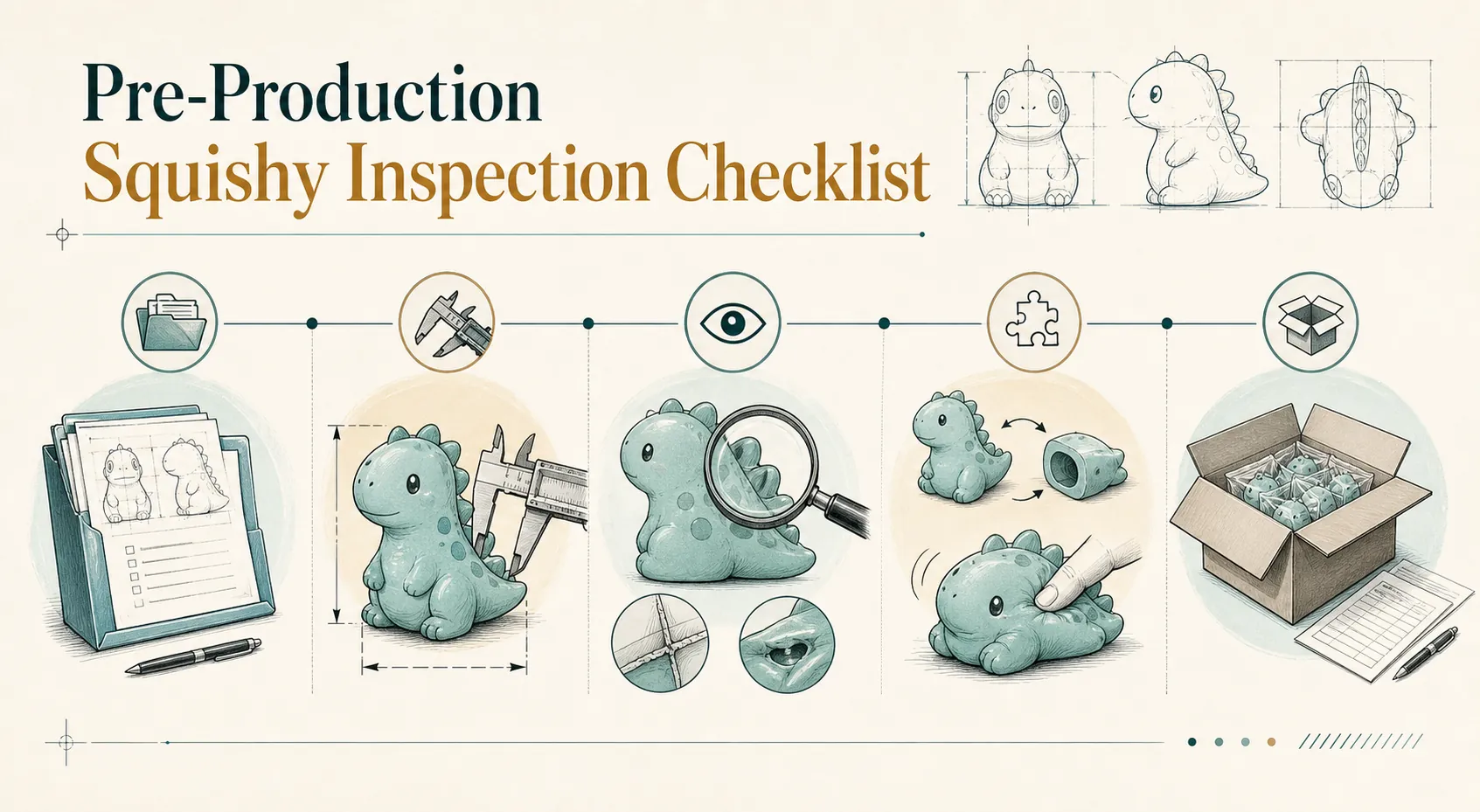
Checklist at a Glance
| Inspection plan on PO | What to check: PO references AQL, defect classes, and release protocol. Red flag: Supplier says 'we use standard AQL' but won't put it in writing. |
|---|---|
| Line clearance | What to check: Written confirmation that labels, colors, and work instructions from the prior SKU were cleared. Red flag: No sign-off photo or a 'we'll handle it' response. |
| Production standard | What to check: Tool number and revision card identified as the reference. Red flag: Supplier sends a Fair photo as the standard. |
| Material and feel | What to check: Resin grade, color, and additive package in the BOM; pre-production samples tested for squeeze feel and recovery. Red flag: BOM says 'ABS' or 'PP' without specifics. |
| Packaging and labeling | What to check: Packaging language, instruction length, and safety warnings match the destination market. Red flag: Packaging mock-up not approved or differs from sample. |
| QC evidence | What to check: QC photos of actual production units, not the hero sample. Red flag: Photos show a different SKU or are retouched. |
| Rework and release | What to check: Supplier documents defect class and rework procedure before release. Red flag: No written isolation or rework protocol. |
What should the inspection plan on my PO include?
The inspection plan should name the AQL levels for critical, major, and minor defects, the defect classes with visual references, and the pass/fail criteria for feel and recovery. For toys, a common AQL setting is 0 for critical, 1.5 for major, and 2.5 for minor, but the exact numbers depend on your product risk and market—so get them in writing on the PO. AQL is a statistical tool, not a guarantee; it doesn't mean every unit is perfect, and sampling risk always exists. That's why the plan should also state what happens on failure: isolation, defect recording, rework, and re-inspection before release.
How do I verify line clearance and the production standard?
Line clearance is boring until a mixed label reaches a retailer, so make it a formal checkpoint. Before production starts, request a written sign-off that labels, colors, and work instructions from the prior SKU were cleared from the line, and ask for a photo of the cleared line. For the production standard, don't accept a booth sample as the reference—ask for the tool number and revision card, which are the ground truth for the run. A Fair photo can mislead because the lighting lies; the revision card does not.
What counts as 'feel' and 'recovery' for a squishy?
Feel and recovery are physical properties you must define as pass criteria because they're buyer-specific—what feels 'soft' to one market may be 'too firm' for another. Work with your supplier to set a squeeze force range and a recovery time, then test pre-production samples against those numbers. For example, a TPR squishy like an 8.5 cm glow-in-the-dark bead baozi may have a different recovery profile than a mixed-material countdown calendar, so the criteria should be per SKU. Don't rely on a type-test report to cover your lot; a lab report covers a specific cohort, so match the report's SKU, materials, and production date to your PO.
How do I check packaging and labeling for my market?
Packaging and labeling must match the destination market: language, instruction length, safety warnings, and any regulatory marks. For a Spanish-language market, for example, you'd want short instructions and child-friendly wording; for an EU or US market, you'll need the required safety labels and possibly a lab report. Request a packaging mock-up for approval before production, and confirm that the BOM lists the resin grade, color, and additive package—generic names like ABS or PP aren't enough for repeatable production. If the supplier can't provide a mock-up or the labels differ from the sample, that's a red flag.
What evidence should I demand before shipment release?
Before you release a shipment, require QC photos of the actual production units, not the hero sample, and verify the product, packaging, markings, quantity, documents, and test status per your PO. If a lot fails inspection, the supplier should isolate it, record the defect class, and document the rework before re-release—ask for this in writing. A lab report is not a shipment certificate; it covers a specific lot, so match it to your PO's SKU and production cohort. Supplier records for materials, production, inspection, and testing should be retained long enough to support your market's recall obligations.
What if the supplier won't share the AQL or inspection plan?
If a supplier won't put the AQL and defect classes in writing on the PO, treat that as a deal-breaker—you can't make a defensible release decision without an agreed inspection plan. In practice, a factory may isolate a failed lot and rework it, but you need that protocol documented before you commit. Ask directly: 'What is the inspection plan for this PO, including AQL, defect classes, and rework procedures?' If the answer is vague or refers you to a catalogue, walk away or escalate to a third-party inspection service.
Worked example: a 5,000-unit squishy order (illustrative)
Imagine you're importing 5,000 squishy baozi units in two packaging variants: a US retail blister pack and an EU bulk display box. Per your PO, the inspection plan is AQL 0/1.5/2.5 at General Inspection Level II, and the BOM specifies TPR resin with a named grade. At pre-production, you ask for line clearance, and the supplier sends a photo of the line cleared of the previous SKU's labels. You receive pre-production samples, squeeze-test them against your agreed recovery time, and approve the run. At final inspection, the inspector checks 200 units per ISO 2859-1 sampling, finds 3 major defects (above the acceptance number), and the lot fails. The supplier isolates the lot, records the defect class, reworks the units, and re-inspects before release. You receive QC photos of the reworked units and a matching lab report for the specific production cohort, then release the shipment. If the supplier had skipped line clearance or sent a Fair photo as the standard, you'd have stopped the order earlier—that's the point of the checklist.
Buyer FAQ
What is the minimum order quantity (MOQ) for a custom squishy order?
MOQ varies by product and supplier. For example, a Mystery Dumpling & Baozi countdown calendar may have a MOQ of 500, while an 8.5 cm glow-in-the-dark squishy might be 720. Always confirm MOQ in writing on the PO, and use it to set your inspection sampling plan.
How long does pre-production inspection take before my order starts?
Pre-production inspection typically happens before or during the first production run, and lead time varies by supplier and order size. A typical production lead time might be 25-35 days, but PPI adds a few days—schedule it early, especially for new suppliers or high-volume orders.
What certifications do I need for squishy toys in the US or EU?
Certification requirements depend on your market and product. For toys, common standards include ASTM F963 in the US and EN71 in the EU, but you must verify which apply to your squishy's materials and age grade. A lab report covers a specific lot, so ensure it matches your PO's SKU and production cohort.
Can I use a pre-production sample as my golden sample for the whole order?
Yes, but only if you agree on the revision and tool number in writing. A golden sample serves as the reference for feel, color, and packaging, but it doesn't cover later production lots—each shipment needs its own inspection and matching lab report.
What if the supplier substitutes cheaper materials to cut costs?
That's a key risk in pre-production, so verify the BOM lists the resin grade, color, and additive package, and ask for material certificates. If a supplier substitutes without approval, the lot fails inspection and must be reworked or rejected per your PO's defect classes.
Sources
Related Products & Categories
Request a Quote
Ready to source squishy toys with a solid inspection plan? Browse our squishy collection for MOQs and specs, or contact our team to discuss your pre-production checklist and get a quote.
Continue the sourcing review
Turn this guide into a quote-ready shortlist. Start with the squishy toys wholesale category, then compare two published SKUs before asking for current freight and document scope.
- Five-Color Steamer Baozi Squishy (SKU sqz350815)MOQ: 5 cartons / 720 pcs; packaging: Display Box.
- 8.5 cm Colorful Bead-Filled Baozi Squishy (SKU sqz350809)MOQ: 5 cartons / 720 pcs; packaging: Display Box.
For logo, color or retail-packaging work, review the custom squishy toys OEM and ODM program or send the selected items through the wholesale quote workspace.