
Mini Animal Squishies for Event Prizes: A Hong Kong Toy Fair Preview
Plan a mixed-character mini squishy carton for carnivals and parties using real catalogue lines and carton data, then compare them in person at the Hong Kong Toys & Games Fair, 11–14 January 2027.
A pop-eye animal, a covering-eye character and a glitter figure can give an event prize table different choices. Start with the action and the way the item reaches the winner: a display-box assortment is a different proposition from an individually defined handout.
For the Hong Kong Toys & Games Fair, January 11–14, 2027, at HKCEC, use these five catalogue references to build a sample-comparison brief. Their character lists, prices and package fields provide starting evidence, without establishing confirmed exhibits, current fair quotations or a fixed mix for your event.
Why put character choice beside the unit price?
Character choice changes how a staffed prize table works: a choose-one display needs a visible assortment, while a uniform handout needs a defined repeat item. Neither arrangement follows automatically from a line's unit price. Use the Hong Kong visit to compare presentation and play action before reserving a role for each candidate.
The official 2027 programme includes Festive & Party Items, Soft Toys & Dolls, Kidult World and Brand Name Gallery. These are search directions for prize and character ideas, rather than proof that the catalogue references occupy particular halls or stands. Keep a simple handling sequence with the search: identify the character, operate its feature, return it and choose the next item.
The five references below are catalogue candidates, not confirmed 2027 exhibits or launches. Their prices are historical references, and character lists do not establish a fixed mix. 'Single item' identifies a packing field; it does not promise a single-character carton. These distinctions make the prize brief more usable than an unsupported popularity ranking.
Which animal line gives a concrete starting point for visible choice?
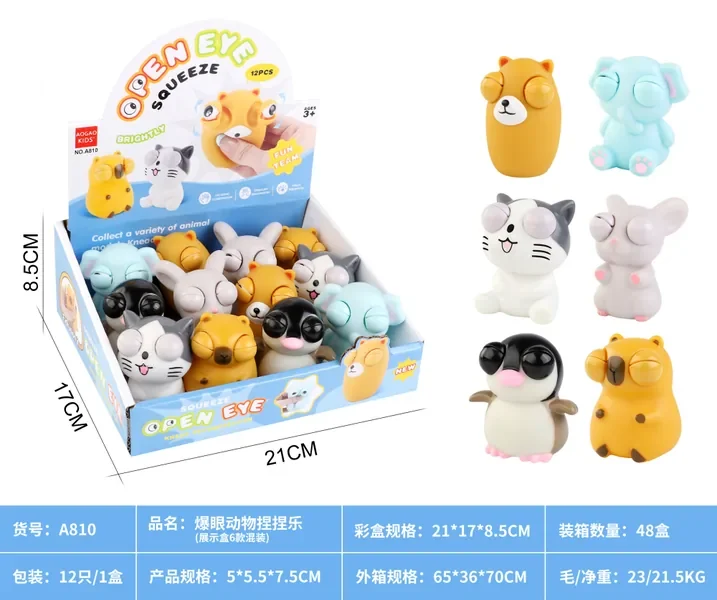
CPS349528 gives a useful starting point because both its written character list and its selected display sheet make the proposed choice visible. The description names capybara, baby elephant, cat, hamster and penguin designs. The sheet depicts six character styles, so do not treat the written five-design list as an exhaustive inventory or an evenly packed carton recipe.
Its supplier sheet labels 12 toys per display box, 48 display boxes per carton and a 21 × 17 × 8.5 cm display. The body is marked 5 × 5.5 × 7.5 cm on this image; here the unit comes from an actual dimension label, not an assumption added to the structured size field. The outer case is 65 × 36 × 70 cm, 23 kg gross/21.5 kg net.
Reference terms are USD 0.32–0.33 per unit, MOQ 576 and 576 units per case. The supplier describes squeezing the body to make hidden eyes pop out and return on release; the sheet's static closed-eye and popped-eye imagery is not a witnessed cycle or a measured reset speed. An effective prize-table comparison follows that action with putting the toy back among the available choices.
The structured material says ABS while the detail describes a soft rubberised body and bead filling. Keep the polymer unresolved, and keep its safety and durability slogans out of the selection score. The picture's 3+ wording belongs to that artwork; it does not establish a common age for this entire prize shortlist.
When does the three-character covering-eye line add a different choice?
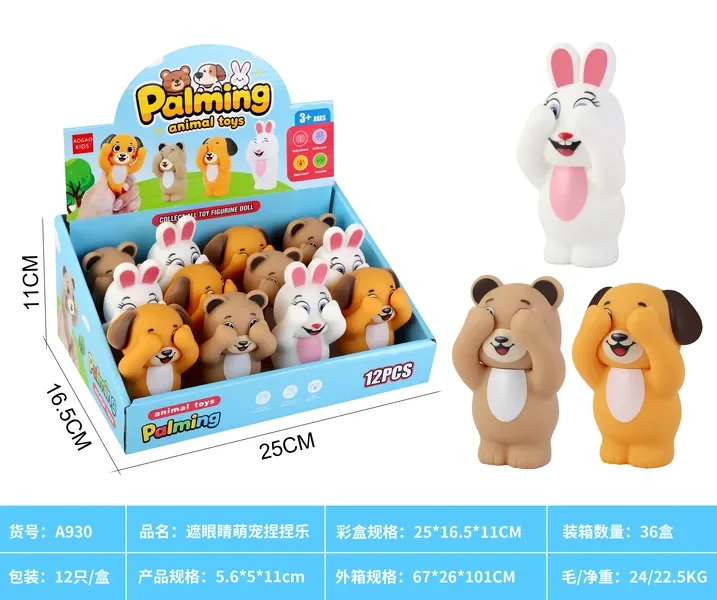
CPS349707 adds a different character action when covering-eye presentation earns its own place beside the pop-eye line. The description names bear, dog and bunny, and the selected sheet shows those three figures with hands at their faces. It does not show a complete squeeze-to-response sequence, so the fixed poses alone cannot establish how their arms or eyes move.
The image labels the body 5.6 × 5 × 11 cm, a 25 × 16.5 × 11 cm display and 12 toys per display box. It lists 36 display boxes per carton, while the structured quantity is 432 units. Reference terms are USD 0.47–0.50 and MOQ 864, with 2 cartons in the commercial fields. Those figures describe an order reference, without promising equal numbers of each character.
Keep two outer-case entries visible: the sheet says 67 × 26 × 101 cm, while the record says 75 × 34 × 71 cm. Both sources give 24 kg gross/22.5 kg net, which does not reconcile the dimensions. Its structured ABS field also conflicts with the written silicone description. Attach the exact pictured or offered package version to the quote instead of treating one dimension set or polymer as independently established.
For an event, the choice is whether these recognisable poses and the actual operating action add something beyond another animal colour. Three catalogue styles do not guarantee a three-style case, a fixed ratio, or a requirement to create three prize tiers.
Can the glitter figure serve a uniform-prize brief?
The glitter figure can be a candidate for that brief, but this record does not establish a uniform-character carton. CPS350772 is catalogued as TPR, with an 8 × 8 × 8 cm package, a 0.09 kg trade gross-weight entry, single-item packing, MOQ 432 and USD 0.56–0.61. No reliable case quantity or mixed-character schedule is supplied.
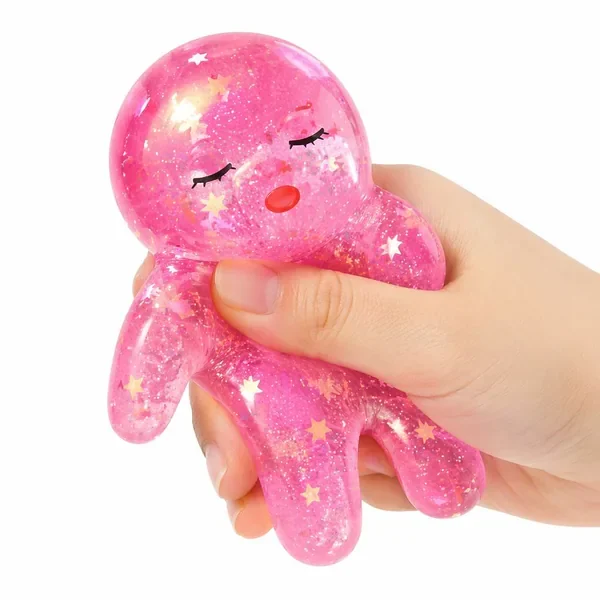
The selected image shows a hand compressing one pink humanoid form with glitter and star-like inclusions. That gives a visible squeezing action and a different silhouette from the animal display boxes. It does not show the retail package, the body's dimensions, a complete order assortment or a timed recovery result.
Use glitter as a visible presentation difference rather than automatic proof of a premium prize or better value. Its package size and trade mass do not establish the figure's hand-fit or individual net weight. If a uniform handout is the intended role, the buying brief needs that explicit identity; it cannot be inferred from this one photographed sample.
How does the sports button ball change the prize action?
CPS349529 changes the action from squeezing a soft body to pressing mechanical buttons on a rigid ABS ball. The detail describes spring buttons, a metal clasp and a retractable attachment, with no electrical power. This is a sports-themed alternative for the Hong Kong comparison, rather than another animal squishy with different decoration.
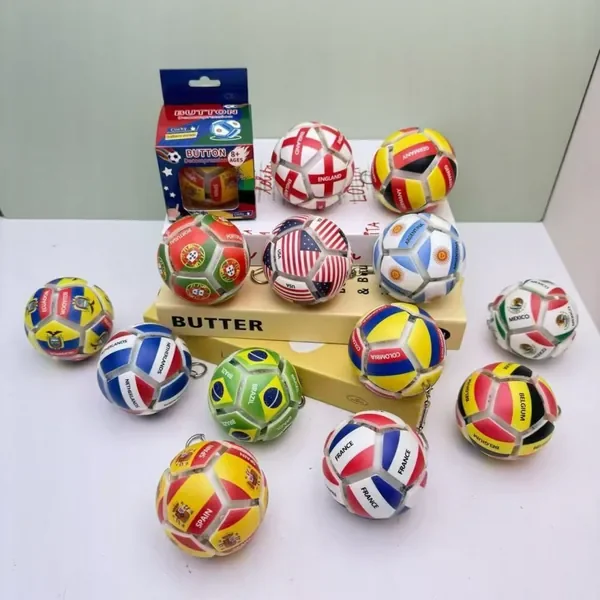
The photo shows football-like balls printed with country names and flag patterns, alongside individual boxes. These printed designs explain a tournament or club-event theme, without establishing any official event licence, selectable country mix or supplied attachment configuration. Keep the described retractable hardware as a separate contents item, since the image does not demonstrate its travel or strength.
Reference terms are USD 0.68–0.71, MOQ 864 and 288 units per carton, with 3 cartons in the source fields. The 60 × 45 × 45 cm case is listed at 22 kg gross/21.3 kg net; it is not the heaviest case in this shortlist. The 7 × 7 × 0 body entry is incomplete and lacks a stated unit, so it is not a measured ball diameter or a three-axis size.
Its useful prize-table demonstration is press → tactile response → next button. Compare that loop with the pop-eye animal's body squeeze and return. A sports graphic can provide a reason to choose the design, while the actual mechanism provides the different play role.
What does a fruit theme offer as an alternative to animals?
A fruit theme offers a recognisable alternative for a market, food-play or summer-event brief. CPS349462's supplier describes squeezing and stretching, but its structured ABS field conflicts with the written TPR description. Its USD 0.25–0.27 range should remain with an identified selling unit instead of being declared the cost of a finished individual prize.
The record gives a 1,152-piece case and one-carton MOQ with display-box packing; its 12 × 15.2 × 0 size is incomplete and unitless. The 26.8 × 14 × 16.3 cm entry describes packaging rather than a fruit. The 70 × 57.5 × 90.5 cm case is 32 kg gross/29 kg net, with a recorded 0.364 m³ volume reference.
Those commercial fields do not define the contained fruit shapes, a single fruit per selling unit or an evenly distributed mix. Keep this candidate's bag/display identity and exact contents in its brief. For fair viewing, compare the actual grip and the proposed presentation with the animal items; a fruit name alone does not settle the distribution plan.
How do you build the prize mix before leaving for Hong Kong?
Assign a role before assigning an order: visible character choice, uniform handout, glitter presentation or sports-button action. A prize programme can use one or several roles; the catalogue does not establish a universal number of tiers or a preferred character for the audience.
Use CPS349528 and CPS349707 to compare animal displays with different described actions. Treat CPS350772 as a glitter-form candidate whose order assortment is still undefined. Keep CPS349529 for a mechanical sports role and CPS349462 for a fruit-led brief, with its selling-unit definition intact. These are selection hypotheses to compare at the fair, rather than fixed participation/middle/top rankings based on unit price.
Use the event's actual attendance and award rules in the quantity field. The catalogue's 576-unit animal case, 432-unit covering-eye case and 288-unit button-ball case are replenishment references; they are not forecasts of how many prizes your event needs. Leave surplus, repeat-use and storage decisions visible alongside the minimum order.
How do the MOQs constrain a small event order?
The MOQs change the commitment at case level: CPS349528 lists 576 units/1 carton, CPS349707 lists 864 units/2 cartons and CPS349529 lists 864 units/3 cartons. CPS350772 lists MOQ 432 without a reliable case count. None of these item-specific entries establishes a mixed-SKU carton offer.
Put the package version and shipping mass beside each retained line. The pop-eye case is listed at 23 kg gross, the covering-eye reference at 24 kg gross and the sports-ball case at 22 kg gross. A unit price alone cannot describe the difference between carrying loose prizes to a staffed table and transporting complete display boxes.
SquishyBulk's published catalogue and RFQ workspace accept item-level quantities, destination market and packaging preference. Use that route to preserve separate terms for each candidate; a multi-item request is not proof that unrelated products can share the same carton or minimum.
What should the actual fair visit focus on?
Follow each prize's action and return to display, then use the physical sample to connect the play brief with its package. The main fair runs January 11–14, 2027, at HKCEC in Wan Chai. Pop & Play runs January 10–13 in the Convention Hall, with trade and public access and a designer/IP/co-branding emphasis; include that stop by January 13 if character presentation is part of the visit.
The digital schedule extends the preparation: Click2Match runs January 4–21, 2027, and hktdc.com Sourcing runs December 11, 2026–February 10, 2027. Those are programme windows, not confirmed individual appointments. HKTDC's ToVisit buyer-registration procedure collects personal, company and matching details and sends confirmation after successful registration; the generic guide does not establish that 2027 registration is already open.
Use Scan2Match in the HKTDC Marketplace App to associate booth or product QR codes with details, favourites, the e-floorplan, chat and meeting scheduling. Keep the specific sample and package version in the note. A scan does not itself confirm an appointment or validate the product specifications.
HKCEC places Exhibition Centre MTR station, Wan Chai MTR station and Wan Chai ferry pier within a 10-minute walk; its airport examples estimate 40 minutes by MTR and 45 minutes by taxi. These are planning references rather than door-to-door guarantees. The concurrent Baby Products Fair does not make these small prize toys suitable for babies or toddlers.
How do you make the prize meeting useful?
Bring the selected role, exact SKU, quantity basis and relevant package version into the same discussion. For CPS349528, connect the chosen character assortment with the 12-unit display. For CPS349707, retain both outer-case dimension entries. For CPS350772, define the intended uniform or mixed offer before assigning it a prize tier.
For CPS349529, keep the mechanical action and proposed country designs separate; for CPS349462, define the bag or other selling unit before counting individual prizes. Save the handling observation with the offer instead of letting a photograph stand for the entire order specification.
The useful meeting result is a version-specific quote and contents/packing description linked to the intended prize role. If a field remains unresolved, leave it attached to that candidate rather than silently filling it with a different product's specification.
What belongs on the one-page prize brief?
Use a compact brief with prize role, exact SKU, chosen character or variant, selling unit, display format, case quantity/MOQ, package version and the observed action. Fill the documented fields before the trip and leave a distinct place for actual fair observations.
The two animal-display sheets make useful anchors: CPS349528 labels 12 per display with 48 displays per case; CPS349707 labels 12 per display with 36 displays per case. Retain the second line's conflicting outer dimensions alongside the chosen version. For the single-item glitter figure, leave the case quantity blank rather than copying an animal line's packing.
Finish with a reason to retain each product: a character choice the programme needs, a distinct action or a suitable presentation. The fair provides a setting for that comparison; it is not the only possible place to review samples, and the article does not claim a booked demonstration or completed order.
Next step
Build the shortlist on the SquishyBulk line sheet and bring the one-page prize-mix template to the HKCEC on 11–14 January 2027.
Continue the sourcing review
Turn this guide into a quote-ready shortlist. Start with the squishy toys wholesale category, then compare two published SKUs before asking for current freight and document scope.
- Five-Color Steamer Baozi Squishy (SKU sqz350815)MOQ: 5 cartons / 720 pcs; packaging: Display Box.
- 8.5 cm Colorful Bead-Filled Baozi Squishy (SKU sqz350809)MOQ: 5 cartons / 720 pcs; packaging: Display Box.
For logo, color or retail-packaging work, review the custom squishy toys OEM and ODM program or send the selected items through the wholesale quote workspace.