
Squishy Dumpling Toy Packs: Reorder or Resample?
Decide whether to reorder squishy dumpling toy bulk packs or resample using squeeze-feel checks, two catalog comparisons and an approval worksheet.
Reorder a squishy dumpling toy bulk pack without a new sample round only when its squeeze response, assortment and packaging remain within the approved specification and no unresolved change affects the repeat order. Run a new sample round for a changed feel, construction, size, finish or mix. For party favors, carnival prizes and value-channel fidgets, compare the actual squeeze-and-release action with the agreed requirements; an unchanged product name or carton count does not establish that the product is unchanged.
Immediate reorder means skipping another development round—not skipping production verification. Keep the decision focused on what each recipient gets: the intended toy, the approved squeeze feel and the promised assortment.
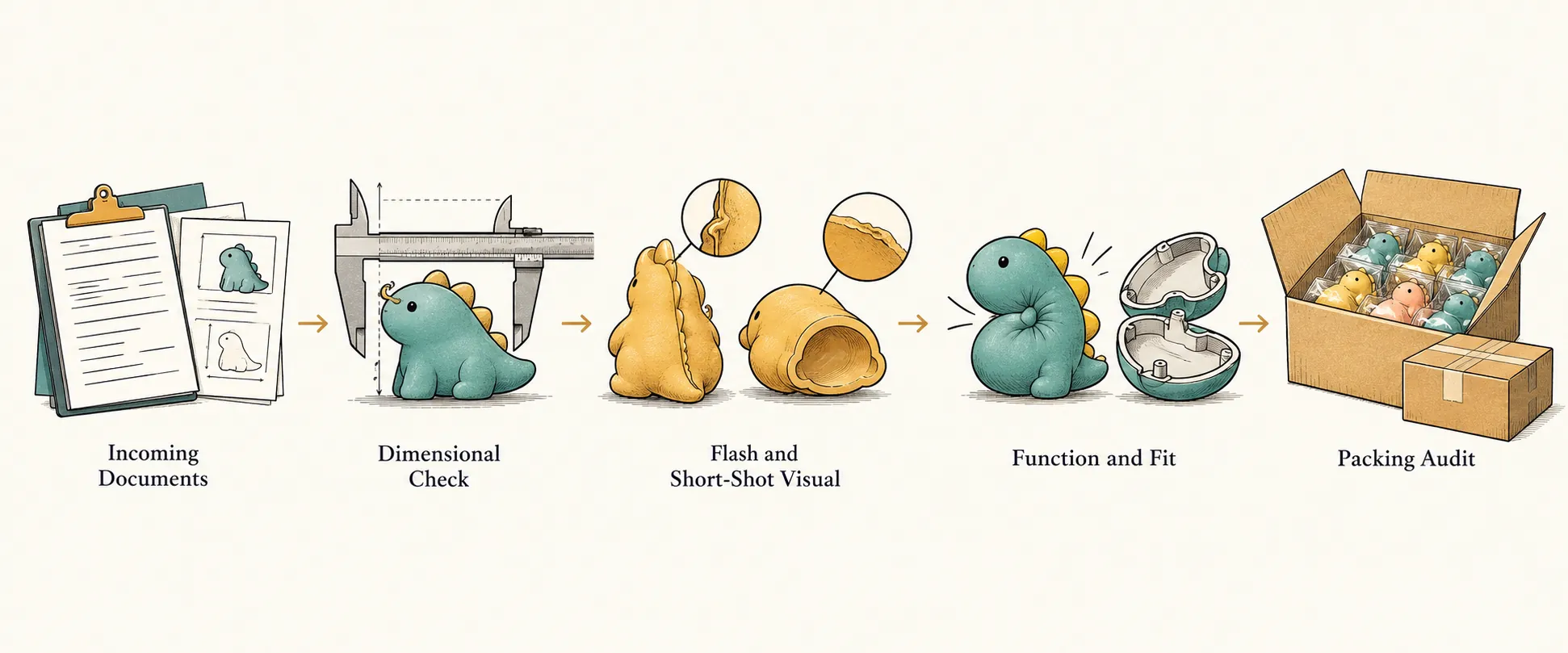
When should buyers reorder, resample or hold?
| REORDER — unchanged repeat | Use the existing approval when current verification supports the same construction, squeeze response, dimensions, finish and agreed pack-out. Resolve prior corrective actions and confirm the current order terms. Retain the bulk inspection gate. |
|---|---|
| RESAMPLE — changed product or assortment | Request a representative sample when the squeeze feel, construction, dimensions, finish or display format changes. For a revised mix, inspect each newly introduced variant and approve the revised assortment schedule. |
| HOLD — release-blocking discrepancy | Pause the affected approval or shipment when the product differs from the agreed specification, a correction remains unverified or an order-critical condition is unsettled. A correctable labeling error may need corrected artwork and a pack-out check rather than a complete product sample round. |
How should the first physical sample be approved?
Compare the first physical sample with the agreed written specification and design requirements before designating it as the approved production reference.
Define the intended squeeze action rather than accepting “soft” as the entire requirement. Record where the user presses, what deforms, how the toy recovers and whether that response suits the intended favor bag, prize assortment or retail display. Do not assume that every food-shaped squeeze toy has the same mechanism.
Use the following checks as a commercial inspection sequence. Record the actual observation beside each target; do not replace an observation with a general “looks good.”
| Function and squeeze feel | Compare the specified squeeze area, resistance, deformation and recovery with the physical sample. Look for sticking, incomplete recovery or inconsistent response between matching pieces. A mismatch requires correction or an explicitly approved specification revision before release. |
|---|---|
| Materials and construction | Compare the agreed component descriptions and construction details with the sample and supplier's written confirmation. Check accessible joints, closures and assembly consistency. Request clarification or correction when construction differs; hand feel cannot verify material composition. |
| Finish | Compare color placement, surface condition, decoration and visible seams with the approved design. Record smearing, residue, unintended roughness or an unexpected odor for investigation. These observations are commercial screening findings, not chemical-safety conclusions. |
| Dimensions | Measure the toy at the agreed reference points and compare it with the written dimensions and buyer-agreed tolerances. Record retail-package dimensions separately. An out-of-tolerance result calls for correction or a documented concession, not silent acceptance. |
| Packaging and assortment | Open the proposed display pack and compare the toy count, variant quantities, arrangement, artwork and labels with the agreed packing schedule. A display box alone does not establish a mixed assortment. Resolve substitutions or count differences before approval. |
What changes after the sample is approved?
After approval, identify and retain the accepted sample as a production reference, then compare bulk production with the specification, reference and approved change records together.
Label the retained reference with the product identity, specification revision, sample identifier, approval date and approver. Keep the inspection observations and any accepted deviations with it. Photographs help, but a missing photograph alone does not invalidate a review supported by identifiable samples, measurements and written approval.
At the bulk stage, select production pieces across the relevant variants and packing positions under the agreed inspection plan. Repeat the squeeze, finish, dimensional and pack-out checks. Record the lot inspected and the results against the same targets used for approval.
If production feels harder than the approved target, hold the affected release and request a construction/change review. Compare corrected production with the existing requirements. If the buyer deliberately accepts a different feel, approve the revised specification and replacement reference before proceeding. A fresh sample is useful only if it represents the construction that will actually be supplied.
A retained reference supports comparison and traceability; it cannot by itself reveal an undisclosed change. Commercial hand inspection also does not establish regulatory safety or determine an appropriate age.
How do the two catalog products affect the reorder decision?
| Squeezing Toy — CPS349707 | Recorded material: ABS. Packing: display box. Reference minimum order: 864 units. Units per carton: 432. Catalog reference price: US$0.47. |
|---|---|
| Baking Workshop Squeezable Fun — CPS344333 | Recorded material: ABS. Packing: display box. Reference minimum order: 192 units. Units per carton: 64. Catalog reference price: US$2.44. |
How should carton quantity and mix-pack fit influence the choice?
Use carton quantity to plan allocation, but approve squeeze feel and assortment independently of volume.
At the recorded minimum quantities, the Squeezing Toy represents two cartons of 432 units, while Baking Workshop Squeezable Fun represents three cartons of 64 units. Those are arithmetic equivalents, not evidence that every order must be placed in full-carton multiples.
For party favors or carnival prizes, write the required number of individual giveaway pieces and the intended variant allocation. For a value-channel display, specify the presentation and replenishment mix. Confirm what one quoted unit contains before converting a display-box or set price into cost per individual toy.
Calculate merchandise cost per piece from the current quoted merchandise total divided by the confirmed number of individual toys. Keep each product's calculation separate before assessing the combined assortment. A lower recorded price is not a reason to accept a different squeeze feel or an unwanted substitution.
The ABS entries may describe a component rather than the whole squeeze construction. Use the agreed component specification and representative sample to establish what is being approved.
What should the two-product approval worksheet contain?
| Squeezing Toy — CPS349707 | Prefill catalog references: ABS; display box; 864-unit reference minimum; 432 units/carton; US$0.47 reference price. Enter the channel role, proposed quantity, agreed variant allocation and current quote reference. Link the specification revision, sample identifier and production lot when applicable. Record target versus observation for squeeze action, construction, finish, dimensions and packaging. |
|---|---|
| Baking Workshop Squeezable Fun — CPS344333 | Prefill catalog references: ABS; display box; 192-unit reference minimum; 64 units/carton; US$2.44 reference price. Identify whether the repeat retains the approved product and display arrangement or introduces a change. Enter the same target-versus-observation checks, with its own specification revision, sample identifier and applicable production lot. |
| Decision and open conditions — complete separately for each product | Record REORDER, RESAMPLE or HOLD, followed by the reason. List each open condition, its responsible owner and the evidence needed for closure. Identify the responsible approver and actual decision date. Record any accepted deviation explicitly rather than changing the target after inspection without approval. |
| Follow-up closure — complete separately for each product | Record the correction or approved change, verification result, evidence reference, closure approver and closure date. State whether approval covers the product sample, packaging correction or bulk release. Keep destination-specific document review separate from the squeeze-feel decision. |
How does a discrepancy change the recorded decision?
A discrepancy changes the decision according to what must be corrected: the product, the packing or the release conditions.
Consider two hypothetical worksheet entries. For the Squeezing Toy, assume the current comparison matches the approved squeeze response, dimensions, finish and unchanged assortment. The recorded route is REORDER, with current commercial acceptance and the agreed bulk inspection gate retained as conditions. The approver records the actual comparison evidence and decision date.
For Baking Workshop Squeezable Fun, assume a proposed repeat sample recovers differently from the written squeeze-response target. Record RESAMPLE for product approval and HOLD for the affected order commitment. Assign the supplier contact to establish the reason for the difference and provide a corrected representative sample. Close the condition only after the buyer records an acceptable comparison—or deliberately approves a revised requirement and reference.
Do not restart the whole product approval merely because a display label needs correction. Identify the affected requirement, obtain the correction and verify that part of the pack-out. The useful question is not “Do we always need another sample?” It is “What evidence is needed to approve this specific repeat?”
Continue the sourcing review
Turn this guide into a quote-ready shortlist. Start with the squishy toys wholesale category, then compare two published SKUs before asking for current freight and document scope.
- Five-Color Steamer Baozi Squishy (SKU sqz350815)MOQ: 5 cartons / 720 pcs; packaging: Display Box.
- 8.5 cm Colorful Bead-Filled Baozi Squishy (SKU sqz350809)MOQ: 5 cartons / 720 pcs; packaging: Display Box.
For logo, color or retail-packaging work, review the custom squishy toys OEM and ODM program or send the selected items through the wholesale quote workspace.