
Custom Squishy Toys: How to Approve Accessory Scope
Record accessories per toy, pack, display, and carton with a reusable scope worksheet and approval steps for squishy and squeeze toy bulk orders.
Record accessory scope for custom squishy toys by model and sample revision, with separate quantities per toy, selling pack, display box, and shipping carton. For party favors, carnival prizes, and value-channel assortments, approve the squeeze experience and toy mix before adding presentation extras. A PU foam bun and a cube squeeze toy need separate scope records: each accessory must have a defined purpose, quantity, placement, and approval status before the order is released.
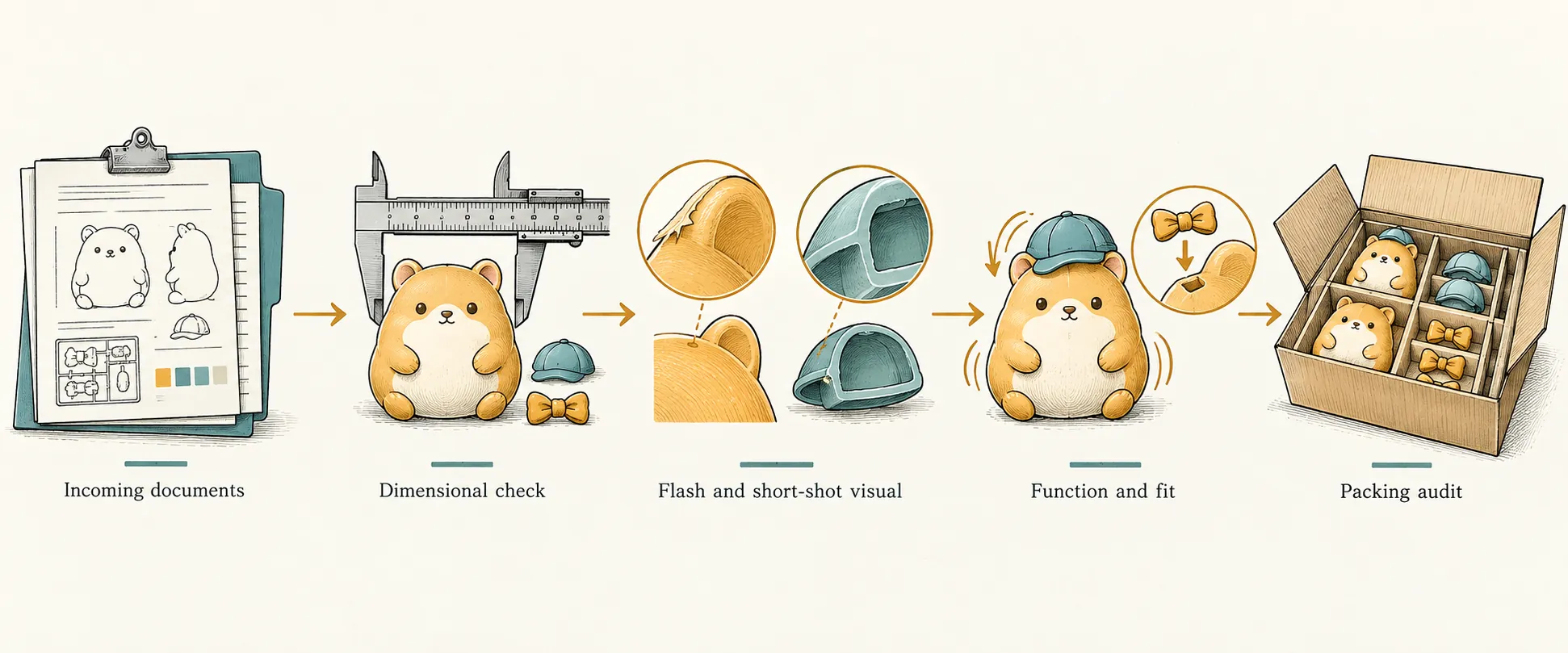
Why record accessory scope per toy model rather than per carton?
Use a separate scope record for each toy model because its squeeze feel, packing format, and accessory placement need their own approval.
Start with how the assortment will be used. If pieces will be handed out individually as prizes or party favors, specify what accompanies each toy after the display packaging is removed. If the box stays on a retail counter, record display-level accessories separately. An insert placed once in a display box is not an insert supplied with every toy.
Keep the core toy distinct from optional additions. Record squeeze resistance, recovery behavior, surface feel, and any filling or assembly details against the physical sample. A catalog material entry alone does not establish the complete construction or tactile response.
What starting specifications distinguish the bun and cube examples?
| Gradient Mini Bun Squishy Display Box | Model reference: CPS350803. Recorded material: PU foam. Packing: display box. Reference minimum order quantity: 864 toys. Recorded carton quantity: 288 toys. Scope focus: approve the foam squeeze feel and identify which additions belong to each toy versus the display. |
|---|---|
| Flour Cubes Squeeze Toy | Model reference: CPS349728. Recorded material: ABS. Packing: box. Reference minimum order quantity: 960 toys. Recorded carton quantity: 192 toys. Scope focus: confirm the complete construction and squeeze action on the sample, then identify accessories at toy and box level. The material entry does not establish the whole toy's construction or filling. |
What counts as an accessory rather than part of the toy mix?
An accessory is an additional item supplied with the toy or its presentation pack; it should not be counted as another toy in the assortment.
Separate three decisions: the toy mix, additional items, and packaging. For the mix, name the selected designs or color variants and their quantities. For each additional item, state whether it accompanies an individual toy or stays with the box. For packaging, identify the selling unit, display arrangement, and shipping carton.
For example, a proposed scope could request one branded insert per display box and no loose accessory per toy. That is a buyer-defined example, not a catalog inclusion. Record the number of toys in each display separately so the insert cannot be mistaken for an extra piece in the advertised toy count.
Avoid phrases such as “standard accessories included” or “assorted as usual.” Name every included item and expressly exclude discussed options that were not selected.
Which fields belong in a one-page accessory scope worksheet?
| Record identity | Enter the product name, model reference, scope revision, preparation date, buyer, and supplier contact. Identify the quotation and proposed order revision to which this scope applies. |
|---|---|
| Use and selling unit | Specify individual party favor, carnival prize, or retail selling pack. State whether the display remains at the counter or accompanies the purchase. |
| Core toy and squeeze feel | Target: identify the selected construction and reference sample for squeeze resistance, recovery, and surface feel. Observation: record the sample ID, review date, and any difference from the target. |
| Assortment recipe | Target: name each selected design or color variant and its quantity per selling pack or display. Observation: count the sample contents and record substitutions or quantity differences. |
| Accessory identity and function | For every proposed accessory, enter its name, purpose, specification, and photograph or drawing reference. Record each accessory separately rather than using a single description for all extras. |
| Quantity and placement | Target: state the quantity per toy, selling pack, display box, or shipping carton, and whether it is loose or attached. Observation: record the actual count and placement in the reviewed sample. |
| Appearance and fit | Target: identify the approved artwork revision, dimensions, color reference, attachment arrangement, and required fit. Observation: describe mismatches, obstruction of the toy, or interference with opening and display. |
| Inclusions and exclusions | List all supplied accessories and presentation items. Explicitly exclude unselected options, including props shown in reference photographs that are not part of the order. |
| Packing and carton basis | Record toys per selling pack, packs per display where applicable, and toys per shipping carton. Keep accessory counts separate. Confirm the customized configuration and minimum order quantity in the current quotation. |
| Cost boundary | Identify which accessories and packing operations are included in the quoted price and which are separate charges. Compare quoted pack cost per included toy; do not include inserts or display items in the toy denominator. |
| Destination, age marking, and review references | Specify the destination market and requested item-specific age marking. Have the responsible reviewer confirm the relevant labeling and supporting document references for the selected construction and accessories. |
| Approval decision | Record approve, revise and resubmit, or hold. Name the responsible approver and role, sign-off date, exact scope revision, sample ID, and any release conditions. |
| Condition closure and order release | Assign each action an owner and due date. Record the correction evidence, closure reviewer, closure date, and final release authorization. Link any revised sample, artwork, quotation, or scope revision. |
Who approves the scope, against what, and when?
The buyer's designated approver should authorize the exact scope revision against the identified sample, with specialist review assigned where the accessory affects labeling, construction, or safety.
Compare the assembled pack with the worksheet before release—not just the loose toy. Check that each selected variant is present, accessory quantities match their stated level, the display works as intended, and extras do not obstruct the squeeze action. These are commercial sample checks, not substitutes for safety testing.
Approve a matching pack; request a revised sample for a material difference in feel, fit, contents, or placement. Hold order release while required approval conditions remain unresolved. A safety concern can justify a hold on its own; it does not need to recur across several models.
Carry the approved scope revision into the order reference. If an accessory, attachment, assortment ratio, or packing arrangement changes, record the change and obtain the appropriate reapproval. The record supports traceability, but it cannot by itself reveal an undisclosed substitution.
Continue the sourcing review
Turn this guide into a quote-ready shortlist. Start with the squishy toys wholesale category, then compare two published SKUs before asking for current freight and document scope.
- Five-Color Steamer Baozi Squishy (SKU sqz350815)MOQ: 5 cartons / 720 pcs; packaging: Display Box.
- 8.5 cm Colorful Bead-Filled Baozi Squishy (SKU sqz350809)MOQ: 5 cartons / 720 pcs; packaging: Display Box.
For logo, color or retail-packaging work, review the custom squishy toys OEM and ODM program or send the selected items through the wholesale quote workspace.