
Squishy Dumpling Toy Packs: Which Fields Must You Request?
Request exact unit counts, mix ratios, inner packs and carton details for squishy dumpling toy bulk packs, with a reusable approval worksheet.
Approve a squishy dumpling toy bulk pack only after the supplier defines the sellable unit, confirms the squeeze sample and supplies an exact carton breakdown. For party favors and carnival prizes, request counts of individually distributable toys; for a countdown calendar, distinguish complete calendars from the toys inside them. Send a separate packing worksheet for each item, carry over the catalog references, and ask the supplier to complete the unit, assortment, inner-pack and shipping-carton fields before you release the purchase order.
A description such as “display box” or “color box” identifies a packaging format. It does not establish how many toys sit inside that package, whether colors are fixed, or how the retail packages are arranged inside the shipping carton.
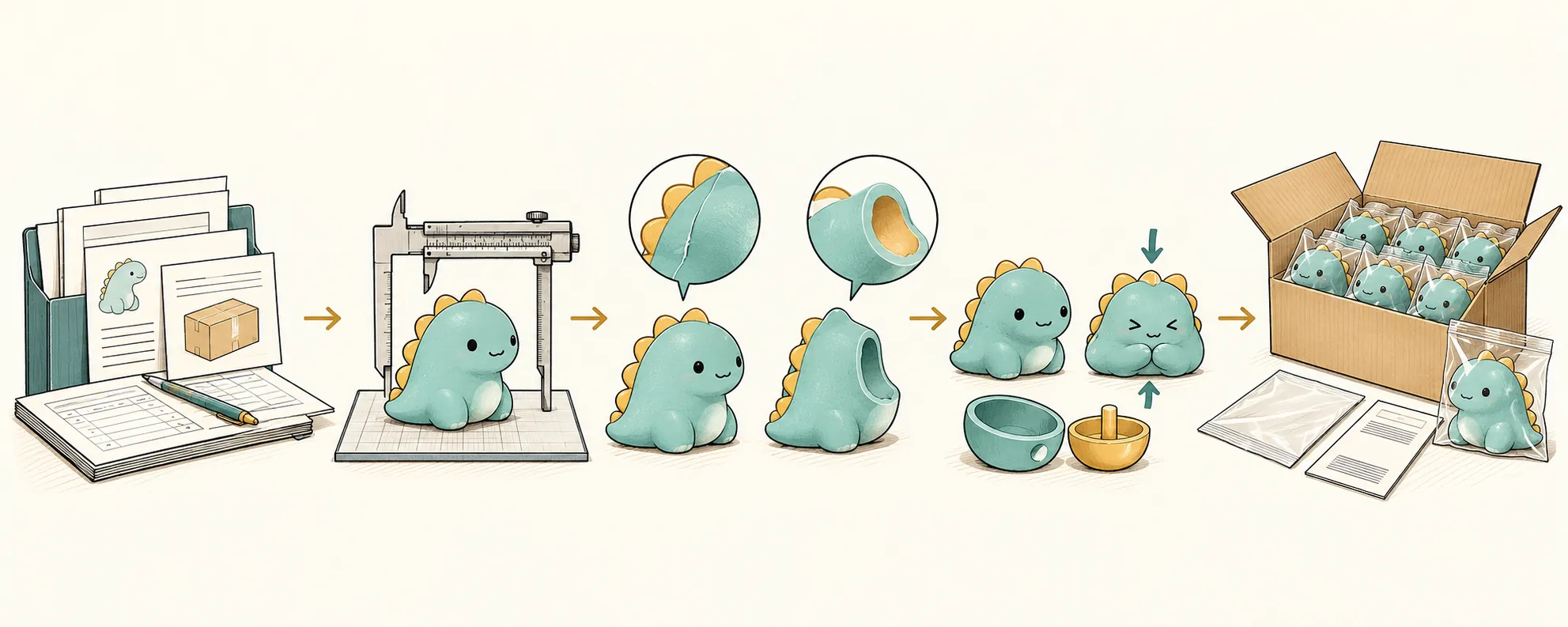
Which packing fields are recorded for these two formats?
| 6 cm maltose squishy cube | Supplier item identifier: CPS349391. Recorded material: ABS. Packing: display box. Reference MOQ: 960. Recorded units per carton: 96. Ask the supplier to identify the counted unit and show the number of toys per display box and display boxes per shipping carton. |
|---|---|
| Mystery Baozi 24-Day Fidget Squishy Countdown Calendar | Supplier item identifier: CPS350807. Recorded material: mixed sensory-toy materials. Packing: color box. Reference MOQ: 240. Recorded units per carton: 48. Ask whether each counted unit is a complete calendar, then request its contents list and the number of complete calendars per shipping carton. |
Which pack format fits individual giveaways rather than calendar sales?
Choose a format confirmed for individual distribution when the buying unit is one party favor or carnival prize; choose the countdown-calendar format when the intended selling unit is the complete calendar. Do not compare the two on “cost per piece” until the supplier states what a piece means in each quote.
For the display-box cube, request a packed sample showing how each toy is protected and whether it carries the information needed for your intended distribution. For the calendar, ask for a compartment-by-compartment contents list. The “24-day” name alone should not become your purchasing denominator.
Judge squeeze feel from an identified sample, not from the material field. The cube’s ABS entry does not establish the construction or feel of every component. Record feel, odor, recovery behavior, surface finish and small components alongside the individual packing and display quantity. These are practical comparison criteria recommended by the Global Toy Buyer Notes, not substitutes for safety testing.
How do you request and record the missing packing fields?
| Item identity and revision | Record supplier item identifier, buyer item identifier, product name, color or variant, destination and intended channel. Add quote reference/date, worksheet revision/date and sample reference. Request: “Please confirm that your packing response and photos apply to this exact configuration.” |
|---|---|
| Catalog reference versus current offer | Carry over the recorded material, package type, reference MOQ and units per carton. Request: “Please confirm or revise each entry and state whether the MOQ applies per item, color, assortment or packaging configuration.” Record the supplier’s dated response separately from the catalog reference. |
| Sellable unit and quantity chain | Requested selling or distribution unit: ____. Supplier-confirmed unit: ____. Request: “How many toys are in each individual pack, packs in each display or inner box, and displays or inner boxes in each shipping carton? State what the quote’s ‘piece’ and ‘unit’ mean.” For the calendar, request complete-calendar counts and a separate contents list. |
| Assortment and carton breakdown | Requested mix: ____. Supplier-proposed mix: ____. Request: “List the exact quantity of each item, color and variant in every carton type. Is the mix fixed or random? If random, what assortment limits can you commit to?” Record carton numbers or carton ranges against their contents. |
| MOQ, order increments and remainder handling | Requested order quantity: ____. Supplier-confirmed MOQ and any order increment: ____. Request: “Can you supply this quantity? If it leaves a partial carton, how will that carton be packed, counted and marked? Identify any restriction or additional charge before approval.” Do not treat a carton quantity as an order multiple unless the supplier explicitly confirms that restriction. |
| Individual protection and mixed-pack compatibility | Requested protection: ____. Sample observation: ____. Request: “Show the individual wrap or container, dividers and carton arrangement. If formats share a carton, show how display boxes, calendar boxes and toys are kept from crushing or rubbing one another.” Attach the proposed pack-out photo and identify the reviewed sample. |
| Shipping-carton measurements | Request: “Provide external carton dimensions with units, net and gross weight with units, carton count, and measurements for each different carton configuration, including partial cartons.” Record the supplier’s values and the measurement or photo reference used for review. |
| Package information and receiving marks | Request: “Send photos or artwork showing the item description, quantity, carton numbering and any barcode or receiving marks requested by our warehouse. Also provide the proposed item-specific age grading and warnings for review.” Record artwork revision and reviewer; do not transfer warnings from one item to the other. |
| Response ownership and closure | For each open field, record the supplier contact, buyer owner, response due date, response/evidence reference and status. Use: open, confirmed, or change requested. Closure entry: what was resolved, by whom, on what date, and in which revised document. |
| Approval and change control | Decision: approve, approve with stated conditions, or hold. Record conditions, responsible buyer approver/date and supplier acknowledgment/date. Request: “Do not substitute products, change assortment ratios or alter packaging without our written approval.” Link any later change to a revised worksheet and close the resulting follow-up actions. |
What makes a mixed-carton response precise enough to approve?
A usable mixed-carton response states exact quantities by item and variant, identifies each carton configuration, and explains how any remainder is packed. “Assorted colors, mixed carton” is not enough to reconcile a party assortment or allocate prizes across events.
Keep three arrangements separate: different products shipped together in separate cartons, multiple products packed inside one shipping carton, and a retail mix pack sold as one unit. Ask which arrangement the supplier is offering. Agreeing to combined shipment does not establish a mixed-carton contents list.
Request a numbered carton schedule and a pack-out photo for each configuration. For cartons containing both display boxes and calendar boxes, review their physical arrangement rather than accepting a total count alone. Exact item breakdowns and packaging compatibility are also recommended in Mixed-SKU packing guidance.
When is the packing plan complete enough to release the order?
Release the purchase order when the sellable unit, quantity chain, assortment, carton breakdown and remainder treatment are agreed, and the responsible buyer has signed the applicable packing revision. Review the squeeze sample and carton data together before selecting the format; the Global Toy Buyer Notes likewise recommends scoring only after samples and carton data are available.
Use conditional approval only for clearly named follow-up items with an owner, deadline and release condition. A detail that changes the ordered quantity, distribution unit or assortment should be resolved before PO release—not left to the warehouse to interpret. Keep commercial packing approval separate from the item’s safety and destination-market review.
Before dispatch, compare the final packing list with the approved PO and packing revision. Reconcile item quantities, colors, carton counts, packaging and any partial shipment. Obtain written buyer approval for substitutions or assortment changes and have the supplier acknowledge the revised instruction. This follows the pre-dispatch reconciliation approach described in Mixed-SKU packing guidance.
The worksheet provides a traceable agreement; it does not by itself reveal an undisclosed change. Use the agreed pack-out photos, shipment records and receiving checks to compare the actual shipment with that agreement.
Continue the sourcing review
Turn this guide into a quote-ready shortlist. Start with the squishy toys wholesale category, then compare two published SKUs before asking for current freight and document scope.
- Five-Color Steamer Baozi Squishy (SKU sqz350815)MOQ: 5 cartons / 720 pcs; packaging: Display Box.
- 8.5 cm Colorful Bead-Filled Baozi Squishy (SKU sqz350809)MOQ: 5 cartons / 720 pcs; packaging: Display Box.
For logo, color or retail-packaging work, review the custom squishy toys OEM and ODM program or send the selected items through the wholesale quote workspace.