
How to Approve Squishy Texture and Slow-Rise Feel
Approve squishy feel with a repeatable squeeze test, retained samples, pilot checks, and revision control before releasing OEM or ODM production.
Approve squishy texture and slow-rise feel against an identified physical sample and a written squeeze-test specification—not the words “soft” or “slow rising.” Define surface feel, compression resistance, recovery endpoint, acceptable timing range, and test conditions before evaluating pilot units. Release production only after the pilot meets those agreed criteria and the approval record identifies the construction, mold, decoration, and packaging revisions. Keep sample approval, tooling authorization, and production release as separate decisions so a promising prototype does not become an accidental production commitment.
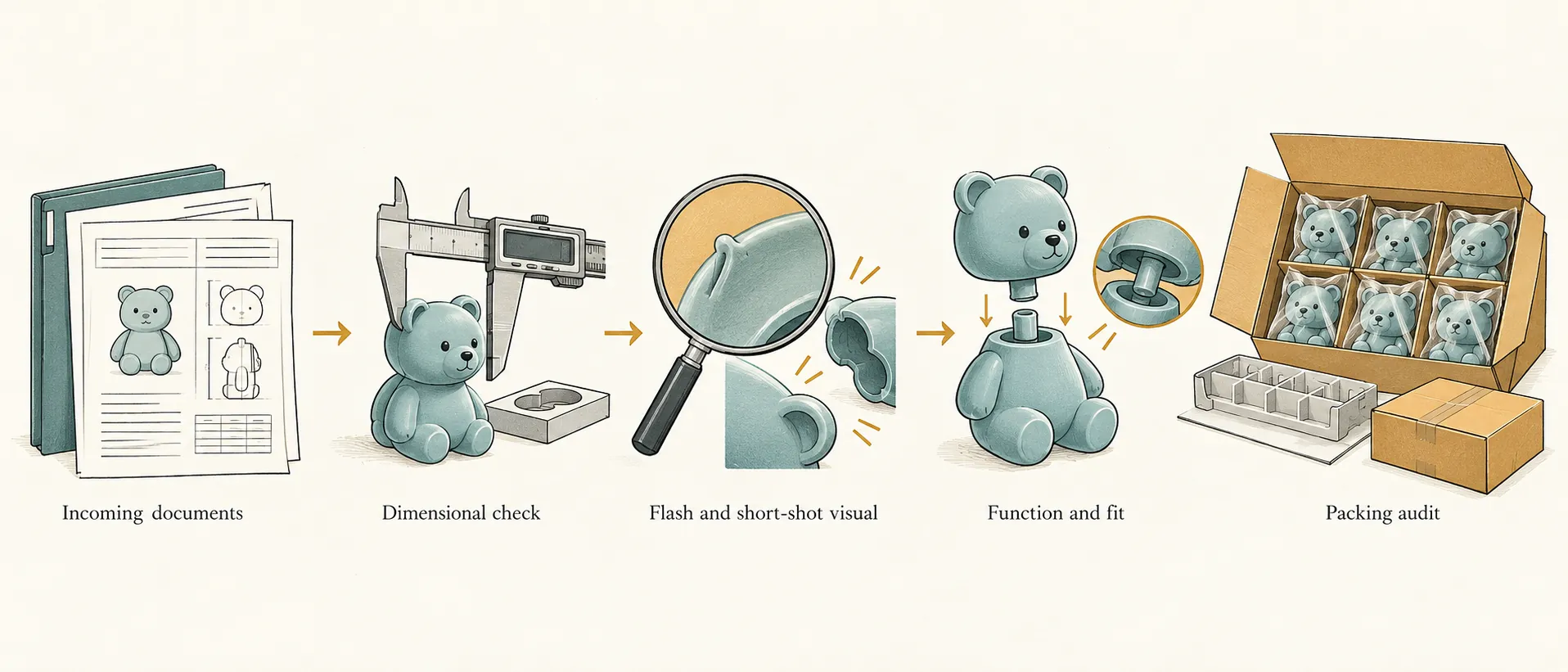
Why is “slow rising” not enough to approve a sample?
“Slow rising” does not tell the factory how deeply to compress the toy, when recovery ends, or what variation you will accept. Turn the description into a purchasing specification before signing off.
PU or memory foam is commonly associated with slow-rising squishies, but a material name is not a finished-product performance specification. Approve the actual construction and geometry rather than assuming every toy with the same material description will feel alike. What Are Slow Rising Squishies?
Separate three judgments: surface texture, squeeze resistance, and recovery behavior. A sample can recover at the right speed yet feel too tacky, too resistant, or rougher than the approved reference. Passing the stopwatch check should not override a failed texture requirement.
Which OEM or ODM route gives you the right approval control?
Choose buyer-defined OEM development when your design and texture specification must lead the project; choose a supplier-developed ODM design when an existing construction already meets your intended feel. These labels do not determine mold ownership or approval rights—the written agreement should.
For buyer-defined OEM work, provide the design requirements and acceptance criteria, then require the manufacturer to demonstrate that the proposed construction and tooling can reproduce them. Approve development samples before authorizing the next tooling or production stage.
For ODM adaptation, identify exactly what will change from the reference design: dimensions, surface finish, decoration, branding, or packaging. Require a finished sample of the adapted version; approval of the original design should not automatically cover the modified one.
Document the mold owner, tool identification, storage location, maintenance responsibility, permitted use, and any transfer rights. Paying a tooling charge is not a substitute for agreeing on those terms. Retain matching, revision-labeled approval samples with both buyer and supplier.
Where aluminum or steel tooling is proposed, evaluate the supplier’s tooling process, expected production life, maintenance needs, and cost tradeoffs. Do not select a mold metal as a shortcut to approving feel. Keep tooling, samples, production parts, decoration, testing, packaging, freight, and taxes separate in the quote so the approval stages remain visible.
What should a repeatable texture and squeeze test specify?
A useful test fixes the sample condition, compression procedure, recovery endpoint, and acceptance limits before anyone measures the pilot. The following is a proposed buyer screening method, not a compliance standard or a durability prediction; adjust it with the manufacturer before adoption.
1. Identify the test article. Record the product revision, material or construction reference, mold or cavity identifier where applicable, decoration revision, sample date, and pilot lot. Use finished decorated samples for final feel approval.
2. Control the starting condition. As an example, condition unpacked units for two hours at 23 ± 2°C and record the actual temperature. Keep the reference and pilot units together under the same conditions, without repeatedly warming one sample by hand.
3. Define the squeeze. Measure the uncompressed height at a named location and orientation. Using a repeatable setup that does not damage or restrain the toy, compress it to 50% of that height, hold for two seconds, and release completely. Define release as time zero.
4. Define recovery. For this example, stop timing when the measured height first returns to 90% of its starting height. Call this “time to 90% recovery,” not “full recovery.” A proposed acceptance window could be four to eight seconds, inclusive. These numbers are illustrative purchasing criteria, not an industry definition of slow rise.
5. Repeat without hiding variation. A bounded pilot screen could use five units taken from different points in the run, with three repetitions per unit. Allow a fixed 60-second reset between releases and the next compression; if a unit has not regained its starting height, record the residual deformation and stop testing that unit under this method. Retain each result rather than only the average.
6. Judge feel separately. Compare surface drag, tackiness, roughness, and squeeze resistance side by side with the retained reference. Describe each attribute individually. If hand assessment cannot resolve a disputed resistance difference, agree on a force-measurement method and limits before retesting rather than declaring either sample correct by preference.
How should you compare two samples with different feel?
Choose the sample that meets both the written recovery window and the approved tactile requirements; do not choose the slowest sample by default.
Using the illustrative four-to-eight-second window above, a candidate with acceptable recovery but excessive surface tack should remain on hold for texture correction. A second candidate that matches the surface reference but recovers outside the window should remain on hold for recovery correction. Neither earns approval by performing well on only one dimension.
If both candidates satisfy the timing limits but one feels noticeably firmer than the reference, resolve the resistance criterion before release. Accept the firmer feel only through a documented specification revision—not by quietly replacing the reference sample.
This comparison is decision logic, not a report of measured samples. On the actual pilot record, enter the agreed target beside the individual observations and identify which requirement caused each hold.
How do pilot runs and packaging affect production release?
Approve the pilot only after units made with the intended production construction and process meet the agreed feel criteria, including checks after representative packaging.
Select pilot units across the run rather than accepting only a presentation sample. Use cavity identifiers where relevant, compare units against the retained reference, and record individual results. The small screen described above supports an initial approval decision; it is not a statistical batch-acceptance plan or proof of long-term consistency. Agree separately on ongoing inspection sampling.
Pack pilot units using the intended retail package and export carton. Agree on a packed dwell period and an unpacking-to-test interval, then check for persistent deformation, surface marking, coating transfer, and changed recovery behavior. Record those intervals so a freshly unpacked pilot is not compared with a reference that has rested overnight.
Use a packaging drop check to assess protection and inspect for damage or newly exposed sharp or loose components. Review packaging hazards, including suffocation hazards, separately; a successful drop check cannot establish packaging safety by itself.
Any proposed material, coating, mold, process, or packaging substitution should go through written change review. Assess its possible effect on feel and protection, then repeat the affected checks before approving the new revision.
What should the texture approval record contain?
| Product and revision identity | Enter the product name, specification revision, construction reference, mold or cavity identifiers where applicable, pilot lot, and retained reference-sample IDs. |
|---|---|
| Specified target and tolerance | Record the required surface attributes, squeeze-resistance reference or measurement limits, recovery endpoint, timing range, and treatment of residual deformation. |
| Test conditions and method | Identify the method revision, conditioning period, actual temperature, compression location and depth, hold duration, reset interval, unit selection, and repetitions. |
| Observed pilot results | Enter each unit’s recovery measurements, separate tactile observations, deviations, photographs or video references, and the tester’s name and date. |
| Linked production and packaging revisions | Link the approved sample, mold, artwork, decoration, retail package, export carton, and applicable packaging-check records to the production release. |
| Decision and responsible approval | Select approve, hold, or reject for the stated scope. Record conditions or authorized concessions, the responsible buyer approver, supplier acknowledgment, and dates. Distinguish tooling authorization from production release. |
| Follow-up and closure | Assign each corrective action an owner and due date. Record the revised sample or retest evidence, closure decision, responsible closer, and closure date before removing a release hold. |
What should be true before production release?
- The written specification and retained sample should agree. If they conflict, resolve the conflict and issue a new revision before release.
- Pilot evidence should show individual recovery results and a separate tactile judgment under the agreed conditions. A good average should not conceal a unit that fails the agreed acceptance rule.
- The release should name the approved construction, tooling, decoration, and packaging revisions, with unresolved conditions clearly assigned.
- Your next action is to send the supplier a draft texture specification and approval record, agree on the test method, and request pilot evidence against that revision. Authorize production only through the named approver after any required corrections are closed.
What else should buyers resolve before approving feel?
Can a squeeze video replace a retained physical sample?
Use video to document the recovery procedure and timing, not as the sole reference for surface feel or squeeze resistance. Identify the sample in the recording and retain matching physical references with buyer and supplier.
Does texture approval also approve safety or durability?
No. Texture approval addresses the agreed sensory and recovery criteria. Keep applicable safety evaluation and durability requirements separate; a short squeeze screen does not establish either.
Continue the sourcing review
Turn this guide into a quote-ready shortlist. Start with the squishy toys wholesale category, then compare two published SKUs before asking for current freight and document scope.
- Five-Color Steamer Baozi Squishy (SKU sqz350815)MOQ: 5 cartons / 720 pcs; packaging: Display Box.
- 8.5 cm Colorful Bead-Filled Baozi Squishy (SKU sqz350809)MOQ: 5 cartons / 720 pcs; packaging: Display Box.
For logo, color or retail-packaging work, review the custom squishy toys OEM and ODM program or send the selected items through the wholesale quote workspace.