
How Online Sellers Should Source Wholesale Stress Balls
A practical framework for online sellers to source wholesale stress balls: range planning, RFQ, samples, evidence verification, inspection, shipping, and reorders.
Sourcing wholesale stress balls for your online store comes down to a simple rule: treat every order as a mini project with documented steps—range planning, RFQ, sample evaluation, evidence verification, production oversight, shipping, and reorder triggers. This workflow helps you make defensible decisions that protect your margin and brand reputation. You’ll learn what to ask suppliers, what to check at each stage, and how to avoid costly surprises that turn a cheap fidget toy into a liability.
Key Takeaways
- Define your target market first: corporate gifting, school/prize distribution, marketplace resale, or mixed-container import each changes your SKU mix, packaging, and evidence requirements.
- Always request physical samples before bulk commitment and evaluate them against written criteria—feel, rebound, odor, and print quality—not just subjective impression.
- Match every certificate or test report to a specific SKU, material, and production lot; a generic report does not automatically cover your shipment.
- Confirm your MOQ per SKU and whether you can mix SKUs to reach it; 300 pieces per SKU is a common starting point, but it varies by supplier and product.
- Build reorder triggers based on sales velocity, not guesswork—monitor sell-through and stockout patterns to time your next order.
Buyer Segments Compared
| Corporate gifting agencies | Priority: discreet branding, premium feel, display packaging. Sourcing: low-volume custom colors, material documentation per SKU. |
|---|---|
| School and prize distributors | Priority: child-friendly design, no aggressive parts, cheerful look. Sourcing: bulk standard SKUs, compliance evidence (e.g., EN71, ASTM). |
| Marketplace sellers (e.g., Mercado Libre) | Priority: fast-moving designs, quick reorders, low MOQ. Sourcing: mix of 6+ SKUs, blister packaging, FOB quotes, QC photos before shipment. |
| Mixed-container importers | Priority: filler products to complete container space. Sourcing: high-turnover generic unbranded items, CBM per SKU for load planning. |
Step 1: What SKU Mix Should You Order?
Map your product range to the end customer before sending a single inquiry. A corporate gift buyer wants something that doesn’t look like a gas-station giveaway; a school distributor needs sensory toys that are cheerful and safe for kids. A marketplace seller might chase viral designs with fast sell-through. Your range should reflect that context.
Decide whether you’ll order a single SKU in depth or mix several SKUs. Mixing spreads risk and lets you test new designs, but it can complicate QC and labeling. One marketplace seller started with a mix of six soft SKUs—fruits, animals, stress balls—in clear blister packaging, which gave her variety without overcommitting to any one item. The tradeoff: each SKU in the mix still has its own minimum, so confirm whether you can mix to reach the supplier’s overall MOQ.
Checkpoint: Does your range match the end-customer context? If you’re not sure, order samples of two or three styles and test them with real customers before you commit to bulk.
Step 2: What Should Your RFQ Include?
Your RFQ is the contract’s backbone. Include every SKU, quantity, and packaging specification. State your target price point and ask for a FOB quotation. If you’re an online seller, think about how each item will be displayed—blister cards for retail hooks, poly bags for subscription boxes, display boxes for counter displays.
Ask for lead time in writing. A typical production lead time is 25–35 days, but that can stretch if you’re customizing. Break down that period into production, QC, and packaging days so you know where the time goes.
Checkpoint: Does your RFQ include all SKUs, quantities, packaging specs, and the delivery date you need? A vague RFQ invites vague answers—and delays later.
Step 3: How Do You Evaluate Samples?
Never rely on product photos. Order physical samples before you commit to bulk. When they arrive, test them systematically: squeeze each one and note how it feels—soft but firm, slow rebound, or dense? Check for any chemical odor, which can be a red flag for low-grade materials. Squeeze repeatedly to see if it holds its shape; some gel-filled balls deform after a few hundred cycles, while polyurethane foam typically retains shape better after 5,000+ squeezes.
If you’re branding the balls, inspect the print quality. Does the logo crack or peel when you stretch the material? Is the color accurate? One corporate gifting agency found that generic stress balls felt cheap compared to clients’ expectations. Texture mattered as much as the logo.
Checkpoint: Write down your evaluation criteria before the samples arrive—score each sample on feel, rebound, odor, print, and overall quality. Compare notes with a colleague if you can.
Step 4: How Do You Verify Supplier Evidence?
Certifications are not all the same. A UKCA mark and a VOC test report on an electric bubble machine are different documents—you can’t use one to cover the other. For stress balls, relevant standards might include EN71 for Europe, ASTM F963 for the US, and CPSIA for children’s products. But a generic certificate doesn’t prove your specific lot is compliant.
Ask for material documentation per SKU. That means a report that lists the exact material, colors, and production date of your order. Match that report to your PO. If the report doesn’t reference your SKU and production batch, it’s not evidence for your shipment.
Checkpoint: Can the supplier map every document to a specific SKU, lot, and target market? If not, ask for clarification before you pay.
Step 5: What Customization and Packaging Specs Matter?
If you’re branding, get the details in writing: logo placement, color codes (Pantone, for example), and any label or sticker requirements. For corporate clients, discreet branding might mean a small embossed logo rather than a loud print. For kids’ products, you might need Spanish or other language stickers—confirm those before production.
Packaging is part of the product. A display box can make a stress ball feel premium; a poly bag signals bulk. Choose based on your sales channel and confirm the spec with a mockup or digital proof before the factory starts.
Checkpoint: Have you received a written confirmation of all customization and packaging specs, including a visual proof? Any deviation from this spec is a reason to stop production.
Step 6: How Do You Manage Production and Inspection?
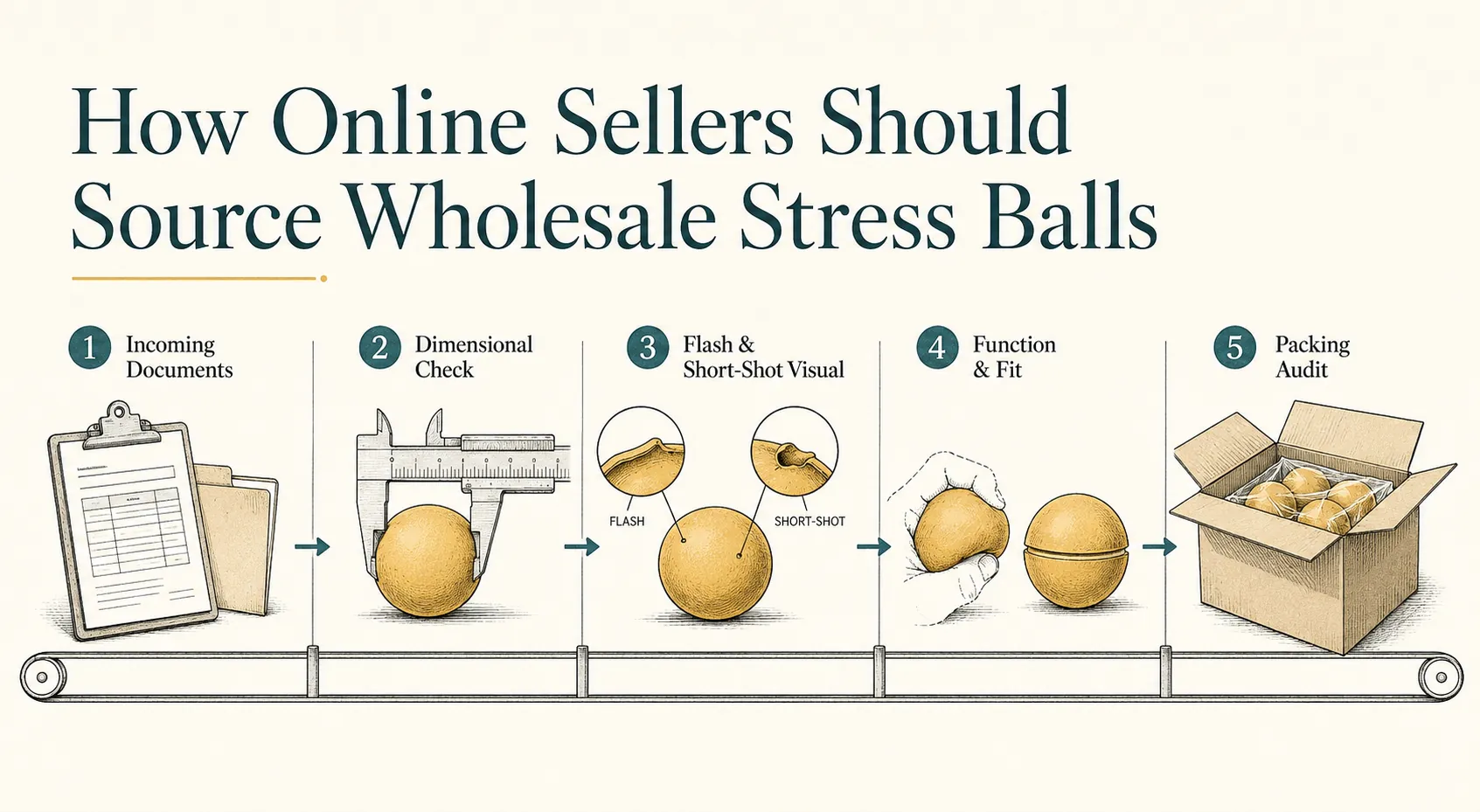
Ask for QC photos during production, especially before shipment. One buyer’s first order included QC photos that showed the correct colors and packaging—that small step caught a labeling error before it became a disaster. Line clearance is another control point: a factory should clear the line between SKU runs so that leftover labels or materials from the previous product don’t contaminate yours.
For higher-value orders, consider hiring a third-party inspection service. They can check quantity, packaging, and basic quality against your PO. But understand what an inspection does and doesn’t cover: a visual check won’t catch chemical composition. That’s what material documentation is for.
Checkpoint: Do the QC photos match your ordered SKUs, colors, and quantities? Is there a line-clearance procedure in place for each production run?
Step 7: How Do You Plan Shipping and Logistics?
Confirm the Incoterms—FOB is common for factory-direct orders. If you’re consolidating with other products, ask for the CBM (cubic meter) per SKU so you can plan your container load. A mixed-container importer might use stress balls as filler to complete a 20GP or 40HQ; knowing the exact volume helps avoid wasted space.
Ensure your export documentation is complete: commercial invoice, packing list, and any certificates your destination market requires. Double-check that the documents match the shipment—a mismatch can delay customs clearance.
Checkpoint: Do your shipping documents align with the inspection results and the PO? Is the Incoterm clear and agreed in writing?
Step 8: How Do You Set Reorder Triggers?
Track sell-through rates per SKU and set reorder points based on your sales velocity. One marketplace seller reorders every 6–8 weeks based on sell-through data, not guesswork. If a design goes viral on social media, you’ll need a faster reorder cycle—consider that when choosing a supplier.
Factor in lead time: if production takes 25–35 days, add that to your reorder trigger. A supplier that prioritizes repeat customers can be a real advantage when you need a quick turnaround.
Checkpoint: Have you defined a reorder trigger (e.g., when inventory drops below X units or when a SKU sells out in Y weeks)? Review your sales data monthly to adjust those triggers.
What to Ask Suppliers (RFQ Checklist)
Use this checklist when you talk to potential suppliers. It covers the critical unknowns that can make or break your order.
Ask: “Can we mix multiple SKUs to reach the minimum, or is the MOQ per SKU?” – This affects your range planning and inventory investment.
Ask: “What is the cost and timeline for physical samples before bulk order?” – Samples are non-negotiable; confirm they ship before you pay for bulk.
Ask: “Can you provide material documentation per SKU, and which specific tests does each document cover?” – You need evidence that matches your lot, not a generic brochure.
Ask: “Which certificates apply to which market and which production lot?” – A UKCA mark doesn’t cover VOC emissions, and a VOC report doesn’t cover toy safety.
Ask: “What QC checkpoints occur during production, and can we receive photos before shipment?” – Visual checks catch labeling and color errors early.
Ask: “How do you prevent cross-SKU contamination (labels, colors, materials) between production runs?” – Line clearance is boring until a mixed label reaches your customer.
Ask: “How much of the lead time is production vs. QC vs. packaging?” – So you know where the 25–35 days actually goes.
Ask: “Can you provide CBM per SKU to help plan mixed-container loads?” – Essential if you’re consolidating with other products.
Ask: “For repeat orders, do existing customers get production priority?” – When you need a fast reorder, this matters.
FAQ
What MOQ should I expect for wholesale stress balls?
MOQs vary by supplier and product. A common starting point is 300 pieces per SKU, but some factories require more for custom orders or specific materials. Always ask if you can mix SKUs to reach the minimum.
How do I get accurate FOB quotes?
Send a detailed RFQ with SKU quantities, packaging specs, and target price. Ask for a FOB quotation that includes production lead time and any customization costs. Compare quotes from multiple suppliers to gauge market rates.
Which certifications do I need for stress balls in my market?
It depends on your destination. For the US, ASTM F963 and CPSIA may apply; for Europe, EN71. Confirm with your supplier which tests cover your specific SKU and lot, and ask for material documentation per SKU. A generic certificate may not apply to your shipment.
How can I tell if a stress ball is good quality?
Evaluate samples on feel (soft but firm), rebound (should not stay squished), odor (should be minimal), and print durability. Polyurethane foam generally retains shape better than some gel-filled balls. Ask for cyclic compression test results if durability is critical.
What should I look for during pre-shipment inspection?
Check that colors, labels, and packaging match your PO. Ask for QC photos during production. Verify that line clearance procedures are in place to prevent cross-SKU contamination. For higher-value orders, consider a third-party inspection service.
How do I plan for reorders to avoid stockouts?
Track sell-through rates per SKU and set reorder triggers based on inventory levels and sales velocity. Factor in the supplier's lead time (e.g., 25–35 days for production). Some sellers reorder every 6–8 weeks; adjust based on your own data.
Sources
Related Products & Categories
Continue the sourcing review
Turn this guide into a quote-ready shortlist. Start with the stress balls wholesale category, then compare two published SKUs before asking for current freight and document scope.
- Five-Color Steamer Baozi Squishy (SKU sqz350815)MOQ: 5 cartons / 720 pcs; packaging: Display Box.
- 8.5 cm Colorful Bead-Filled Baozi Squishy (SKU sqz350809)MOQ: 5 cartons / 720 pcs; packaging: Display Box.
For logo, color or retail-packaging work, review the custom squishy toys OEM and ODM program or send the selected items through the wholesale quote workspace.