
Factory vs Trading Company for Squishy Toys: How to Choose
Compare factory vs trading company for squishy toys: pricing, MOQ, QC, compliance, and how to verify a real manufacturer before you order.
Key Takeaways
- A factory quote is usually lower because it skips one margin layer, but a trading company can be worth that margin when you are consolidating squishies with other products (e.g., packaging or outdoor goods) into one container.
- MOQ is rarely a single magic number: for squishy toys it is shaped by packaging units (12 pcs per display box, 6 boxes per carton = 72 pcs) and by whether you want a stock design or a fully custom mold.
- The most reliable proof of a real factory is not a catalog page but process evidence: a workshop video, a live call, WIP photos, and a written line-clearance or change-over procedure.
- Lead time is fiction without peak-season notes: verbal 'quick color change' promises in September have missed vessels, so demand a written freeze date and change-over hours.
- Compliance is a separate verification step: confirm the actual certificates (e.g., ASTM F963 and CPSIA for the US; CE and EN71 for the EU) against your target market rather than accepting a generic 'we have certs' claim.
What is the actual difference between a squishy toy factory and a trading company?
A squishy toy factory is the place where TPR or PU foam granules become a molded bun, dumpling, or fruit. It owns the injection or foaming lines, the color mixing, the label applicators, and the packers. When a problem shows up — the pink is wrong, the label is from the previous SKU, the slow-rise takes 14 seconds instead of 8 — the factory is where the fix happens.
A trading company is a supply-chain coordinator. It can find you a factory, negotiate a price, manage sampling, handle export paperwork, and sometimes bundle your squishies with totally different goods. A good trading company is a real service; a bad one is just an extra margin layer that hides which factory actually made your goods.
Neither is automatically better. For a detail-sensitive product like a squishy, where the face print, the stuffing texture, and the packaging all matter, direct factory access gives you more control over consistency on reorders. A trading company makes more sense when you are ordering small quantities across many categories, or when you genuinely do not have the time to manage multiple factories in Chenghai or Yiwu yourself.
Why is factory verification harder than it looks for squishy toys?
Every supplier can say they are a factory. The evidence is in the process. A real squishy factory has line-clearance procedures: when a new SKU starts, the line stops and the previous SKU's labels, colors, and work instructions are physically cleared from the hopper before anything else runs. It sounds boring — until a mixed label from a previous run reaches a retailer's shelf and a customer complains they got the wrong product.
A trading company cannot show you that level of control because it does not operate the line. So when you compare quotes, ask for proof that would be hard to fake: a 1–2 minute workshop walkthrough video, a live video call showing the production floor, WIP photos with timestamps, and an internal production order sheet. A transparent supplier will show you these without hesitation.
There is a second trap: capacity and lead time. Factory qualification should evaluate capability, material control, quality records, compliance evidence, and subcontracting — not just a catalog page. And toy lead time should be broken into tooling, first sample, testing, production, packaging, and shipping, because one total number can hide different dependencies. If a supplier quotes '25–35 days' without saying after what point that clock starts, you do not have a lead time yet.
Factory vs Trading Company for Squishy Toys at a Glance
| Pricing | Factory: typically lower, one less margin layer. Trading company: higher, but may include coordination and consolidation services. |
|---|---|
| MOQ | Factory: custom mold designs often start at 5,000–10,000 units; stock designs can ship smaller. Trading company: can sometimes split a factory MOQ across multiple buyers or categories. Always confirm whether MOQ is per SKU or per order. |
| Lead time | Factory: 25–35 days after sample approval is a typical production window (not including tooling or shipping). Trading company: similar, but depends on the factory they use; demand written confirmation of which factory. |
| QC control | Factory: direct control over line clearance, color mixing, and packing — you can audit the line. Trading company: relies on the factory's QC; you need to verify their inspection process. |
| Compliance evidence | Both: must provide certificates for your target market (ASTM F963/CPSIA for US; CE/EN71 for EU). Verify the actual certificate, not a claim. |
| Best for | Factory: detail-sensitive custom squishies, reorder consistency, larger volumes. Trading company: multi-category consolidation, small test orders, buyers without a sourcing team. |
How do MOQ and pricing really work for squishy toys?
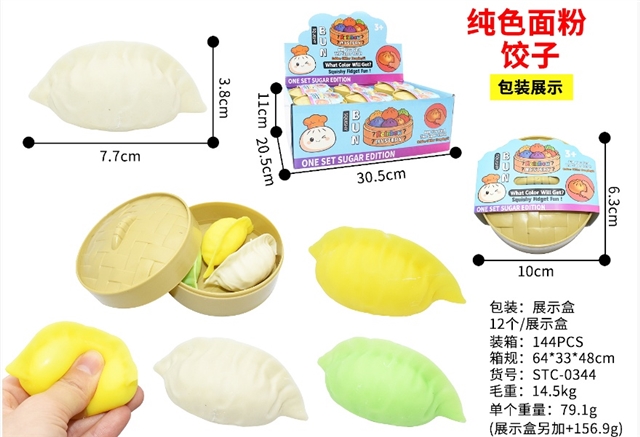
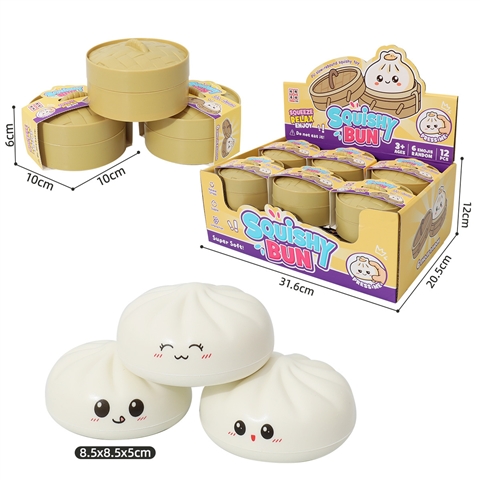
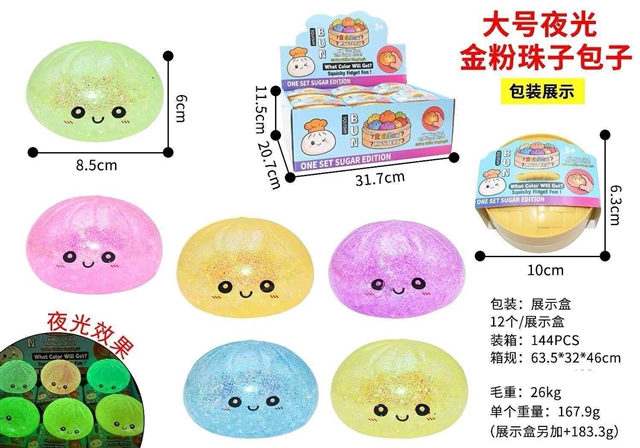
MOQ is not just a factory's preference — it is often dictated by packaging and freight. A common dumpling squishy display box holds 12 pieces, and a carton holds 6 boxes, so 72 pieces is one carton's worth. Shipping practicality creates its own MOQ: sea and express freight are not friendly to very tiny orders, so a trial wholesale order of 500–1,000 sets is more realistic for gathering meaningful sales data than a 100-piece test.
On price, keep the full chain in mind. Factory prices for common dumpling squishy styles are often in the $0.40–$0.60 range, while retail prices can reach $3.50–$8.69. That gap includes export costs, freight, distributor margins, and your own selling costs — not just the factory's profit. When a trading company's quote is higher, ask what the extra margin buys you: inspection, consolidation, or just a middleman?
Material choice also shifts cost and MOQ. PU foam gives a very slow rebound and is lighter, while TPR is bouncier, heavier, and better for transparent or glitter-filled designs. A TPR shell with flour-style filling is the classic slow-rise construction. Match the material to your retail story, not just to the lowest unit price.
Which QC and compliance checks should you run before ordering?
Compliance is not a checkbox — it is a separate verification step. For the US market, confirm ASTM F963 and CPSIA; for the EU, confirm CE and EN71. Do not accept a screenshot of a certificate without checking the manufacturer name, the product scope, and the expiry date. If your squishy has any electronic or radio component (e.g., a light-up feature), EU RED may add electromagnetic-compatibility requirements on top of the toy safety standard.
Incoming resin inspection is a factory-level control you can ask about: verify the supplier, grade, color, lot, packaging condition, and required material documents before molding. If a factory cannot tell you what resin grade went into your last production run, they are not tracking their own material control.
Retained samples matter more than most buyers realize. A real factory keeps samples identified by model and lot, so later comparison of color, construction, and packaging is possible when a failure investigation happens. Ask to see their retained-sample shelf on a video call — it is hard to fake.
Watch the packaging details too. EU packaging rules (PPWR) include waste-prevention measures, which is a separate review from CE marking. And a barcode needs a clear quiet zone around the symbol, or scanners will fail at the retail checkout. Gross weight includes packaging; net weight is the product alone — make sure the two are labelled consistently on your cartons.
What should you demand in writing before peak season?
Peak-season mold swaps eat lead time. A verbal 'quick color change' in September has missed more vessels than steel problems. The fix is a written freeze date, the change-over hours, and a clear statement of which job is on the press. Production lead time without those peak-season notes is fiction.
If you are ordering in the run-up to a holiday (think Christmas or Chinese New Year), put these three things in your purchase order: the date after which no design or color changes are accepted, the number of hours allocated to mold change-over, and the penalty or rebooking responsibility if a verbal change causes a missed vessel. A factory that refuses to write these down is telling you something.
How do you evaluate a factory in Chenghai or Shantou objectively?
Chenghai, a district of Shantou in Guangdong, is one of China's core toy production clusters. Its advantage is density: mold makers, resin suppliers, label printers, and packaging houses sit close together, which shortens development cycles. Yiwu, by contrast, is stronger for general merchandise consolidation and small mixed orders.
When you evaluate any factory in these clusters, work through a checklist rather than a gut feeling. First, ask for the business license and confirm the legal entity matches the factory name on your contract. Second, request a live video call to the production floor — not a pre-recorded tour. Third, ask technical questions about their process: how do they clear a line between SKUs, and how do they record mold change-overs? Fourth, ask for a sample of their retained-sample records. Fifth, request a quote breakdown that separates tooling, unit price, packaging, and testing fees, so you can see where the money goes.
FAQ: Factory vs Trading Company for Squishy Toys
How can I tell if a squishy toy supplier is a real factory and not a trading company?
Ask for a live video call to the production floor, a 1–2 minute workshop walkthrough, and WIP photos with timestamps. A real factory can show you the molding line and its line-clearance procedure; a trading company usually cannot. Also check the business license to confirm the legal entity matches the factory name.
What MOQ should I expect for custom squishy toys?
Custom mold designs from a factory often start at 5,000–10,000 units, while stock designs can ship in smaller quantities. MOQ is also shaped by packaging (e.g., 72 pcs per carton for a common display box) and freight practicality. A trial wholesale order of 500–1,000 sets is a realistic starting point for market testing.
Are factory prices always lower than trading company prices for squishy toys?
Usually yes, because there is one less margin layer. Factory prices for common dumpling squishy styles often land in the $0.40–$0.60 range. But a trading company can be worth the extra margin if they consolidate your squishies with other products or handle inspection and export paperwork you cannot manage yourself.
Which safety certifications do I need for squishy toys in the US and EU?
For the US, confirm ASTM F963 and CPSIA. For the EU, confirm CE and EN71. If your squishy has a radio or electronic component, EU RED may add EMC requirements. Verify the actual certificate document — manufacturer name, product scope, and validity — rather than accepting a verbal claim.
How long does a squishy toy order actually take from a factory?
A typical production window is 25–35 days after sample approval, excluding tooling and shipping. But lead time should be broken into tooling, first sample, testing, production, packaging, and shipping. During peak season, demand a written freeze date and change-over hours, because verbal change promises can miss vessels.
A trading company offered me a lower MOQ than the factory — is that a red flag?
Not necessarily. A trading company may split a factory's MOQ across multiple buyers or consolidate your order with another client's to reach the factory minimum. The risk is losing control over which factory actually makes your goods, so ask for written confirmation of the factory name and a spec sheet for every reorder.
Sources
Related Products & Categories
Get a Factory-Checked Quote for Your Squishy Order
Bring your product list and target market to a sourcing conversation and ask for the evidence this article describes: line-clearance procedures, written freeze dates, material documents, and retained-sample records. When you are ready to compare suppliers against that checklist, request a quote or a factory audit and see who can actually show you their production floor.
Continue the sourcing review
Turn this guide into a quote-ready shortlist. Start with the squishy toys wholesale category, then compare two published SKUs before asking for current freight and document scope.
- Five-Color Steamer Baozi Squishy (SKU sqz350815)MOQ: 5 cartons / 720 pcs; packaging: Display Box.
- 8.5 cm Colorful Bead-Filled Baozi Squishy (SKU sqz350809)MOQ: 5 cartons / 720 pcs; packaging: Display Box.
For logo, color or retail-packaging work, review the custom squishy toys OEM and ODM program or send the selected items through the wholesale quote workspace.