
Squishy Dumpling Toy: How to Check Bulk-Pack Photos
Compare two bulk-pack options, match source photos to samples, verify squeeze feel, and set a bounded shelf trial before committing to volume.
Prioritize the PU-foam mini bun for a squishy dumpling toy sample, but approve neither bulk pack from source photos alone. For party favors, carnival prizes, and value-channel displays, the buying decision starts with the squeeze-and-recovery action, the actual piece supplied, and the assortment packed—not simply a food-shaped photograph. Match each photo set to its catalog identity, then compare a physical sample with that record before accepting the feel, display format, or cost-per-piece basis.
Which bulk-pack option should advance to sampling?
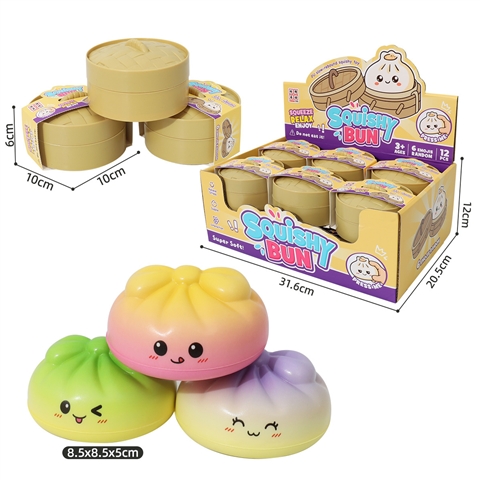
| Gradient Mini Bun Squishy with Steamer Display Box | Catalog identifier: CPS350804. Recorded material: PU foam. Packing: display box. Reference MOQ: 864 pieces. Units per carton: 288. Recorded size: 10 × 10 × 6 cm. Decision: request a physical sample and current quote; confirm which component the recorded dimensions describe and whether the steamer shown is included with each saleable unit. |
|---|---|
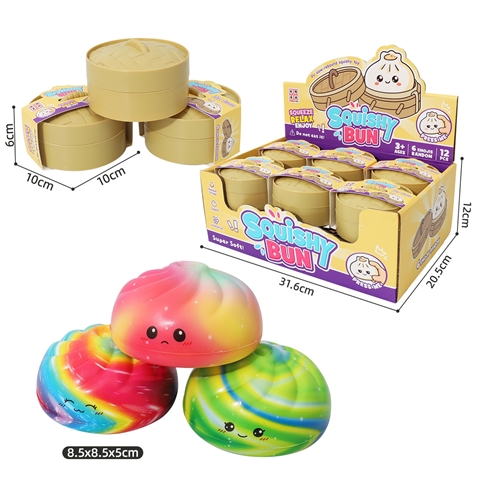
| Baking Workshop Squeezable Fun | Catalog identifier: CPS344333. Recorded material: ABS. Packing: display box. Reference MOQ: 192 pieces. Units per carton: 64. Decision: request photos and a demonstration identifying the squeezable component and its action, followed by a physical sample if the mechanism fits the program. Hold bulk approval until that distinction is resolved. |
What must source photos establish about the toy and assortment?
Source photos should establish which physical item, packaging, and assortment the quotation covers; they cannot establish squeeze resistance or recovery feel.
Request one connected photo set: the item beside its identifier, front and back views, the opened steamer or container where applicable, the complete saleable unit, the populated display box, and the carton label. Add a ruler view that distinguishes toy dimensions from container and packaging dimensions. A collection of attractive close-ups is not an assortment record.
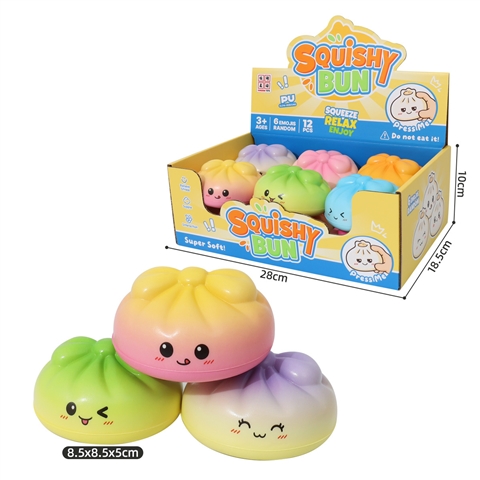
For a mix pack, request a layout showing every included design and a written count by design. Identify whether the pictured selection is fixed or illustrative, whether substitutions are permitted, and whether buyers choose variants or receive an assortment. Display-box packing alone does not establish a mixed assortment, a blind-pack format, or the number of pieces in each display.
Use the photos to separate three things that can look deceptively similar: the squeezable piece, a reusable container, and display decoration. Do not count a pictured steamer as an included accessory until the quoted saleable unit explicitly includes it.
Source-photo and sample approval worksheet
| Record identity and revision | Record the product identifier from the comparison above, worksheet revision, source-photo filenames and dates, quote revision, physical sample ID, and intended market and channel. Link any replacement images to the revision they supersede. |
|---|---|
| Gradient Mini Bun: specified target | PU foam; display-box packing; 288 units per carton; reference MOQ 864 pieces; catalog size 10 × 10 × 6 cm. Request separate measurements for the toy, steamer, and complete packed unit. |
| Baking Workshop: specified target | ABS recorded as material; display-box packing; 64 units per carton; reference MOQ 192 pieces. Identify the component covered by the material declaration and request dimensioned views of the toy and packed unit. |
| Photo identity: target versus observation | Target: the same item and revision across the identifier image, product views, packaging, and quote. Enter match or mismatch for each view, describe the visible difference, and link the relevant image. Resolve differences rather than accepting a similar food shape. |
| Assortment and packing: target versus observation | Target: an agreed list of included designs and quantities, plus a defined saleable unit. Record the observed contents of the sample display, pieces per display, displays per carton, included accessories, and any proposed substitutions. |
| Physical squeeze feel: target versus observation | Define the intended action before testing: resistance, compression, recovery, and handling comfort. Record what the sample actually does, including recovery time if measured and any visible splitting, leakage, or detached parts. Treat this as commercial screening, not safety certification. |
| Initial disposition | Gradient Mini Bun: proceed to sample request and quote, not purchase approval. Baking Workshop: request mechanism clarification and a demonstration; advance to physical sampling only if the action fits the program. Neither item is bulk-approved by this worksheet. |
| Approval responsibility and closure | The responsible buyer records the decision, conditions, name, and date. Assign each corrective action an owner and due date; close it with the revised image, replacement sample, or supporting document reference. The approver dates the closure before releasing the next purchasing stage. |
Which current US signal deserves attention during identity checks?
A September 3, 2026 US recall makes internal construction a specific identity check for bun-shaped squishies, not a reason to treat all such toys as the same product.
The CPSC notice identifies Rainbow Mystery Squishy Bun Toys, Model D08004, sold at various third-party stores nationwide from May through August 2026. It states that water beads inside the dumplings expanded beyond the permitted size, creating an ingestion hazard. This is a named-product safety event, not a measure of category demand or sell-through. CPSC squishy bun recall
For each proposed item, request a construction description identifying any filling and whether water beads are present. Match that description to the sample and item-specific supporting documents. The recall does not establish the construction or safety status of either catalog option compared here, and its US scope should not be rewritten as an EU recall.
Keep each item's own age grading and warnings attached to its approval record. Do not transfer an age label from a visually similar dumpling toy. A safety failure in one evaluated item is enough to stop that item's approval while it is investigated; there is no reason to wait for the same failure in another design.
What shelf trial should follow sample approval?
Run a small, separately tracked local trial after sample and destination-market review, and use its sell-through—not the source photograph—as the replenishment signal.
For a value-channel store, test the approved items beside each other in a defined checkout display, with equal visibility and recorded prices. Keep the placement and prices unchanged during the observation period. Record units offered, net units sold, units withdrawn, and any replenishment; do not silently combine sales with giveaways or carnival prize issues.
The example below is hypothetical and uses a proposed 14-day observation period. Its 24-piece allocations describe shelf exposure, not supplier order terms. Arrange trial stock through an agreed pilot quantity or an approved wider program; do not assume that a small shelf test overrides a reference MOQ.
| Hypothetical Gradient Mini Bun trial | Placement: one participating store's checkout display. Period: 14 days. Units offered: 24. Net units sold: 18. No replenishment or withdrawals. Sell-through: 18 ÷ 24 × 100 = 75%. |
|---|---|
| Hypothetical Baking Workshop trial | Placement: the same checkout display, with equal visibility. Period: the same 14 days. Units offered: 24. Net units sold: 9. No replenishment or withdrawals. Sell-through: 9 ÷ 24 × 100 = 37.5%. |
| Proposed reorder rule | Set a buyer-defined threshold before launch—for example, at least 70% sell-through over 14 days, acceptable margin at the actual selling price, and no unresolved safety or quality concern. In this hypothetical result, the Mini Bun meets the sales threshold; Baking Workshop does not. Reorder only after checking the other conditions. |
| Scope of the result | The result describes the participating store, placement, prices, and observation period. Repeat across the intended locations before committing to broader depth. For party giveaways or carnival prizes, track units issued and handling feedback separately; those are not retail sales. |
What must be settled before a bulk purchase order?
Release a bulk purchase order only when the approved item identity, physical feel, assortment, and current commercial terms refer to the same product revision.
Request a current quote that defines the saleable piece, included accessories, display contents, carton quantity, MOQ, and any explicit order-multiple restriction. The recorded carton quantity is a packing fact, not automatically a mandatory ordering multiple. For cost-per-piece comparison, divide the quoted goods total by the actual number of saleable toys—not by the number of containers or displays.
Obtain item-specific age and warning information and have the responsible reviewer assess the documents for the intended US, EU, or other destination. Match report coverage to the actual construction and applicable rules rather than relying on a generic certificate image.
The practical decision remains narrow: prioritize the foam mini bun for sampling, clarify the Baking Workshop action before treating it as a substitute, and commit to volume only after the physical sample and bounded channel trial support that commitment.
Sources
Continue the sourcing review
Turn this guide into a quote-ready shortlist. Start with the squishy toys wholesale category, then compare two published SKUs before asking for current freight and document scope.
- Five-Color Steamer Baozi Squishy (SKU sqz350815)MOQ: 5 cartons / 720 pcs; packaging: Display Box.
- 8.5 cm Colorful Bead-Filled Baozi Squishy (SKU sqz350809)MOQ: 5 cartons / 720 pcs; packaging: Display Box.
For logo, color or retail-packaging work, review the custom squishy toys OEM and ODM program or send the selected items through the wholesale quote workspace.