
Custom Squishy Toy Packaging: What Buyers Should Approve
Define custom squishy toy packaging requirements, compare samples, check evidence, and set inspection and reorder terms before approving production.
Approve custom packaging for squishy toys only against a written, SKU-specific specification, a signed physical sample, and evidence matched to the toy and destination market. Fix the pack structure, dimensions, artwork revision, language, warning layout, barcode data, and shipping configuration before production. Choose the format that protects the approved toy and fits the selling channel; release the order only after responsibilities, acceptance criteria, change controls, and delivery terms are agreed.
A good-looking artwork proof is not a finished-package approval. Buyers also need to know whether the packed toy retains its intended feel, whether the barcode scans, and whether the retail unit arrives in saleable condition.
Which requirements should control packaging approval?
- Control packaging approval through one specification and revision record for each toy, pack format, and destination-market version.
- Keep three categories separate: the buyer’s specified target, the observed sample or inspection result, and the supplier’s quoted commercial terms. A quoted production window is not an inspection result or a guaranteed delivery date.
- Approve the toy inside its final packaging, not the empty package alone. Retain an identified reference, document deviations, and close approval conditions before the affected production step.
- Use a bounded shelf trial to choose between commercially acceptable formats. Packaging performance in one store and period is a local decision signal, not proof of wider demand.
Which fields belong in a custom squishy packaging RFQ?
Send every supplier the same per-SKU brief so quotations cover the same toy, packaging construction, market versions, and approval work.
1. Range and product identity: list the model reference, images, dimensions, construction, fill where applicable, intended age grade, colors, and quantity by variant. Separate packaging-only customization from changes to the toy itself.
2. Sales channel and markets: identify the destination countries, retail or online channel, shelf or peg placement, and whether a separate shipping pack is needed. Define language versions, warning layout, barcode data, and retailer label requirements for each version.
3. Packaging specification: state the proposed structure, packaging materials, internal and external dimensions, inserts or restraints, closure, print coverage, finish, and artwork revision. Request a drawing showing the toy’s position and available clearance.
4. Customization scope: specify logo placement, artwork preparation, sample rounds, and any tooling or print setup. If the quotation uses OEM terminology, define exactly what the supplier will manufacture to your design or technical requirements; address ownership and reuse rights separately in the contract.
5. Evidence and approval: request product identification, relevant test reports, the proposed scope of market-specific review, physical samples, and the production-release sequence. State who approves the toy, packaging, artwork, and evidence.
6. Commercial terms: request separate toy and custom-packaging minimums, any print-run minimum, setup charges, unit price, sample costs, payment terms, and quote validity. Ask whether minimums apply per design, artwork, language version, or combined order.
7. Case packing and delivery: request units per inner and master carton, outer-carton dimensions, gross weight, shipping marks, delivery basis, and the event that starts the production clock. A carton quantity describes packing; do not treat it as an order multiple unless that restriction is expressly quoted.
How should buyers approve samples, color, and feel?
Approve a production-representative toy in the intended packaging, using a signed physical reference and agreed measurement conditions rather than photographs alone.
Assess the packed sample as it will be received: open it, check for deformation, surface marks, residue, print transfer, leakage where relevant, and interference from inserts or closures. Compare the unpacked toy with the approved reference for squeeze resistance, recovery behavior, surface tack, and overall handling. Use identical conditioning and handling steps for the comparison.
For color, name the master reference, lighting conditions, measurement method, and acceptance tolerance. Agree whether instrumental measurement or controlled visual comparison governs each surface. Screen images can help communicate a change, but should not settle a disputed color match.
Treat feel checks and package-opening trials as commercial acceptance checks, not safety testing. If you propose a squeeze-cycle count or a dimensional tolerance, identify it as a buyer acceptance criterion and agree it before inspection.
Retain signed samples identified by model, packaging revision, and sample or production lot. Agree who holds each reference, how it is stored, and how long it is retained. Retention supports later comparison and investigation; it does not by itself detect an undisclosed substitution.
What should the packaging approval record contain?
Use a revision-controlled approval record that puts the specified target beside the actual observation and assigns responsibility for every unresolved condition.
Identity and revision: record the model, variant, destination market, intended age grade, toy construction reference, packaging drawing revision, artwork revision, sample ID, supplier, and relevant lot.
Target versus observation: provide separate entries for specified and measured dimensions, print and color assessment, barcode scan result, closure and fit, toy appearance and feel after unpacking, and case-pack configuration. Reference the measurement method or inspection instruction.
Decision and authority: record approved, conditionally approved, or rejected; identify the approver and date; and state exactly which production activities may proceed. A conditional artwork approval should not silently authorize an unresolved packaging fit.
Follow-up closure: assign an owner and due date to each deviation, record the correction and replacement-sample reference, and obtain dated closure from the responsible approver. Record subsequent changes to materials, artwork, dimensions, packing arrangements, or subcontracted work before accepting the revised configuration.
Which evidence should support the toy and its packaging?
Review evidence against the actual toy configuration and destination market, while keeping commercial packaging approval separate from the applicable safety and labeling assessment.
Compare report descriptions and photographs with the ordered model, including construction, components, fill, coating, and intended age grade. Ask the responsible laboratory or compliance reviewer to resolve material differences and determine whether existing evidence covers the final configuration. Do not assume that every internal SKU needs a separate report, or that one report covers every squishy toy.
For US testing arrangements, CPSC explains that laboratory acceptance is specific to particular safety rules; one laboratory may not cover every required test. Check the relevant laboratory scope rather than relying on its name alone. CPSC third-party testing
Have the responsible reviewer establish the applicable warning text, language, age grading, and other labeling for each destination. Preserve SKU-specific instructions. Do not copy an age warning from a visually similar toy or use one market’s review as approval for all markets.
Apply the same material specifications, sample references, inspection instructions, change controls, and traceability expectations to outsourced printing, packing, or other production steps. Define who communicates changes and who authorizes them.
What should inspection and shipping checks cover?
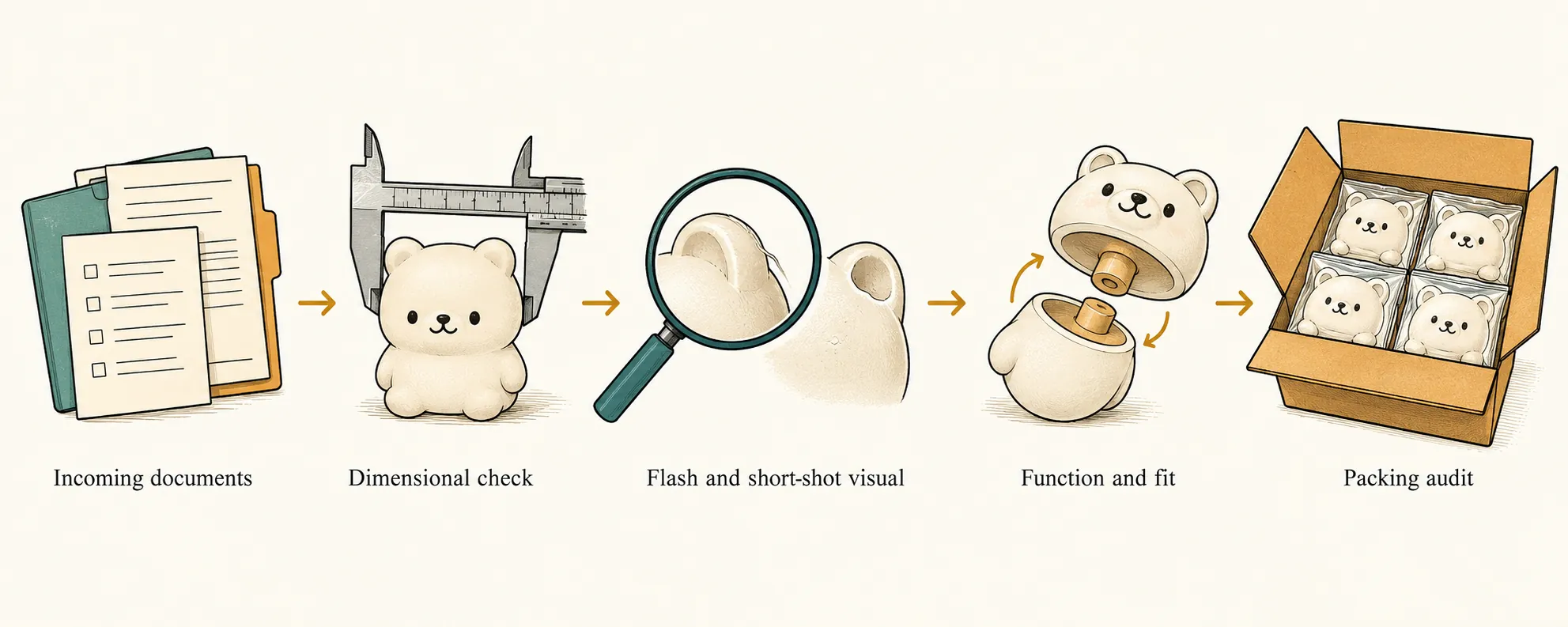
Inspect finished, packed goods against the approved revision and reference sample, then assess the shipping configuration separately.
At product level, check appearance, decoration, seams or closure points where present, fill consistency where applicable, and the agreed tactile characteristics. At package level, verify fit, seals, print, language version, warning placement, barcode readability, counts, and identification.
Write defect classifications, sampling arrangements, acceptance limits, and escalation rules into the purchase agreement. Suspected safety failures require an immediate hold on affected goods and investigation; do not wait for the same failure to appear across several models.
For shipping, record actual packed dimensions, carton construction, gross weight, internal arrangement, and intended handling and stacking conditions. Agree transport and compression checks appropriate to the route and distribution channel. Repeat the relevant assessment after a packaging substitution that could change fit or protection.
Compare freight quotations using the final carton dimensions and weights. A smaller retail pack is not automatically the lower-cost delivered option: case packing, protection, handling, and the carrier’s charging method also affect the comparison.
How can a small shelf trial guide the packaging decision?
Test packaging with the same toy, price, and defined placement before committing the full range to a new format.
For a hypothetical 28-day trial in one US specialty toy store, offer 60 units in package A and 60 in package B on the same sensory-toy fixture. Keep the retail price and promotional treatment equal, rotate shelf positions on a documented schedule, and record availability so stock gaps are not mistaken for weak demand.
Suppose package A sells 42 units and package B sells 30, with no replenishment during the trial. Sell-through is units sold divided by units offered: A reaches 42 ÷ 60 = 70%, while B reaches 30 ÷ 60 = 50%. Record damaged packs, customer returns, and any units removed from sale separately.
If the buyer had set a hypothetical 60% sell-through threshold before launch, A would qualify for reorder consideration and B would not. Reorder A only if its delivered margin and product and packaging checks also pass; revise or retest B rather than expanding it unchanged.
This is a decision example, not an observed sales result. An actual trial supports a choice for that store, placement, price, and observation period—not a national growth claim or proof that packaging alone caused the difference.
When should buyers reorder approved packaging?
Set reorder timing from total replenishment time and usable inventory, not from the date the shelf becomes empty.
Include artwork or sample reapproval where needed, packaging procurement, toy production, inspection, transport, and receiving. Confirm which activities overlap and when each supplier-quoted clock starts. Keep quoted production time distinct from door-to-door replenishment time.
A practical planning formula is reorder point = average daily unit sales × total replenishment days + buyer-selected safety stock. Review that point against inventory position: usable stock plus confirmed inbound units minus committed demand. For a short shelf trial, treat the observed sales rate as provisional rather than a stable forecast.
Before each repeat order, confirm the approved toy and packaging revisions, quantity by market version, retained reference, current commercial terms, and any proposed substitutions. Repeat business is not permission to change the specification.
What other questions matter before packaging approval?
Can several squishy designs share one custom package?
Use a shared package when each design passes fit, identification, presentation, and market-specific labeling review. Check every design in the package; approval of the largest toy does not establish that smaller toys are adequately restrained or correctly identified.
Is a digital artwork proof enough to approve production?
Use a digital proof to approve content and layout, then approve a physical, production-representative pack for fit, print appearance, closure, barcode scanning, and interaction with the toy. Record any difference between the sample process and intended production.
Does changing only the packaging always require new toy testing?
Assess the actual change rather than applying an automatic rule. Ask the responsible reviewer whether the change affects access, instructions, warnings, intended use, or existing evidence coverage, and document the resulting decision.
What should buyers send with the next RFQ?
Issue the RFQ with a per-SKU packaging specification, destination-market list, quantities by artwork version, sample-approval terms, and an evidence request.
Attach the approval-record format and require suppliers to identify exceptions before quoting. Compare offers on that common scope, then authorize production only after the required approvals and conditions are closed.
Continue the sourcing review
Turn this guide into a quote-ready shortlist. Start with the squishy toys wholesale category, then compare two published SKUs before asking for current freight and document scope.
- Five-Color Steamer Baozi Squishy (SKU sqz350815)MOQ: 5 cartons / 720 pcs; packaging: Display Box.
- 8.5 cm Colorful Bead-Filled Baozi Squishy (SKU sqz350809)MOQ: 5 cartons / 720 pcs; packaging: Display Box.
For logo, color or retail-packaging work, review the custom squishy toys OEM and ODM program or send the selected items through the wholesale quote workspace.