
Custom Fidget Toys in Volume: Colorways, Display-Box Counts and Master-Carton Replenishment
Plan custom fidget toys by the carton: 12 vs 24-unit display boxes, color ratios, safety-stock math for a 25-35 day lead time, and CPSC checks per colorway.
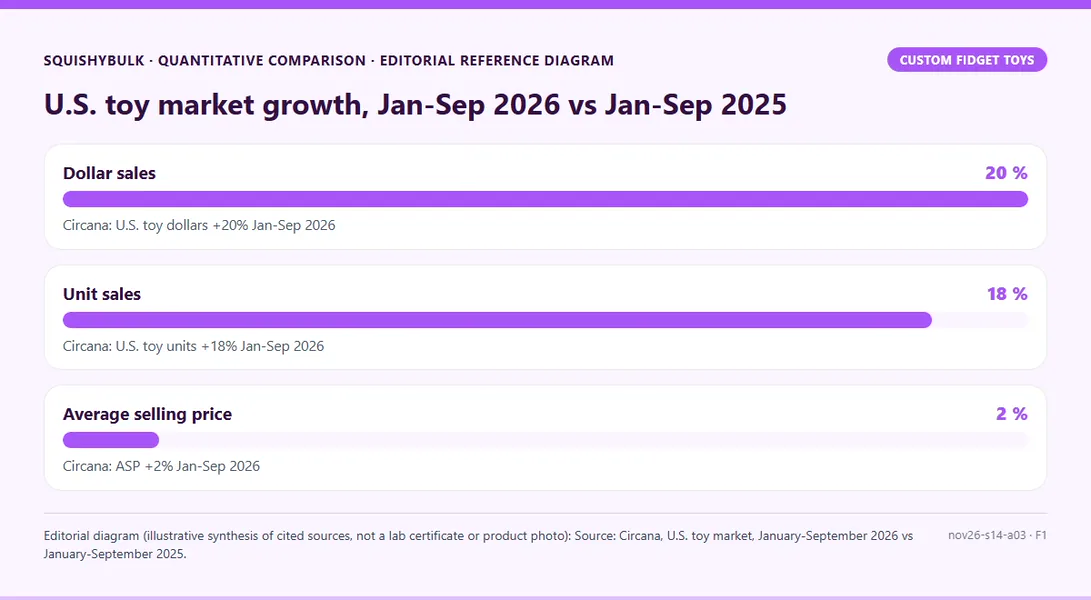
A dollar-store buyer staring at a 4-foot counter run has to decide one thing before signing a purchase order for custom fidget toys: does the shelf take a 12-unit inner display box or a 24-unit one? That single choice sets the counter footprint, the colorway count per facing, the pieces per master carton, and the safety-stock trigger for the next reorder. November 12, 2026 release makes the volume case concrete: U.S. toy dollar sales grew +20% from January through September 2026 versus the same period last year, unit sales rose +18%, and average selling price moved only +2% (). Unit growth nearly matching dollar growth means reorder demand is real in pieces, not just price inflation.
The squeeze segment sits inside a broader adult-driven shift. s that consumers aged 12 and older accounted for the majority of U.S. toy industry growth through September 2026, with collectible toy sales up 56% and licensed toys up 27%. The Toy Association's 2026 trend briefing names 'Cozy Culture' — low-tech and no-tech play experiences that engage the senses through tactile materials — and notes kidults account for roughly one-quarter of U.S. toy sales (). For a volume buyer, that breadth of demand justifies planning carton-level replenishment instead of one-off buys.
This article walks the three numbers that decide the box format: counter facings per display, color ratio inside a mixed inner box, and master-carton safety stock across a 25-35 day lead time. Every arithmetic step is labeled as an illustrative planning example, not a lab test or a price quote.
Why volume fidget reorders are worth planning in cartons right now
The U.S. toy market closed 2025 at $30.3 billion in retail sales, up +6% versus 2024, data published by The Toy Association (). Within that base, Games/Puzzles reached $4.9 billion (+37%), Building Sets $4.3 billion (+15%), and Outdoor & Sports Toys $4.0 billion (-6%). The categories losing ground are the bulky, seasonal ones; the tactile and collectible formats are where unit velocity sits. A fidget and squeeze assortment belongs on the fast side of that split.
The 2026 holiday study adds a value-seeking constraint. found expected holiday spending averaging $779 versus $796 last year, with 74% of consumers planning money-saving behaviors such as buying more promotional items and seeking deals (). Shoppers who compare price per piece reward a compact display that shows more colorways in the same counter inches. A 24-unit box that stacks one or two colors deep wastes the facing.
The Toy Association briefing also reports that 81% of parents in 2025 were likely to add a toy or game for themselves to their holiday shopping list, up from 72% the year prior. Adult self-purchase widens the colorway range a buyer can carry without stranding slow colors — but only if the inner box is built to break open cleanly into single-color facings. That is a packaging decision, not a merchandising afterthought.
SquishyBulk's published profile lists a 300-piece minimum order quantity, a 25-35 day lead time, 20,000 pcs monthly capacity, 12 production lines, and 30+ export countries, with no certifications listed (SquishyBulk). Those are the planning inputs for every calculation below; treat them as the supplier's own published claims and confirm order-specific details on the PO. The sourcing base behind those numbers is Chenghai, where the toy sector reports about 68,100 toy production and trading entities, roughly 200,000 direct workers, and 2025 full-chain toy output value above RMB 50 billion (Shantou Federation of Industry and Commerce).
Counter footprint: what a 12-unit vs 24-unit display box actually claims
A 12-unit inner display box presents 12 pieces across its front row; a 24-unit box presents 24. On a dollar-store counter with a 24-inch run, a 6-inch-wide 12-unit box fits 4 facings, while a 9-inch-wide 24-unit box fits 2 full facings with 6 inches left over. The 12-unit format therefore delivers 48 pieces visible across the run versus 48 for the 24-unit format — same piece count, but the 12-unit layout splits into 4 color blocks instead of 2. More color blocks per counter inch is the merchandising win when 74% of shoppers are hunting deals and comparing options.
Shelf depth matters as much as width. A 12-unit box at 6 inches deep leaves 12 inches of an 18-inch shelf for a second SKU; a 24-unit box at 9 inches deep leaves 9 inches. Party stores that stock 6 to 8 fidget SKUs on one shelf lose a full SKU position to the deeper box. The 24-unit format earns its space only when the store runs a single hero colorway or a licensed theme that sells through in one block.
There is a capital angle too. At the same cost per piece, a 12-unit box ties up half the inventory dollars per facing that a 24-unit box does. A buyer testing a new colorway on 4 facings commits 48 pieces with the 12-unit box versus 96 pieces with the 24-unit box — a 2x difference in test exposure. For a first PO on an unproven color, the 12-unit format is the lower-risk shelf test.
12-unit vs 24-unit inner display box: carton math side by side
The table below uses 4 inner boxes per master carton as a planning input to confirm on the PO; the safety-stock column applies the 80-piece lead-time spread from the worked example later in this article.
Every row assumes a 240-piece monthly sell-through and a 25-35 day lead time, both drawn from the illustrative planning example.
| Format | Counter footprint | Units per inner box | MOQ rounding at 300 pcs | Pieces per master carton | Safety-stock master cartons for 80-pc spread | Inner boxes per master carton (planning input) |
|---|---|---|---|---|---|---|
| 12-unit inner box | Compact, 4 facings per 24-inch run | 12 | 7 cartons = 336 pcs | 48 | 2 (96 pcs) | 4 |
| 24-unit inner box | Bulky, 2 facings per 24-inch run | 24 | 4 cartons = 384 pcs | 96 | 1 (96 pcs) | 4 |
| 12-unit, 4-color mix | 4/4/2/2 ladder, 4 color blocks | 12 | 7 cartons = 336 pcs | 48 | 2 (96 pcs) | 4 |
| 24-unit, 6-color mix | 6/6/4/4/2/2 ladder, 6 color blocks | 24 | 4 cartons = 384 pcs | 96 | 1 (96 pcs) | 4 |
SKU color ratios inside a mixed inner box
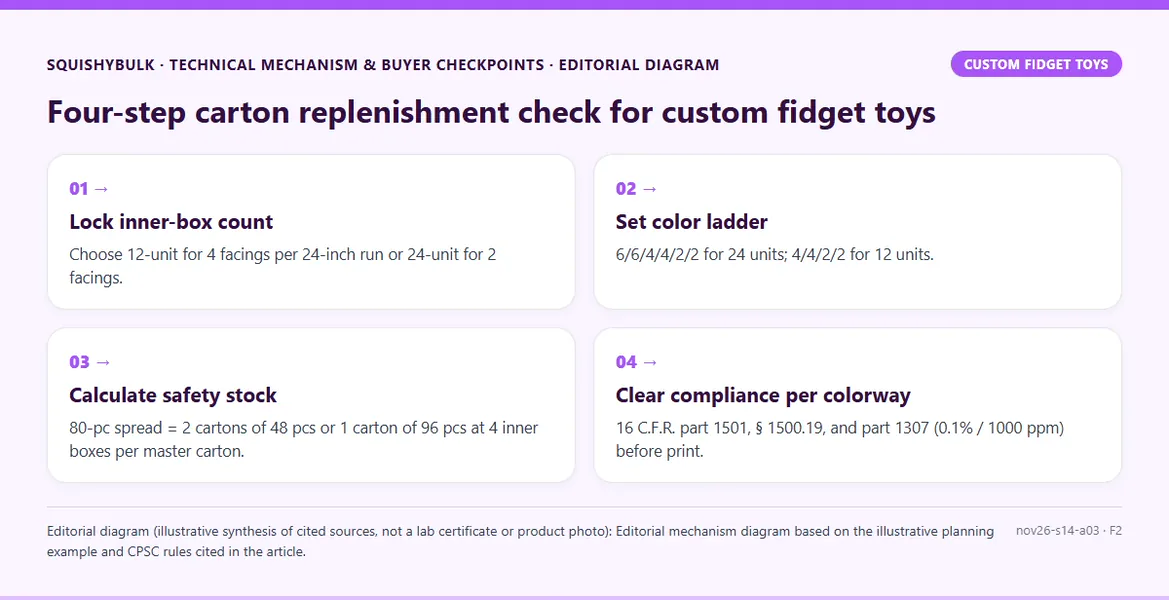
A 24-unit box split across 6 colorways gives 4 pieces per color; the same 6 colors in a 12-unit box gives 2 pieces per color. The 24-unit box holds one more sell-through cycle per color before a restock, but it also strands 4 pieces of a slow color if the display breaks open at retail. The fix is a ratio ladder, not an even split: anchor colors take 6 pieces, mid colors 4, and test colors 2, summing to 24.
For a 24-unit box, a 6/6/4/4/2/2 ladder covers 6 colorways in 24 pieces. For a 12-unit box, a 4/4/2/2 ladder covers 4 colorways in 12 pieces. The anchor colors — usually the two highest-velocity solids — absorb the inventory risk, while the 2-piece test slots let a buyer read a new color at 2 facings instead of 4. The Toy Association's kidult data supports a wider ladder: with adults buying for themselves at 81% in 2025, a novelty color can sell to a self-purchaser even when it underperforms with gift shoppers.
The ratio ladder must be locked before the display box is printed. A printed header that names 6 colors cannot ship with 4; the header artwork, the inner tray dividers, and the master-carton label all reference the same color list. Changing the ladder after print means a new header plate and a new approval cycle inside the 25-35 day lead time. Confirm the ladder in writing on the PO and on the pre-production sample.
Master-carton reorder math with transparent assumptions
Illustrative planning example. A buyer sells 240 pieces per month and faces a 25-35 day lead time. Daily rate = 240 / 30 = 8 pcs/day. Lead-time demand at 25 days = 8 x 25 = 200 pcs; at 35 days = 8 x 35 = 280 pcs. The 10-day lead-time spread equals 280 - 200 = 80 pcs of safety stock. This is arithmetic on stated inputs, not a demand forecast.
Now convert 80 pieces into master cartons, assuming 4 inner boxes per master carton. Option A (12-unit box): 12 x 4 = 48 pcs per master carton; ceil(80 / 48) = 2 master cartons = 96 pcs of safety stock. Option B (24-unit box): 24 x 4 = 96 pcs per master carton; ceil(80 / 96) = 1 master carton = 96 pcs. The 24-unit box halves the carton count needed to cover the same 80-piece spread.
The MOQ check reverses part of that advantage. At a 300-piece MOQ, Option A needs 300 / 48 = 6.25 master cartons, rounded to 7 cartons = 336 pcs. Option B needs 300 / 96 = 3.125 master cartons, rounded to 4 cartons = 384 pcs. The 24-unit box forces 48 more pieces of MOQ rounding (384 vs 336) — a 14% larger opening commitment — while saving one carton of safety stock.
The reorder trigger follows from the same numbers. With 2 master cartons of 48 pcs on hand (96 pcs) and 8 pcs/day sell-through, the trigger point is 96 / 8 = 12 days of cover. Place the reorder when on-hand stock hits 96 pcs, which is 12 days before the 35-day worst-case lead time would bite. For Option B, 1 master carton of 96 pcs gives the same 12-day cover, so the trigger is identical in days but half the carton count to count and receive.
Compliance gates per colorway before display-box approval
U.S. federal rules apply per product and per accessible component, not per purchase order. The small parts ban at 16 C.F.R. part 1501 covers children's products intended for use by children under 3 that present a choking, aspiration, or ingestion hazard because of small parts; a small part is any object that fits entirely into the small parts cylinder at 16 C.F.R. § 1501.4 (CPSC — Small Parts). Choking-hazard warning labeling sits at 16 C.F.R. § 1500.19, and advertising for children's toys subject to that labeling must use the same warning per 16 C.F.R. § 1500.20.
Phthalates are the colorway-sensitive gate. 16 C.F.R. part 1307 prohibits children's toys and child care articles containing more than 0.1% (1000 ppm) of eight listed phthalates in an accessible plasticized component, and a Children's Product Certificate cites '16 C.F.R. part 1307 – Phthalates' in section 2 (CPSC — Phthalates). A new colorway is a new plasticized component; it can change the test scope and the approval timeline before a display box is released. Confirm the component list, the CPC citation, and the choking-warning artwork per colorway before print.
Should I choose a 12-unit or 24-unit inner display box for custom fidget toys?
Choose the 12-unit box for tight dollar-store or party-store counters and lower capital per facing; choose the 24-unit box when carton-count simplicity and fewer master cartons outweigh counter space. At 240 pcs/month sell-through, the 12-unit box needs 2 master cartons of 48 pcs for an 80-piece lead-time spread, while the 24-unit box needs 1 master carton of 96 pcs.
How many master cartons should I hold as safety stock with a 25-35 day lead time?
Hold 2 master cartons of 48 pcs (12-unit box) or 1 master carton of 96 pcs (24-unit box) at 240 pcs/month sell-through, assuming 4 inner boxes per master carton. The 10-day lead-time spread equals 80 pieces, which rounds up to 96 pcs in either format.
What must be confirmed per colorway before a display box ships to the U.S.?
Confirm the small-parts ban at 16 C.F.R. part 1501, choking-hazard warning labeling at 16 C.F.R. § 1500.19, and phthalate limits of 0.1% (1000 ppm) at 16 C.F.R. part 1307 for each accessible plasticized component. A new colorway is a new plasticized component, so the CPC citation and warning artwork must be re-checked before print.
Put the next fidget PO on a carton plan
Build the next custom fidget toys order around three locked numbers: inner-box count (12 or 24), color-ratio ladder (6/6/4/4/2/2 for 24 units, 4/4/2/2 for 12 units), and safety-stock cartons (2 of 48 pcs or 1 of 96 pcs at 240 pcs/month). SquishyBulk's published 300-piece MOQ and 25-35 day lead time set the rounding and the trigger point. Send the color ladder, the display-box artwork, and the CPC citation list together so the pre-production sample clears compliance before the print plate is cut.
Sources
www.cpsc.gov — Small Parts Ban and Choking Hazard Labeling | CPSC.gov
www.cpsc.gov — Phthalates Business Guidance | CPSC.gov
stgsl.shantou.gov.cn — 融媒观察 | 澄海把玩具的门开给世_图片新闻_汕头市工商业联合会(总商会)
Continue the sourcing review
Turn this guide into a quote-ready shortlist. Start with the squishy toys wholesale category, then compare two published SKUs before asking for current freight and document scope.
- Five-Color Steamer Baozi Squishy (SKU sqz350815)MOQ: 5 cartons / 720 pcs; packaging: Display Box.
- 8.5 cm Colorful Bead-Filled Baozi Squishy (SKU sqz350809)MOQ: 5 cartons / 720 pcs; packaging: Display Box.
For logo, color or retail-packaging work, review the custom squishy toys OEM and ODM program or send the selected items through the wholesale quote workspace.