
Bulk Sensory Toys for 2027 Classrooms and Prize Counters: Separating Quiet Focus From Visual Novelty
Plan 2027 bulk sensory toys by handling, not looks: decibel-free sample checks, cleanability specs, CPSC small-parts and phthalate documents, and a 60/40 carton mix.
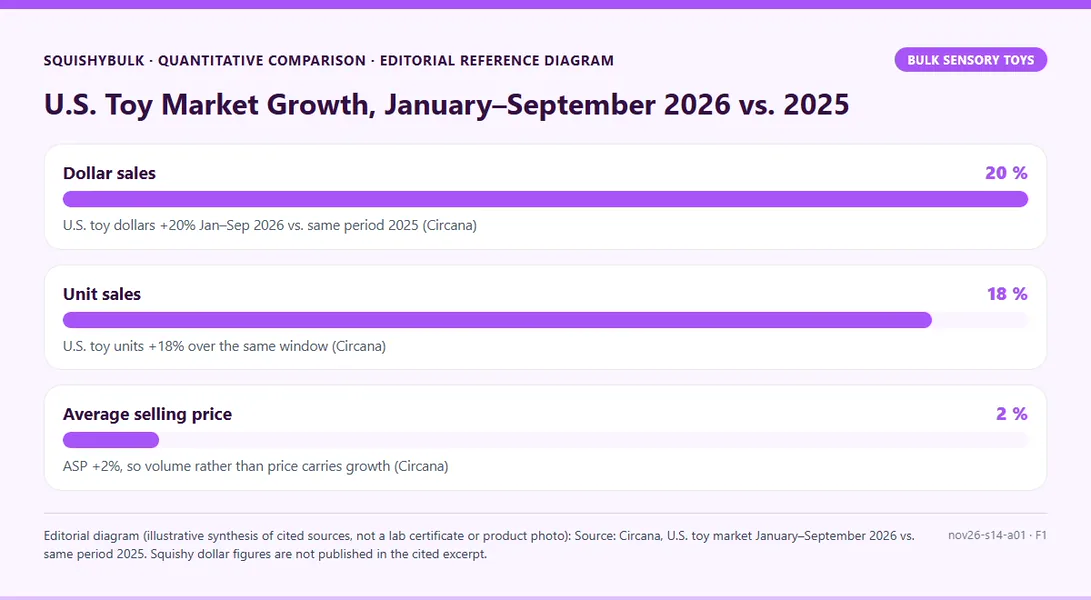
A 300-piece carton lands on the loading dock in 25–35 days, and the buyer has to answer one question before it ships: how many of these pieces can a teacher drop into a shared bin without a single click, rattle or beep interrupting a reading group? The 2026 U.S. numbers say the volume is there — ed toy dollars up +20% and units up +18% for January–September 2026, with average selling price up only +2% . also names squishies among the self-expression products driving explosive growth in the emerging-toy segment.
That +2% ASP against +18% units is the planning signal: growth is riding unit throughput, not premium price, so a 2027 sensory program should be built around mix-pack breadth and per-piece handling rather than a higher ticket. This article splits one carton into two jobs — silent squeeze and textured rollers for the quiet corner, desk fidgets and visual-novelty pieces for the prize counter — and gives the sample-stage checks, cleanability specs and CPSC paperwork fields that decide whether the split holds.
SquishyBulk's public profile lists a 300-piece minimum, a 25–35 day lead time, 20,000 pcs monthly capacity across 12 production lines and no certifications, so every compliance statement below is a document to request in writing, not a badge the catalog already carries.
What 'Decibel-Free Handling' Means at the Sample Stage
Decibel-free handling means the piece produces no sound-producing mechanism at all: no button cell, no clicker dome, no rattle insert, no bead chamber, no squeaker valve. The American Academy of Pediatrics advises avoiding toys that are loud to prevent hearing damage, and a shared classroom bin multiplies any small sound by 30 pieces . A visual-novelty piece with a printed face and a sealed gel core can pass; a novelty piece with a plastic bead in a clear window cannot.
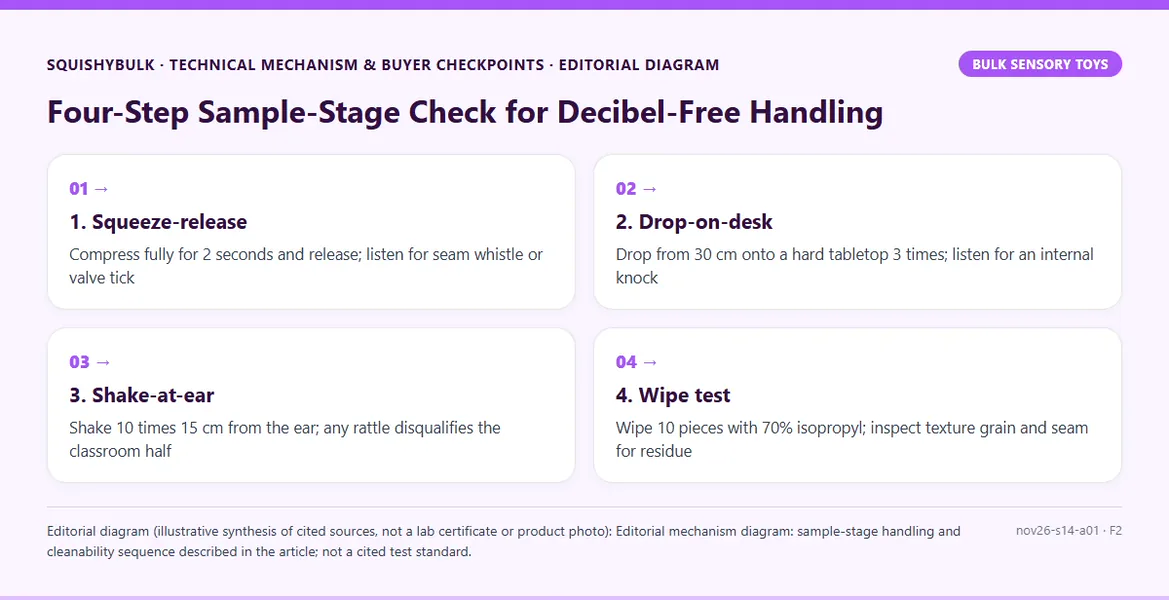
Run three checks on the sample bench, not on the catalog photo. First, the squeeze-release check: compress the piece fully for 2 seconds and release; listen for air whistling through a seam or a valve tick. Second, the drop-on-desk check: drop the piece from 30 cm onto a hard tabletop three times and listen for a hard internal knock that signals a loose insert. Third, the shake-at-ear check: shake the piece 10 times 15 cm from your ear; any audible rattle disqualifies it from the classroom half of the carton.
Visual-novelty pieces fail these checks more often than they look like they will. A color-change squeeze toy with a rigid printed cap, a desk fidget with a metal spinner ring, and a novelty shape with a hard eye insert all produce a knock or a ring at the drop-on-desk check even when the outer skin is soft. Keep those pieces in the prize-counter segment and specify 'no internal loose component' on every SKU tagged for classroom kits.
Three Families, Three Cleanability Profiles
Silent squeeze pieces are the simplest to clean when the skin is a closed-cell TPR or silicone with a matte finish and a fully sealed seam: a 70% isopropyl wipe across the surface leaves no residue in a texture grain. Glossy skins with a printed decal are the problem case — the decal edge lifts after repeated wiping, and the gloss shows every fingerprint. Specify matte, unprinted, seam-sealed skins for any SKU going into a shared classroom bin.
Textured rollers sit between the two: the texture is the product, so the grain depth decides whether a wipe reaches the bottom of the pattern. Ask for a grain depth no deeper than 0.5 mm and a roller body molded in one piece rather than assembled from two halves, because a two-half assembly leaves a seam line that traps sanitizing residue. play guidance notes that stacking and sensory-motor handling build spatial understanding, which is exactly the use case a textured roller serves .
Desk fidgets are the hardest to clean because they combine moving parts with a small footprint. A one-piece silicone popper with no detachable cap wipes clean in one pass; a multi-part spinner with a metal bearing ring needs a crevice brush and a drying step. For a prize counter where the piece goes home with one child, the cleanability bar is lower — but the small-parts bar is not, which is the next section.
Classroom Bin vs. Prize Counter: A 300-Piece Carton Compared
The table below maps four piece families against the five fields that decide channel fit. Mix share is expressed as a percentage of a 300-piece carton, which is SquishyBulk's listed minimum order; the two classroom-bin families sum to 60% (180 pcs) and the two prize-counter families sum to 40% (120 pcs).
| Best channel | Cleanability | Piece family | Mix share in 300 pcs | Small-parts exposure | Sound risk at handling |
|---|---|---|---|---|---|
| Classroom bin | One-pass 70% isopropyl wipe | Silent squeeze (sealed matte skin) | 40% = 120 pcs | Whole-piece only; check cylinder fit | None — no internal component |
| Classroom bin | Grain depth ≤0.5 mm, one-pass wipe | Textured roller (one-piece mold) | 20% = 60 pcs | Whole-piece only | None — solid body |
| Prize counter | One-pass wipe, no crevice | Desk fidget (one-piece popper) | 25% = 75 pcs | Check any detachable cap | Low — soft pop, no clicker |
| Prize counter | Decal edge lifts; single-user only | Visual-novelty piece (printed face, color-change) | 15% = 45 pcs | High if eye or cap detaches | Medium — drop-on-desk knock |
The Compliance Floor: What to Request in Writing
Every squeeze toy is a soft plasticized component, which puts it directly inside the phthalate rule. CPSC prohibits more than 0.1% (1000 ppm) of eight listed phthalates in accessible plasticized components of children's toys under 16 C.F.R. part 1307, certified through a Children's Product Certificate citing '16 C.F.R. part 1307 – Phthalates' CPSC — Phthalates Business Guidance. Request the CPC and the test report by SKU, with the lab name and the test date printed on the report.
For any piece aimed at under-3 channels, the small-parts ban applies: a children's product for under-3 that fits entirely into the small parts cylinder without compressing is a banned hazardous substance under 16 C.F.R. part 1501, and choking-hazard warning labels are required under 16 C.F.R. § 1500.19 CPSC — Small Parts Ban and Choking Hazard Labeling. The CPC citation for that ban is '16 CFR part 1501 – Small parts'. Eliminate detachable eyes, caps and clips from any SKU tagged for the under-3 shelf rather than relying on a label alone.
SquishyBulk's profile lists no certifications, so the correct move is to put the document list into the purchase order: CPC per SKU, phthalate test report per plasticized component, small-parts cylinder result per detachable part, and the exact warning label artwork for each age band. A 25–35 day production run leaves no room to discover a missing CPC at the port.
Why 2027 Planning Rests on Volume, Not Category Growth
The Toy Association's 2026 briefing named 'Cozy Culture' — tech-free toys with tactile materials and gentle interactivity that help families power down and reset — as a top trend, and put kidults at roughly one-quarter of U.S. toy sales, with 81% of parents in 2025 likely to add a toy or game for themselves, up from 72% . That gives a quiet squeeze carton two buyers: a teacher filling a quiet corner and an adult filling a desk drawer.
The base, however, is flat. U.S. retail toy sales were $30.3 billion in 2025, +6% vs. 2024 but level with $30.4 billion in 2021; Games/Puzzles reached $4.9 billion (+37%) and Building Sets $4.3 billion (+15%), while Dolls fell -7% and Outdoor & Sports fell -6% . Flat five-year totals mean shelf space is being reallocated, not expanded, so the 2027 argument is for facings taken from declining Dolls and Outdoor slots, not for riding category-wide growth.
The consumer wallet reinforces the volume logic. 2026 holiday study of 3,534 U.S. consumers found expected average holiday spending of $779 versus $796 last year, with 74% planning money-saving behaviors . A prize counter priced per piece fits that wallet; a premium single-item squeeze does not.
The 60/40 Mix Arithmetic at a 300-Piece Minimum
Illustrative planning example, not a price quote or a lab result: a buyer fills a 2027 classroom-and-prize-counter program at the 300-piece minimum and splits 60% quiet-focus pieces against 40% novelty pieces. Quiet segment = 300 × 0.60 = 180 pieces, made up of 120 silent squeeze (40%) plus 60 textured rollers (20%). Novelty segment = 300 × 0.40 = 120 pieces, made up of 75 desk fidgets (25%) plus 45 visual-novelty pieces (15%). Classroom kits = 180 ÷ 30 = 6 kits of 30 pieces; remaining for the prize counter = 300 − 180 = 120 pieces, which matches the novelty allocation exactly, leaving zero leftover.
A second illustrative step sizes the kits to students: at 3 pieces per student, 30 ÷ 3 = 10 students per kit, so 6 kits cover 60 students; at 2 pieces per student, the same 6 kits cover 90 students. The number to negotiate with the factory is therefore the 60/40 ratio, the four-family breakdown inside each half, and the per-kit piece count, not the 300-piece total. Chenghai's cluster, where SquishyBulk sources, reports about 68,100 toy entities and 2025 full-chain output above RMB 50 billion, so mix-pack breadth is a realistic ask rather than a special favor Shantou Federation of Industry and Commerce — Chenghai toy cluster.
The Counter-and-Classroom Playbook Before the Run Starts
Write the OEM brief around four fields per SKU: squeeze feel (soft, medium or firm, with a target compression force stated in newtons), surface finish (matte, unprinted, seam-sealed), sound status (no battery, no clicker, no rattle insert, no bead chamber), and cleanability (one-pass wipe, grain depth ≤0.5 mm on textured rollers). Add the age band and the exact CPC citations for each SKU so the factory cannot substitute a cheaper skin at the last minute.
Before the 25–35 day run begins, confirm in writing: the approved sample piece number, the squeeze-force target, the small-parts cylinder result for every detachable part, the phthalate test report per plasticized component, and the warning label artwork per age band. A 20,000 pcs monthly capacity across 12 production lines means a substitution can happen fast; the written spec is the only brake.
On reorder, keep the mix identity stable and recheck squeeze feel per piece from the first carton of the new run. Treat cleanability as a reorder criterion, not a one-time approval: wipe 10 pieces from the new run with 70% isopropyl and inspect the texture grain and seam for residue. The AAP's guidance that the best toys match a child's developmental skills and encourage new skills is the merchandising test as well — a silent squeeze that a 6-year-old can knead for 5 minutes beats a louder novelty that loses attention in 30 seconds .
Can a bulk sensory toy carton be both classroom-quiet and prize-counter-ready?
Yes, when the mix is split by handling rather than by look. At the 300-piece minimum, a 60/40 split gives 180 quiet-focus pieces (120 silent squeeze plus 60 textured rollers, forming six 30-piece classroom kits) and 120 novelty pieces (75 desk fidgets plus 45 visual-novelty pieces) for the prize counter, and only pieces with no battery, clicker, rattle insert or bead chamber go into the classroom half.
What should I confirm in writing with a wholesale fidget toy supplier before production?
Confirm four documents and two physical specs before the run starts. The documents are the CPC per SKU, the phthalate test report per plasticized component at or below 0.1% (1000 ppm) citing '16 C.F.R. part 1307 – Phthalates', the small-parts cylinder result per detachable part under 16 C.F.R. part 1501, and the warning label artwork under 16 C.F.R. § 1500.19; the physical specs are the squeeze-force target and the matte, seam-sealed surface finish. SquishyBulk lists no certifications, so these are requests, not assumptions.
Is the 2026 demand data strong enough to plan 2027 sensory cartons on?
It supports volume planning, not a guarantee. ed U.S. toy dollars +20% and units +18% for January–September 2026 with ASP up only +2%, and the Toy Association named tactile, tech-free 'Cozy Culture' play as a 2026 trend, but the U.S. base was flat versus 2021 ($30.3 billion in 2025 vs. $30.4 billion), so plan facings as reallocated space rather than category-wide growth.
Build the 2027 Mix Pack Around Handling, Not Looks
Start the 2027 program with a 300-piece sample carton split 60/40 between quiet-focus pieces (120 silent squeeze plus 60 textured rollers) and novelty pieces (75 desk fidgets plus 45 visual-novelty pieces), and run the squeeze-release, drop-on-desk and shake-at-ear checks on every SKU before the 25–35 day run is released. Send the four-field OEM brief — squeeze feel, surface finish, sound status, cleanability — with the CPC and phthalate document list attached, and the carton arrives ready for both the classroom bin and the prize counter.
Sources
www.cpsc.gov — Small Parts Ban and Choking Hazard Labeling | CPSC.gov
www.cpsc.gov — Phthalates Business Guidance | CPSC.gov
stgsl.shantou.gov.cn — 融媒观察 | 澄海把玩具的门开给世_图片新闻_汕头市工商业联合会(总商会)
Continue the sourcing review
Turn this guide into a quote-ready shortlist. Start with the squishy toys wholesale category, then compare two published SKUs before asking for current freight and document scope.
- Five-Color Steamer Baozi Squishy (SKU sqz350815)MOQ: 5 cartons / 720 pcs; packaging: Display Box.
- 8.5 cm Colorful Bead-Filled Baozi Squishy (SKU sqz350809)MOQ: 5 cartons / 720 pcs; packaging: Display Box.
For logo, color or retail-packaging work, review the custom squishy toys OEM and ODM program or send the selected items through the wholesale quote workspace.