
OEM vs ODM Squishy Toys: Which Route Fits Your Brand?
Compare OEM vs ODM for squishy toys: MOQ, lead time, IP, mold ownership, sampling, and packaging. Decide your best route with our buyer checklist.
Choose OEM when you own the design and need proprietary molds and IP; choose ODM when you want faster entry and lower MOQs using an existing squishy design. The trade-offs—texture approval, mold ownership, sampling rounds, lead time, and version control—determine which route fits your brand. This guide gives you a concrete comparison, a step-by-step sourcing workflow, and the key questions to ask any factory before you commit.
Key Takeaways
- OEM means you provide the complete design and own the IP and molds; ODM means you customize an existing factory design, and the factory typically retains base design IP.
- OEM generally requires higher MOQs and longer lead times (often 4–8 months from design finalization to shipment), while ODM can be faster (1–3 months) with lower entry barriers.
- Always approve a sealed golden sample physically before bulk production—photo approval leads to costly mismatches on the second lot.
- Confirm line clearance procedures when mixing SKUs or changing labels to prevent cross-contamination of packaging or colors.
- Map compliance paperwork to the specific lot and market—one certificate does not cover all products or destinations.
OEM vs ODM at a Glance
| Design ownership | OEM: You own the design and IP. ODM: Factory owns the base design; you customize colors, logo, packaging. |
|---|---|
| Mold/tooling | OEM: You pay for and own the mold. ODM: Usually no mold fee; factory uses existing molds. |
| MOQ | OEM: Typically higher (500–5,000+ units). ODM: Lower (often 50–500 units). Confirm with supplier. |
| Lead time | OEM: 4–8 months from design finalization to shipment. ODM: 1–3 months including sampling. |
| Sampling rounds | OEM: Usually 3–5 rounds. ODM: Simpler, fewer rounds. |
| Uniqueness | OEM: High—your design is exclusive. ODM: Risk of similar designs sold to other brands. |
| Cost structure | OEM: Higher upfront (design, sampling, tooling) but lower per-unit at scale. ODM: Lower entry, per-unit cost includes development. |
| IP protection | OEM: You own all IP. ODM: Negotiate exclusive sales rights or full acquisition of design IP. |
How to Choose Between OEM and ODM
Three factors drive the decision: your design capability, your capital, and your speed to market. If you have a unique squishy texture or shape that defines your brand, OEM gives you the control and IP protection you need—but budget for mold costs and longer lead times. If you're testing a new market or expanding your catalog quickly, ODM lets you start with lower MOQs and shorter timelines, though you'll need to accept that the base design may be available to other buyers.
Consider your total cost of ownership, not just unit price. OEM has higher upfront costs (sampling, tooling) but typically lower per-unit costs at scale. ODM spreads development into the unit price, which can be cheaper for small orders but limits your differentiation. A hybrid approach—start with ODM to validate demand, then switch to OEM for your winning SKU—is a common and pragmatic strategy.
Step-by-Step: The OEM/ODM Sourcing Process
The process runs through seven checkpoints, whether you're working with a factory in Chenghai, Dongguan, or anywhere else. Each step is a checkpoint—don't skip the boring ones.
1. Define your route and requirements. Write down your target market, distribution channel, and product category. For ODM, pick a base design (e.g., a squishy ice cube or a countdown calendar) and list customizations: colors, logo, packaging, instructions language. For OEM, prepare your technical drawings, 3D models, or reference samples. The more detail you provide, the more accurate the quote.
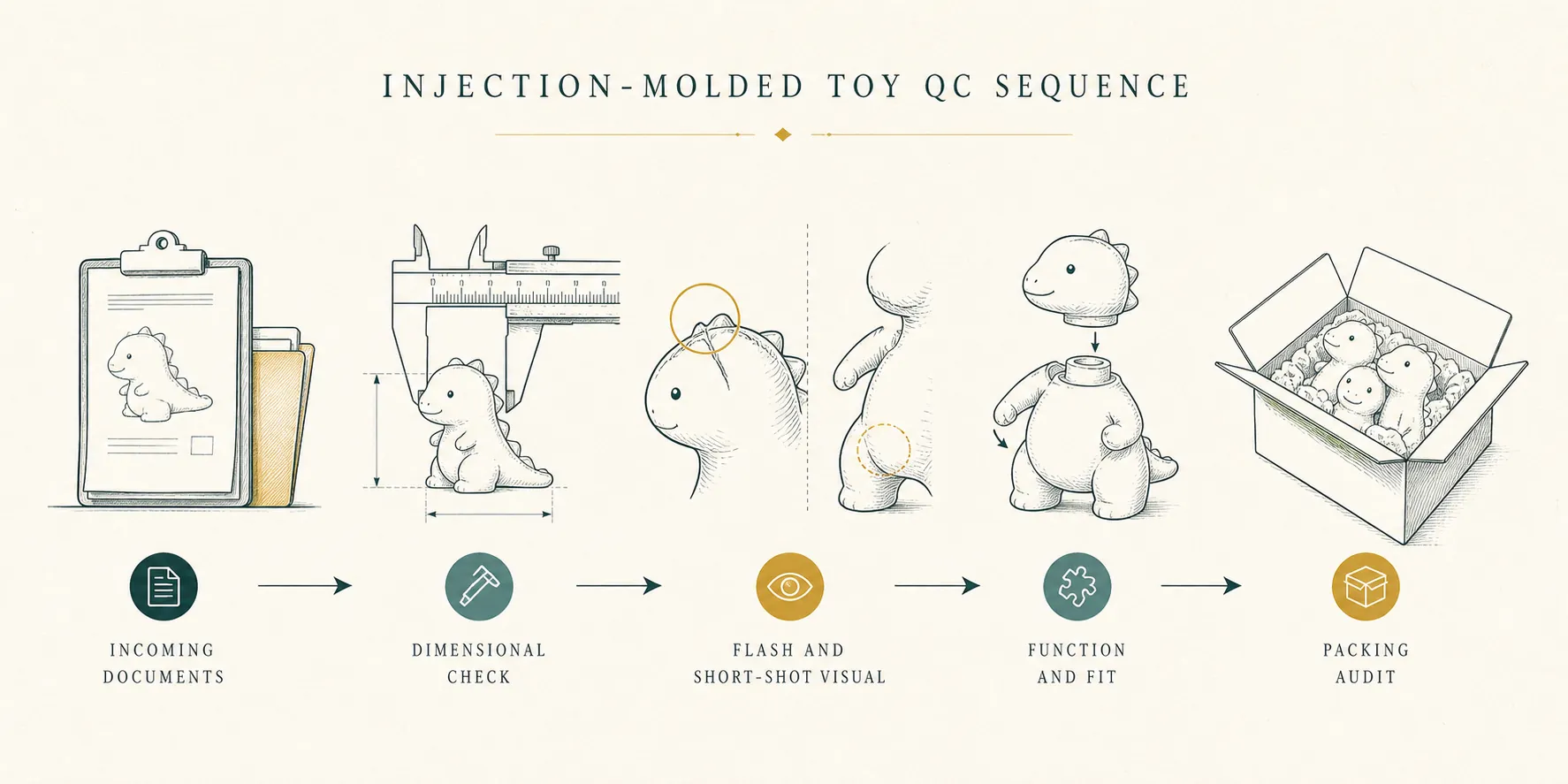
2. Request the sealed golden sample. Before any bulk order, ask the factory to send a physical sample that matches your target SKU exactly. Compare bulk production against that physical piece—color, fit, flash, function. Buyers who approve only a photo often pay for it on the second lot. This is non-negotiable.
3. Verify line clearance for customization. If you're mixing multiple SKUs or changing labels, confirm the supplier stops the line and clears labels, colors, and work instructions between runs. A mixed-up label reaching a retailer is a costly mistake that's entirely avoidable.
4. Map compliance paperwork to your lot. For each market (e.g., EU, UK, US), ask which test file covers which product and lot. A UKCA certificate for an electric bubble machine doesn't cover a squishy toy. Make sure the report matches the exact lot number and product description.
5. Approve packaging and language. For Spanish-speaking markets, confirm Spanish instructions and child-safe packaging (no sharp or aggressive parts). Some factories offer localized packaging as standard; others charge a setup fee—ask upfront.
6. Run a pilot run. A pilot run tests the production process, operators, material flow, packaging, and inspection plan at a limited quantity before full ramp-up. Use your MOQ as the pilot size—it's the minimum viable test. Agree on a QC photo protocol: what angles, what lighting, what defects to show.
7. Establish version control. For repeat orders, confirm the factory keeps the sealed golden sample and uses it as the reference for every lot. This prevents drift over time, especially if you renew contracts seasonally.
What Can You Customize in OEM vs ODM?
Customization options differ between the two routes. In OEM, you control everything: material, texture (softness, rebound), color, size, shape, packaging, and branding. You define the critical-to-quality dimensions in your drawing so the factory knows which measurements need focused control.
In ODM, customization is typically limited to colors, logo, packaging, and minor tweaks to an existing design. You may not be able to change the core texture or shape without moving toward OEM. Ask the factory what's possible—some ODM suppliers offer exclusive design modifications for a premium.
Packaging is customizable in both models, but ODM may restrict you to the factory's standard box sizes or layouts. Confirm whether custom packaging requires a separate mold or setup fee, and remember that cushioning should protect painted or textured surfaces without causing damage.
MOQ, Tooling, and Lead Time: What to Expect
MOQs and lead times vary widely by factory and product type, but here are general ranges from industry sources. For OEM, MOQs typically start at 500–5,000 units depending on the toy category; ODM MOQs can be as low as 50–500 units. Tooling costs for OEM can range from $1,000 to $10,000+ per mold, while ODM usually has no mold fee—the cost is embedded in the unit price.
Lead times: OEM from design finalization to shipment typically takes 4–8 months, including sampling and tooling. ODM can be 1–3 months. Sampling costs: OEM prototypes may cost $50–500 per iteration; ODM samples are often free or low-cost. Always confirm these numbers with your supplier—they're not universal.
When comparing quotes, ask for a breakdown that separates tooling, samples, production parts, decoration, testing, packaging, freight, and taxes. This makes the comparison meaningful and prevents hidden costs.
IP and Brand Protection: Mold Ownership and Exclusivity
IP ownership is the biggest differentiator. In OEM, you own the design, the mold, and the IP—provided your contract says so. Sign a non-disclosure agreement (NDA) and a mold ownership clause to prevent the factory from using your mold for other buyers. In ODM, the factory owns the base design IP. If you need exclusivity, negotiate regional exclusive sales rights or pay to acquire the design rights.
The sealed golden sample is also part of your IP protection—it's the physical embodiment of your specification. Keep one copy, and ensure the factory stores a sealed reference for every lot.
Before signing, ask the factory: 'Can this design be sold to my competitors? What modifications would make it exclusive to me?' Get the answer in writing.
FAQ
What is the minimum order for custom squishy toys?
For ODM, MOQs can be as low as 50–500 units, depending on the factory and whether you're only adding a logo. For OEM with a new mold, MOQs typically start at 500–5,000 units. Always confirm with the supplier—these ranges are industry-wide, not universal.
How much does a custom squishy toy mold cost?
Mold costs vary significantly based on size, complexity, and material. Industry sources suggest $1,000–$10,000+ per mold for injection-molded toys. Aluminum molds are cheaper but less durable than steel. Request a detailed quote that separates tooling cost from unit price.
Who owns the mold after production?
In OEM, you own the mold if your contract states so. In ODM, the factory typically owns the mold. Always include a mold ownership clause in your agreement. For OEM, also sign an NDA and a non-compete clause to prevent unauthorized use.
Can I print my logo and use custom packaging?
Yes, both OEM and ODM allow logo printing and packaging customization. In ODM, you may need to work within the factory's standard packaging sizes or pay a setup fee. Confirm costs and minimums for custom packaging upfront.
Will the factory sign an NDA?
Most reputable factories will sign an NDA, especially for OEM projects. Ask before sharing your design files. In ODM, an NDA may be less critical, but it's still good practice to protect your modifications and exclusivity terms.
How long does sampling take for squishy toys?
ODM sampling is usually faster—often 1–3 rounds within a few weeks. OEM sampling can take 3–5 rounds over several months, especially if texture or mold adjustments are needed. Plan your seasonal launches accordingly.