
How to Buy Wholesale Squishy Toys for a Retail Store
A practical guide for retailers on sourcing wholesale squishy toys: range planning, supplier vetting, samples, compliance documents, QC, shipping, and reorders.
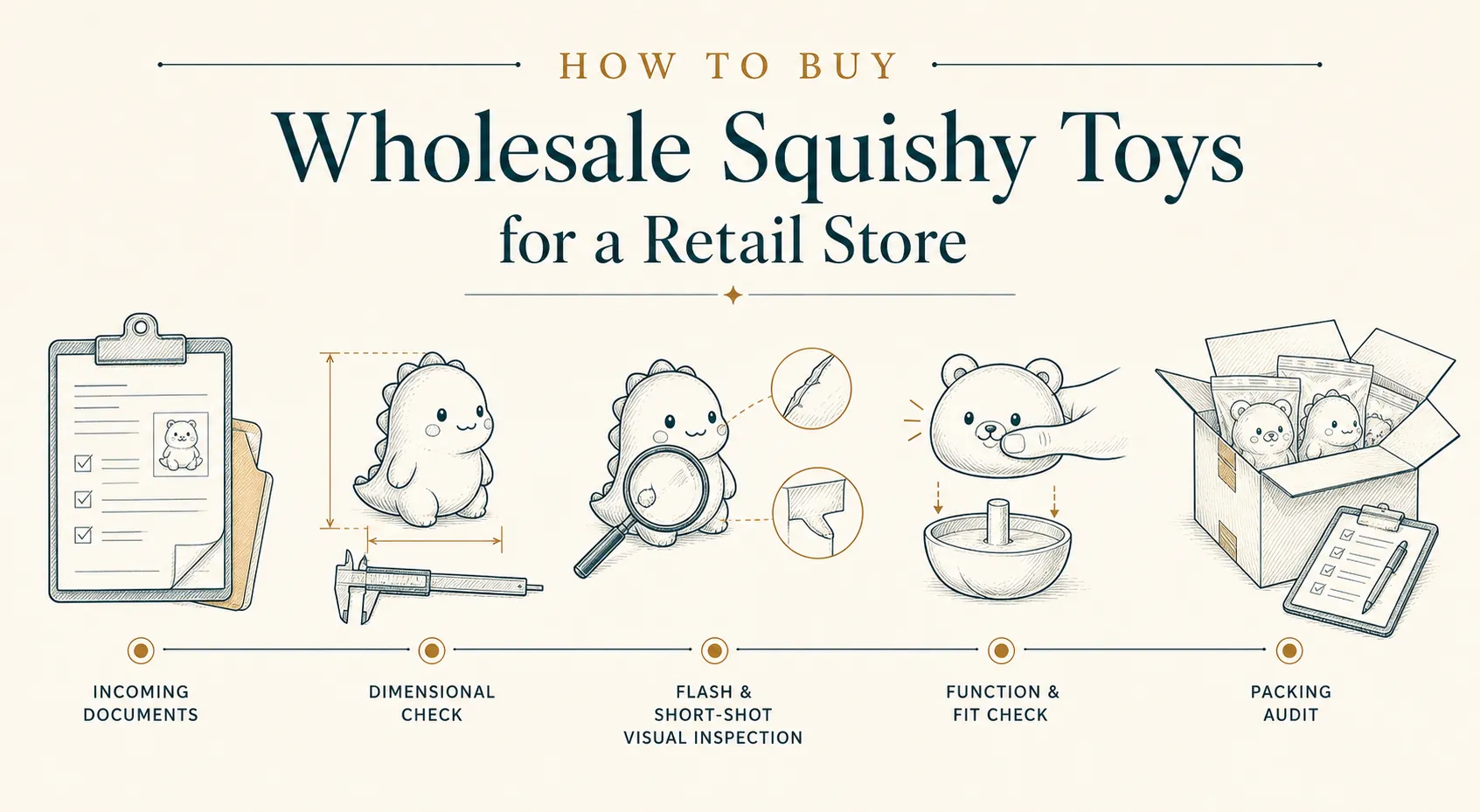
To buy wholesale squishy toys for a retail store, match the product range to your channel's reorder rhythm, verify a physical golden sample before production, and demand compliance documentation that covers the actual fillings and components. This guide walks you through eight steps that separate a defensible sourcing decision from a costly guess: define your buying role, shortlist SKUs, issue an RFQ, evaluate samples against a sealed standard, confirm line-clearance procedures, set inspection checkpoints, plan shipping and reorders, and document what is verified versus what remains open. Whether you are a party-favor seller reordering every six to eight weeks, a container importer filling CBM, or a school and prize distributor, the same evidence-led framework applies.
Key Takeaways
- Match SKUs to your buying role: party-favor sellers need high-turnover impulse items with 6–8 week reorder cycles, mixed-container importers need CBM filler that supports their retail storytelling, and school/prize distributors need child-friendly designs without aggressive parts.
- A sealed golden sample on the QC shelf is the production standard; photos and fair lighting lie. Always request a physical sample with tool number and revision labeled, and compare bulk units to that piece for color, fit, flash, and function.
- Line clearance between SKUs prevents mixed labels and colors from reaching your store. Ask the supplier for their written procedure and verify that no previous SKU's labels remain in the hopper before production starts.
- Reorder by SKU number, not by asking 'do you have stock.' A supplier who can quote a specific batch (e.g., 'when is the next batch of #03?') gives you predictable inventory for peak seasons.
- Compliance documentation is not automatic. Ask for test reports that cover the specific fillings (TPR, PU foam, gel, beads) and components, and confirm which standards apply to your destination market—do not assume a generic CE or CPC mark covers the product.
Suppliers Compared: What to Evaluate for Wholesale Squishy Toys
| Supplier type | Factory-direct (e.g., Chenghai manufacturers), trading companies, distributors, or online B2B platforms. Each has different trade-offs in price, MOQ, and control over production. |
|---|---|
| MOQ | Varies by spec and SKU. Approved examples: 300 pcs for a silicone fidget toy, 720 pcs for a TPR dumpling set, 864 pcs for a PU foam bun set, 1440 pcs for glow-in-the-dark or anniversary baozi squishies. |
| Price posture | Prices below market may indicate counterfeit or non-compliant products. Request a detailed quotation and compare against the cost of certification and quality control. |
| Authorized? | Check whether the supplier is an authorized manufacturer for the brand or product. Unauthorized sources may lack traceability and compliance documentation. |
| Ships from | Typically from the factory's location (e.g., Shantou, China) or a regional warehouse. Confirm shipping terms and lead times (e.g., 25–35 days for production). |
Step 1: What Is Your Buying Role and Reorder Rhythm?
Your sourcing strategy starts with your channel, not with a product. A party-favor seller on a marketplace like Mercado Libre needs impulse items that turn over every six to eight weeks, with consistent colors and availability on viral designs. A mixed-container importer bringing 20GP or 40HQ loads needs high-turnover filler to complete CBM alongside other goods, and that filler should support the story you tell your retail customers. A school and prize distributor needs child-friendly sensory toys with a cheerful look and no aggressive parts, suitable for school fairs and prize operators.
Write a one-page sourcing brief that names your channel, your average order size, your reorder frequency, and the compliance standards you must meet. This brief guides every later decision, from SKU selection to the questions you ask the supplier.
Step 2: Which SKUs Fit Your Buying Role?
The product catalog gives you a pool to match to your role. For a party-favor mix, you might consider the Three-Piece Decorated Dumpling Squishy Set (TPR shell with flour-style filling) or the Rainbow Mini Bun Squishy with Steamer Display Box (PU foam). For container filler, the Glow-in-the-Dark Glitter Bead Baozi Squishy (TPR) and the U.S. 250th Anniversary PU Slow-Rebound Baozi Squishy offer low per-unit cost and visual appeal. For school-safe options, the 6-in-1 Busy Learning Shape Sorter and the Busy Cube are non-squishy sensory alternatives that meet the 'no aggressive parts' requirement.
For each shortlisted product, note the material, the MOQ, and how it fits your role. If a record is missing (e.g., a material field is null), turn it into a verification step in your RFQ.
Step 3: What Should Your RFQ Ask For?
Your RFQ should request pricing, MOQ, lead time, packaging details, and compliance documents. Ask for a breakdown by component, especially for electronic or filled toys. RoHS evidence, for example, should follow the electrical product's component and material structure; a declaration for the empty plastic shell does not automatically cover the populated assembly. Similarly, for an electronic toy, RoHS evidence should cover the electrical and electronic components and the current restricted-substance list.
Also ask about the supplier's production capacity and line configuration, but do not extrapolate beyond what they state. If a supplier claims a monthly capacity, verify it with a production schedule reference.
Step 4: How Do You Evaluate a Physical Golden Sample?
The sealed golden sample on the QC shelf is the standard that ends color and finish disputes. Photos and fair lighting lie; the revision card does not. Ask the supplier to send a physical sample with the tool number and revision labeled, and confirm that bulk production will be compared to that piece—not to a photo.
Evaluate the sample for color, fit, flash, and function. Color matching should use the same resin grade, surface finish, lighting condition, and approved master sample, because appearance changes with all four variables. If you approve only a photo, you are likely to pay for the difference on the second lot.
Step 5: How Do You Verify Packaging and Labeling Before Production?
Mixed labels in the hopper can reach your retail shelf if the supplier does not clear the line between SKUs. Ask the supplier for their line-clearance procedure: how do they remove previous SKU labels, colors, and work instructions before starting a new order? Confirm that they will stop production if any previous SKU's materials remain.
Specify your packaging requirements: label content, warning statements, age grading, and batch traceability. Misspellings, missing manufacturer info, or no batch number are red flags for counterfeit or non-compliant product.
Step 6: What Inspection Checkpoints Should You Set?
Your inspection plan should have at least three checkpoints: pre-production (golden sample and line clearance), in-line (color, fit, flash, function against the golden sample), and pre-shipment (random inspection of finished goods).
Ask the supplier: 'What is your standard for color, fit, flash, and function on bulk units compared to the golden sample?' and 'Can you provide a sealed golden sample with the tool number and revision labeled?' Ask for their sampling plan and any third-party inspection reports.
Step 7: How Do You Plan Shipping and Reorders?
Shipping and reorder logic depend on your channel. For a container importer, squishy toys can serve as CBM filler alongside other goods; ask the supplier about mixed-SKU minimums and whether they can supply unbranded or branded filler that supports your retail storytelling. For a party-favor seller, plan reorders every six to eight weeks and ask 'when is the next batch of #03?' instead of 'do you have stock?'—this gives you a predictable supply for peak seasons.
Confirm lead times (e.g., 25–35 days for production) and shipping terms. If you are importing into the US or EU, verify that the supplier can provide the documentation needed for customs clearance.
Step 8: What Goes in Your Evidence Ledger?
Keep an evidence ledger that separates verified facts, assumptions, and open questions. Verified: the approved supplier facts (MOQ 300, lead time 25–35 days, 200+ staff, 12 production lines, 30+ export countries, founded 2015, monthly capacity 20,000 pcs) and the product catalog entries. Assumed: the role-fit logic for SKU selection, which you validate in Step 2. Open: certifications, test results, prices beyond the catalog, AQL numbers, and defect rates—these must be requested from the supplier and confirmed in writing.
If a compliance document is missing, make it a condition for production approval.
What to Look for in 2026: Compliance and Counterfeit Risks
This year, U.S. and UK authorities have increased scrutiny on squishy toys. The U.S. Consumer Product Safety Commission (CPSC) has intercepted 55 shipments and prevented 355,683 units of violative squishy toys from entering U.S. ports. Counterfeit squishies may contain water beads, small parts, lead, phthalates, or other hazardous substances, and may lack required testing, certification, and labeling. In the UK, a June 2026 recall of 'Squeezy Dumplings' cited excess benzene in the outer layer, and earlier recalls of squishy sausage dog and pug toys raised concerns about asbestos-contaminated sand fillings.
Verify that your supplier has a track record of compliance, request test reports that cover the specific fillings and materials, and do not rely on a CE or UKCA mark alone—counterfeiters can copy markings. If a product smells strongly chemical, feels unusually oily or sticky, or tears easily, treat it as a red flag regardless of the claimed certification.
Buyer FAQ
What documents should I ask for before placing a wholesale squishy toy order?
Ask for test reports covering the specific fillings (TPR, PU foam, gel, beads) and components, plus a Children's Product Certificate (CPC) for the US, CE/UKCA documentation for Europe/UK, and any relevant RoHS evidence for electronic parts. Confirm that the documentation covers the actual product, not just a generic declaration.
How do I verify a supplier's production capacity and lead time?
Request a production schedule reference and ask for their monthly capacity in writing. For example, a supplier may state a capacity of 20,000 pcs per month and a lead time of 25–35 days. Do not extrapolate beyond what they confirm.
What is the minimum order quantity for wholesale squishy toys?
MOQs vary by SKU and material. In the approved catalog, MOQs range from 300 pcs for a silicone fidget toy to 1,440 pcs for a glow-in-the-dark or anniversary baozi squishy. Always confirm the MOQ for your specific SKU before budgeting.
How can I tell if a squishy toy is safe for children?
Check for a strong chemical smell, oily or sticky texture, easy tearing, or exposed filling—these are warning signs. Buy only from suppliers with clear manufacturer identification, proper labeling, and test reports. Avoid prices far below market, which may indicate counterfeit products.
What are the risks of buying squishy toys from a low-cost supplier?
Low-cost suppliers may cut corners on materials and compliance, leading to hazardous substances like lead, phthalates, or benzene, or to counterfeit products that fail safety tests. This creates liability for you as a retailer and risks recalls or customer harm.
How do I plan reorders for a party-favor retail channel?
Track sell-through by SKU and reorder every six to eight weeks if you are a high-turnover seller. Ask the supplier for the next batch date of a specific SKU (e.g., '#03') rather than asking if they have stock, so you can plan for peak seasons.