
AQL Squishy Toy Inspection: When to Release an Order
Set squishy toy AQL checks for feel, recovery, materials, packaging and evidence, with clear pass criteria, failed-lot actions and shipment release.
Release a squishy toy order only when the defined lot meets its agreed sampling acceptance rules and all separate shipment-release conditions are closed. The essential AQL inspection questions for squishy toy orders cover lot identity, random selection, feel, recovery, material traceability, packaging and supporting evidence. Set the methods and pass criteria before inspection, compare production with the approved specification and reference, and document corrections and rechecks. An AQL pass supports a lot-acceptance decision; it does not certify safety.
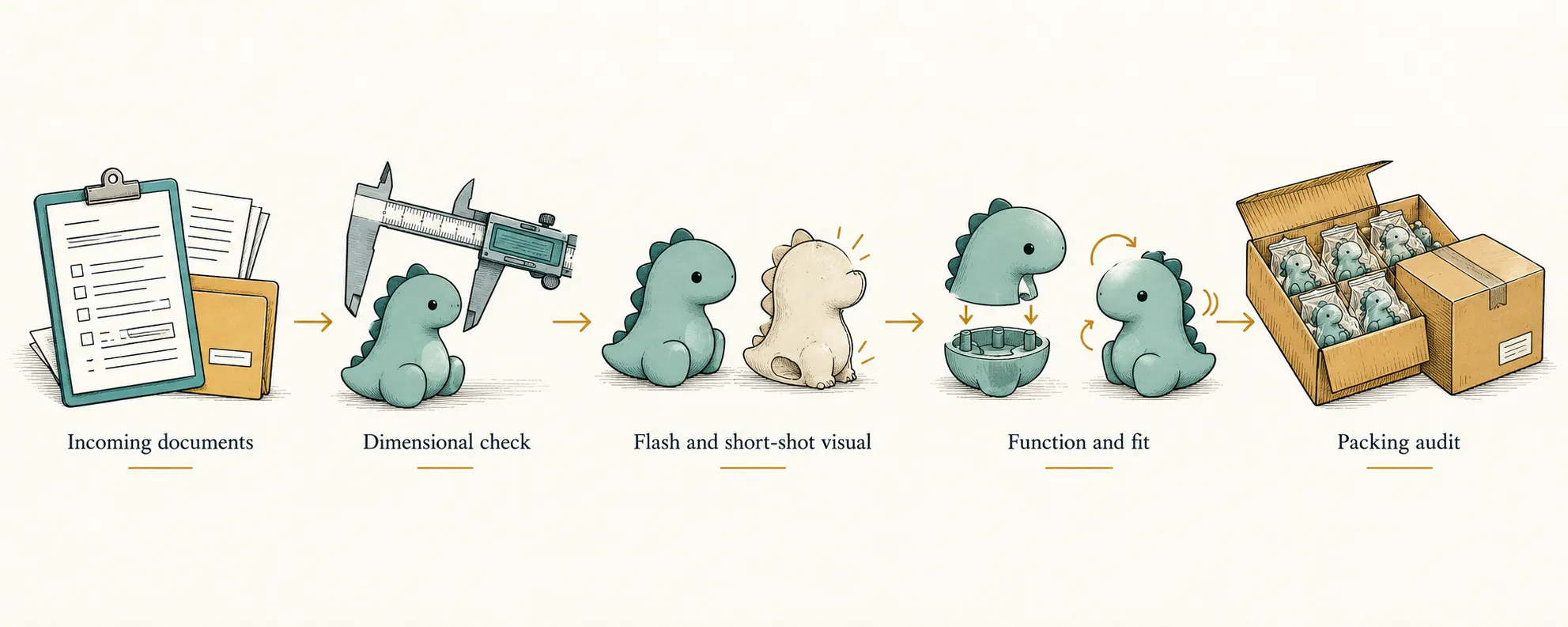
What does an AQL inspection actually decide for a squishy toy lot?
AQL acceptance sampling decides whether a defined lot is acceptable under an agreed statistical sampling plan; it does not prove that every uninspected toy conforms. Random selection, a defined lot and the applicable acceptance/rejection numbers are essential to that decision. AQL sampling guide
Keep four activities distinct. Visual inspection finds observable workmanship and packaging discrepancies. Functional screening checks agreed behaviors such as compression and recovery. Acceptance sampling determines how those findings affect lot acceptance. Laboratory testing evaluates properties using specified test methods. A hand squeeze cannot establish chemical safety or replace a specified physical-safety test. Squishy AQL inspection guide
Do not treat a passing workmanship result as permission to ignore an unresolved safety concern, a material discrepancy or an outstanding release condition.
What reference should production be inspected against?
Inspect bulk production against the agreed specification and the reference created after sample approval—not against an unapproved prototype or a catalog description.
Before first sample approval, compare the submitted sample with the agreed design, dimensions, material specification, tactile requirements and packaging artwork. Record observed differences and the buyer's decision. Only after acceptance should the sample receive an approval identity, specification revision, approver and date.
At pre-shipment inspection, give the inspector that approved reference, the current specification and authorized change records. Record which versions were used. An unexplained difference or conflicting revision is a signal to pause the affected decision and obtain clarification, correction or an authorized revision.
Identify and store the retained reference so its condition can be assessed at later inspections. A reference that has visibly aged or changed should be reviewed rather than treated as an unquestionable benchmark. Photos help document appearance, but they cannot preserve hand feel.
Which inspection-plan fields must be agreed in the PO?
| Lot definition | State the PO, product identifiers, variants, quantity, production period, relevant material batches and carton range. Define how mixed variants will be represented. |
|---|---|
| Standard and edition | Name the adopted sampling standard and its edition in the PO and inspection instruction. Use that edition's tables rather than an unidentified online chart. |
| Inspection level and sampling scheme | Record the inspection level, normal/tightened/reduced status as applicable, and the selected sampling scheme. Include applicable switching rules. |
| Sample size and Ac/Re | Record the sample size and acceptance/rejection numbers for each applicable defect class. Resolve table directions and arrows before inspection starts. |
| Defect definitions and counting rule | Define critical, major and minor findings with product-specific examples. State whether the plan counts nonconforming units or nonconformities; do not interchange the two. |
| Functional and degrading checks | Specify the method, sample count, acceptance criteria and resulting lot action separately where needed. Identify samples that must not return to saleable stock after testing. |
| Failed-lot disposition | Agree who can authorize holding, sorting, repair, reinspection or rejection, and what evidence is needed before release. |
How should a buyer use a numerical AQL example?
Use a numerical AQL example to understand the decision rule, not to replace the adopted sampling table.
A published squishy-toy example describes a lot of 3,201–10,000 pieces at General Inspection Level II, a 200-piece sample and an AQL 2.5 major-defect rule accepting at 10 findings and rejecting at 11. Treat those figures as an illustration, not a universal instruction for squishy orders. Squishy AQL inspection guide
For the actual order, have the inspector derive and record the sample size and Ac/Re from the agreed standard, edition, scheme and counting basis. A result acceptable for the major class does not override a failed minor class, a critical finding or an independent document hold.
Which squishy toy checks belong on the inspection sheet?
| 1. Material identity and traceability | Input: approved material specification, production material records and authorized changes. Action: reconcile identifiers and inspect observable color, surface and construction. Record: material batch references, documents checked and discrepancies. Failure signal: an unexplained substitution or conflicting identity. Next decision: hold affected goods for reconciliation and technical review; appearance alone cannot establish composition. |
|---|---|
| 2. Feel and compression | Input: approved reference and agreed acceptable variation. Action: compare samples under the same conditioning, compression direction and handling method. Record: sample identity, conditions and specific differences such as uneven resistance or unexpected tackiness. Pass criterion: within the agreed reference limits. Next decision: classify out-of-limit findings under the defect list; resolve uncertain judgments before counting them. |
| 3. Recovery behavior | Input: agreed compression depth, hold time, recovery endpoint, cycle count and ambient conditions. Action: apply the same method and time recovery. Record: individual results and any permanent deformation. Failure signal: recovery outside the specified range or failure to regain the required shape. Next decision: count the finding under its agreed class and apply the lot rule. |
| 4. Surface, seam and closure condition | Input: approved appearance limits and a jointly agreed squeeze protocol appropriate to the construction. Action: inspect before and after screening. Record: locations and images of cracks, open joins, coating damage or leakage where applicable. Pass criterion: no prohibited condition under the agreed protocol. Next decision: classify the finding and hold for technical review if it raises a safety concern. |
| 5. Odor | Input: agreed odor acceptance description and safe assessment method. Action: note unusual odor during normal unpacking and handling without deliberately inhaling closely. Record: sample and carton identities, packaging condition and observations. Failure signal: odor outside the agreed commercial criterion. Next decision: hold affected goods for review; neither odor presence nor absence establishes chemical safety. |
| 6. Retail packaging and markings | Input: approved artwork, packaging specification and destination-specific label instructions. Action: compare product identity, print, barcode readability, label content and pack condition. Record: artwork revision, scans and discrepancies. Failure signal: wrong identity, unreadable code, omitted specified text or unacceptable damage. Next decision: correct the affected packaging and verify the correction before release. |
| 7. Packing quantity and carton identity | Input: PO quantity, approved packing configuration and packing list. Action: count units in selected cartons and reconcile total carton counts and identifiers. Record: cartons opened, units found, shortages, mixed variants and damaged packs. Failure signal: disagreement with the approved packing configuration or shipment records. Next decision: investigate scope, correct counts or packing, and recheck the affected population. |
How can recovery testing produce a repeatable pass or fail?
Recovery screening becomes repeatable when the compression method and recovery endpoint are measurable and agreed before production is judged.
Consider an explicitly hypothetical buyer criterion for a slow-rise design: at an agreed ambient temperature of 23°C, compress a 50 mm-high sample to 25 mm, hold for two seconds, release, and measure the time to regain 45 mm. The buyer might propose an acceptable window of 8–12 seconds for that design.
Under that hypothetical instruction, an observed 10.2 seconds passes the recovery criterion; 5.4 seconds does not, even though it recovers faster. The record should identify the sample, actual conditions, measurements, result and inspector. An out-of-range result then enters the agreed defect classification and lot decision—not an improvised judgment that faster must be better.
These numbers are illustrative buyer criteria, not legal limits, industry standards or predictors of return rates. Set the actual range through sample approval. Define the screening cycle count and whether repeated compression changes the product; degrading checks need designated samples and a stated disposition. AQL sampling guide
Which evidence should be matched to the production lot?
Match inspection and testing evidence to the actual product construction and production records rather than accepting a report title or product photograph as sufficient identification.
Check report identifiers, tested product descriptions, materials, colors and construction against the PO and production records. Reconcile the tested sample's date or production cohort with the current lot, including any intervening changes. A type-test or approved-sample report does not automatically establish coverage for a later production lot.
Do not impose an automatic rule that every batch or internal product code needs a new test. Instead, obtain a documented assessment of whether the report covers the current construction and applicable requirements, and arrange additional evaluation where needed.
Keep destination-specific document checks separate from workmanship scoring. Record the required documents, their versions, the responsible reviewer and their release status. A material declaration supports traceability; it is not, by itself, a finished-toy safety conclusion.
What must the shipment-release record contain?
| Identity and revision | Record the PO, lot and carton range, inspected quantity, inspection report number, specification revision, approved-reference identity and inspection date. |
|---|---|
| Specified target versus observation | Show the applicable criteria, actual measurements and observations, sample identities, defect counts by class, sample size and Ac/Re comparison. Attach relevant photographs and document references. |
| Release conditions | Record product, packaging, markings, quantity, document and test-review status separately. Identify each unresolved condition and the evidence required to close it. |
| Decision and authority | State release, hold, rework or rejection. Name the responsible approver and decision date. Identify any authorized commercial concession without treating it as a substitute for applicable safety requirements. |
| Follow-up closure | For each corrective action, identify the affected scope, owner, completion date, correction record, recheck method, recheck result and person authorizing closure. |
What happens when a squishy toy lot fails?
Hold a failed lot, establish the affected scope, complete the authorized correction and recheck it before shipment release.
For a correctable packaging error, document the cartons or units affected, the replacement artwork or labels used, and the verification performed. For a product defect, decide whether sorting, repair, replacement or rejection is appropriate. A suspected material change or safety concern needs technical review rather than a cosmetic concession.
Do not replace only the failed sample pieces and draw again until a passing count appears. Record the disposition of the lot, what happened to rejected units, and the reinspection plan for the corrected population. Keep the original findings and link them to the corrective-action and reinspection records.
Retain the specification, material, production, inspection, change and testing records under the buyer's retention policy. This supports traceability and later review; a complete file does not itself prove that an undisclosed change never occurred.
What else should a buyer resolve before inspection?
Does AQL 2.5 mean that 2.5% of the shipment may be defective?
No. AQL 2.5 is a parameter used with the adopted sampling plan; it is not permission to ship a known 2.5% defective quantity or a measured defect rate for the whole shipment. Apply the plan's sample size and Ac/Re rules.
Does a missing side-by-side photograph invalidate the inspection?
No. Check whether the report identifies the reference, specification revision, method, observations and results well enough to support the decision. A side-by-side photograph can strengthen appearance evidence, but its absence alone does not invalidate other sound inspection evidence.
When should pre-shipment inspection take place?
Schedule it when the defined production lot is available for representative selection and finished packaging is available for the required checks, with time reserved for correction and reinspection. Record actual completion and packing status. If goods are added afterward, define how those goods will be inspected before release.
Which rules should govern the next squishy toy shipment?
- Use an agreed reference, a complete sampling plan and a documented release gate for every inspected lot.
- Keep feel and recovery criteria measurable, classify defects before inspection, and separate workmanship acceptance from laboratory testing and destination-document review.
- For the next order, attach the inspection instruction to the PO before production approval. Have the buyer, supplier and inspector confirm the lot definition, reference revision, methods, Ac/Re rules and failed-lot disposition. Name the release approver and require documented closure of outstanding conditions before shipment authorization.
Continue the sourcing review
Turn this guide into a quote-ready shortlist. Start with the squishy toys wholesale category, then compare two published SKUs before asking for current freight and document scope.
- Five-Color Steamer Baozi Squishy (SKU sqz350815)MOQ: 5 cartons / 720 pcs; packaging: Display Box.
- 8.5 cm Colorful Bead-Filled Baozi Squishy (SKU sqz350809)MOQ: 5 cartons / 720 pcs; packaging: Display Box.
For logo, color or retail-packaging work, review the custom squishy toys OEM and ODM program or send the selected items through the wholesale quote workspace.